
May 26, 2026
The Big Swing: Inside the new golf economy
As May comes to a close and we officially enter the summer months, golf is hotter than ever. We’re not just talking about the millions engaging with the game, but the mainstream headlines, speculation and changes happening across the industry … not to mention Will Ferrell’s golf comedy, “The Hawk,” coming to Netflix on July 16.
While you were at the beach or BBQ this Memorial Day Weekend, the PGA of America announced yet another leadership change as Don Rea Jr. is out as president, Tiger Woods returned to Switzerland to continue rehab following a 10-day U.S. hiatus, and Scott O’Neil continues to go door to door trying to sell LIV Golf to investors.
June will be a busy month for the game, highlighted by the U.S. Women’s Open being played June 4-7 at Riviera and the U.S. Open teeing off two weeks later from June 18-21 at Shinnecock Hills GC.

This and that...
Don Rea Jr. out as PGA of America president
If you started your Memorial Day Weekend celebrations early on Friday, you might have missed the news: Don Rea Jr. is out as PGA of America president. The organization’s Board of Directors announced that Rea, elected president in 2024, was removed following “a series of issues over time that, taken together, were determined to be detrimental to the Association.” He is replaced effective immediately by Vice President Nathan Charnes, PGA, who has been elevated to serve as Acting President. Rea came under fire in late September following his controversial comments around the unruly and unnecessary fan behavior directed at European players during the 2025 Ryder Cup. Not doing himself any favors that weekend, Rea was also seen signing karaoke on Saturday night as the U.S. Team was getting battered. PGA of America Secretary Eric Eshleman, PGA, has been elevated to Vice President and will continue to serve in a dual role as vice president and secretary until November, when the association will hold its officer elections.
Our take: It wasn’t a matter of “if,” but “when” Rea would be removed from his position following the PR nightmare he created for himself and the PGA of America during the 2025 Ryder Cup at Bethpage Black. Not only was the organization already under a microscope for taking a risk by naming Keegan Bradley as U.S. captain, but the inappropriate fan behavior and personal attacks directed toward European players crossed the line. Rea and the PGA failed to take responsibility, initially downplaying behavior saying it was similar to what could be heard at a youth soccer game. Rea issued an internal apology to the organization’s 30,000 members and was immediately removed from the public eye. Rea was replaced on the PGA Tour Policy Board and attended the 2026 PGA Show in January in a “scaled down role.” He was also notably absent at the 2026 PGA Championship earlier this month at Aronimink. Marred by negative headlines and a litany of leadership changes, the PGA of America is hoping new CEO Terry Clark can right the ship ASAP.
LIV Golf seeking $250 million to $350 million to continue operations
Once the beneficiaries of an endless treasure trove of funding from Saudi Arabia’s Public Investment Fund (PIF), upstart LIV Golf is on life support as CEO Scott O’Neil seeks $250 million to $350 million in outside investment in order to continue operations, according to reports. CNBC and Sportico reported that LIV Golf is pitching investors on a reduced 10-event schedule built around international events; attendance figures from Australia and South Africa are being used as bench marks. As O’Neil does his best to pitch LIV Golf to potential investors, Axios reported LIV was targeting profitability in 20 months. Bloomberg, meanwhile, reports the organization is laying groundwork for a potential bankruptcy filing.
Our take: Where LIV Golf goes from here is honestly anyone’s guess as media outlets try to piece together the league’s status and future after the PIF severed funding after injecting a reported $5 billion to $8 billion into the venture. Sources say LIV Golf is a tough sell for investors and corporate sponsors due to a lack of brand awareness, negative PR and lack of significant media rights in the U.S. LIV is also losing stars left and right with Brooks Koepka and Patrick Reed already jumping ship back to the PGA Tour and Bryson DeChambeau saying he is still figuring out his next move as he debates prioritizing professional golf or content creation. LIV is also trying to build up and sell its teams as differentiators for investors with execs revealing bold plans in January that each of its 13 team franchises could reach $1 billion valuations. “If you ask me where the value of this business is, it’s in the teams,” O’Neil said at his pre-tournament press conference ahead of LIV Golf Virginia in early May.
New PGA Tour schedule shaping up?
The PGA Tour continues to gear up for a significant facelift beginning in 2028. The Tour presented players with a concept of a plan featuring two tiers of “tracks” during a meeting at the Truist Championship in Charlotte. According to Sports Business Journal sources, the first track would include 23 elevated tournaments: 16 regular season PGA Tour events, three FedExCup Playoff events and four majors. The regular-season tournaments are expected to have 120-man fields under the plan. Expected to be included in the top track are events in at least three new markets with PGA Tour CEO Brian Rolapp previously discussing the need to play in bigger markets. Boston, Philadelphia, Denver, Nashville and San Francisco have all been considered. Details for the second track aren’t as clear with sources telling SBJ the plan included 20 “track 2” tournaments comprised of 140-man fields.
Our take: Brian Rolapp has made it priority No. 1 to reinvent the PGA Tour since being announced as CEO in June 2025. The former NFL Chief Media and Business Officer is striving to make the PGA Tour and professional golf more mainstream while appealing to younger generations, especially with golf more popular than ever. Shaking up the schedule and bringing the weekly traveling circus to larger markets can unlock lots of doors for Rolapp and the Tour, especially from a broadcast and sponsorship perspective. Love or hate the product, LIV Golf has done a great job bringing pro golf to underserved and oft-overlooked markets in the U.S. and globally, proving that golf’s interest is growing. Coming from the NFL, the king of media, entertainment and financial sporting success, Rolapp knows how to turn interest into fervor. Yes, the NFL and PGA Tour are completely different animals, but if Rolapp can position golf properly, he’ll sustain the Tour’s dominance for decades to come.
Is Tiger Woods’ Brand Too Big to Fail?
Organizations and sponsors shared supportive or neutral statements after the 15-time major winner’s DUI arrest in late March, but experts say Woods isn’t untouchable
May 26, 2026
Michael LoRé | mlore@bigswingmedia.news
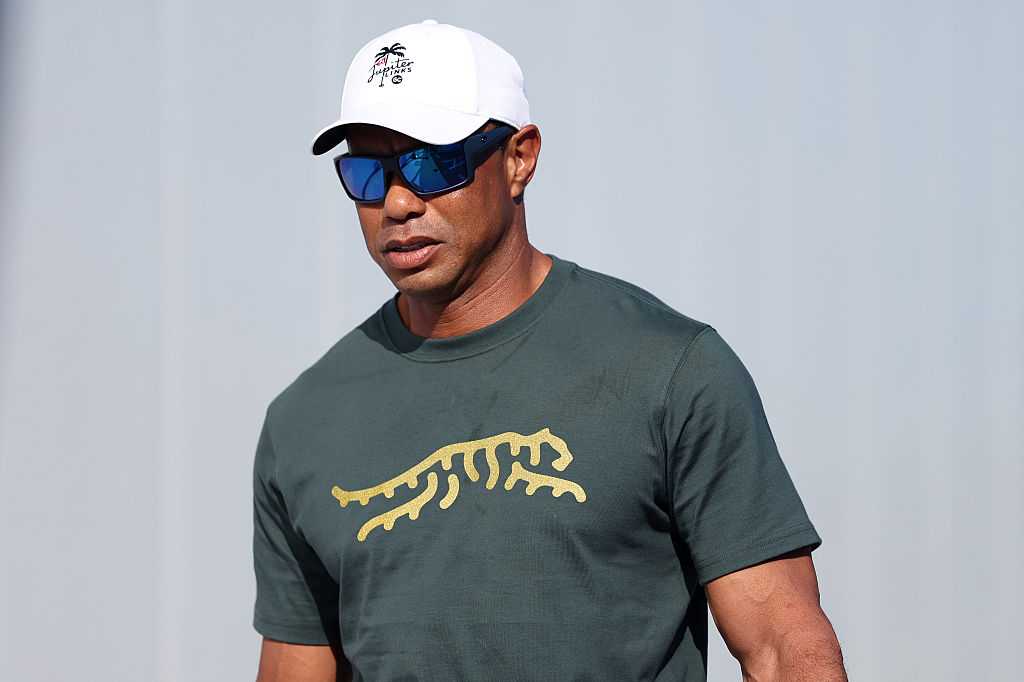
Tiger Woods is reportedly back in the U.S. after a six-week rehab stint in Switzerland following a single-vehicle rollover car crash on March 27 in Jupiter Island, Fla.—his fourth major auto accident since 2009.
The 15-time major winner was arrested on suspicion of DUI after officers on the scene noticed signs of impairment and discovered two hydrocodone pills in his left pants pocket; Woods pleaded not guilty to the charges. He blew a 0.00 on a breathalyzer but refused a urine test.
Shortly after the incident, organizations and sponsors like the PGA Tour, TGL, Sun Day Red, Genesis and Bridgestone Golf offered supportive or neutral messages on Woods’ latest off-course troubles.
With a net worth between $1.3 and $1.5 billion, President Donald Trump on speed dial and an unmatched influence in golf, is the Tiger Woods’ brand too big to fail?
“No brand is immune—and the last decade has proven that definitively. We’ve watched figures who seemed untouchable get completely abandoned by the public and their partners, never to recover,” said Dr. Brandi Sims, Ph.D., MBA and Founder & CEO of Brandinc PR. “Tiger is not exempt from that possibility. What he does have is extraordinary legacy equity built over 30 years, and that buys him more runway than most. But ‘too big to fail’ is a myth in the modern media landscape.
“The ceiling for brand recovery gets lower with each new incident, and with his Nike deal ending in 2024, Sun Day Red still finding its footing, and now a second DUI at 50, the question for partners is no longer just about comeback potential—it’s about whether they’re investing in a legacy or a liability.”
It’s hard to argue against Woods’ legacy and impact on the game of golf, and in pop culture. Like Michael Jordan did to basketball less than a decade before him, Woods modernized and transcended the antiquated, stale game of golf, making it cool and mainstream when he burst onto the scene in 1996.
On-course success to the tune of 15 majors and 82 PGA Tour wins has justifiably led to off-course success, highlighted by a 27-year partnership with Nike that generated over $500 million for the golfer.
Hardly resting on his laurels, Woods expanded his off-course empire with the launch of his golf course architecture firm, TGR Design, in 2006. Looking to embrace golf’s future and integration of technology, Woods launched TMRW Sports and TGL in 2025 alongside Rory McIlroy in partnership with the PGA Tour. Woods’ storied career is also being relived through Sun Day Red, the active premium lifestyle brand he launched in partnership with TaylorMade in 2024.
Yet, despite not playing on the PGA Tour since The Open in 2024, Woods remains a massive draw for audiences, brands and broadcasters, all wondering if it’s potentially the last time they’ll see the GOAT compete or he’s somehow able to channel Prime Tiger and give us one more emphatic Sunday fist pump as he separates himself from Sam Snead atop the PGA Tour career wins list.
Woods’ return to pro golf for Match 2 of the TGL Finals on March 24 gave fans a glimmer of hope that maybe, just maybe, they’d see him suit up for The Masters a few weeks later.
Three days later, everything changed.
After the accident, Woods announced he was “stepping away for a period of time to seek treatment and focus on my health.” He remained out of the public eye for approximately six weeks until he was photographed stepping off his Gulfstream G550 on May 13 at Palm Beach International Airport.
“For someone like Tiger with a long and messy history, (the accident) doesn’t break new ground,” said Brad Chase, founder of reputation and crisis management communications-focused consultancy Chase Global. “He’s already been doing this kind of thing for a while, so there’s no new revelation to alter perception. Audiences may be more likely to process and retain a connection between Tiger and a train wreck, but not in such a way that’s likely to kill [his brand].”
Added Chase: “... Tiger will have a momentary drop, but if his legal team is wise and pleads the case out quickly, he’ll be fine within a few months. All his sponsors will ask to pause activities briefly but will return after this brief blow over period of three to six months at max.”
While we wait to see if his second DUI charge is merely water under the bridge, the immediate reaction from organizational and brand sponsors to Woods’ latest incident is in stark contrast to his headline-grabbing infidelity “transgressions” of 2009 that included crashing his SUV into a fire hydrant on Nov. 27.
By February 2010, Gatorade, Accenture and AT&T formally dropped Woods as a corporate face, while Tag Heuer and Gillette stripped him from their ads. Those lost sponsorships cost him an estimated $25 million to $50 million.
After surviving the sex addiction saga, Woods had his fair share of ups and downs on and off the course, highlighted by further auto accidents following significant surgeries.
A month after a spinal fusion, Woods was arrested in May 2017 on suspicion of DUI in Jupiter, Fla., when he was found asleep at the wheel of a running car. Three months after a microdiscectomy, Woods suffered life-threatening injuries following a high-speed car crash in February 2021 in Los Angeles. Fast forward to 2026 and the latest accident, six months after undergoing his seventh back surgery in October 2025.
Where Tiger Woods, the golfer and human, goes from here is still to be seen. Tiger Woods, the brand, continues to march on for the foreseeable future though another off-course incident may be the straw that breaks the Tiger’s back.
“The DUI itself is manageable. The pattern and the pending legal outcome are where the real risk lives,” Sims said. “He has a court date in July, a suspended license, and a not-guilty plea in play. If this resolves quietly and he returns to the course healthy, partners who stayed loyal will be positioned perfectly for the next comeback chapter. If there are further incidents or a high-profile conviction, the calculus changes fast.
“The smart play for current partners is what I call supportive silence with contingency planning—issue empathetic statements now, quietly audit morality clause language, and have a tiered response framework ready based on how legal proceedings unfold. No brand should be caught flat-footed in either direction.
“Bottom line: Tiger’s brand is bruised but not broken—yet. No brand is too big to fail, but smart partners right now are the ones preparing for both outcomes simultaneously.”

One last thing... Jimmy Roberts
Something totally random came across my instagram feed the other day and it got me to thinking about games and the way we play.
It was 43 years ago, when the Kansas City Royals George Brett hit what appeared be a go ahead home run in the 9th inning at Yankee Stadium against the Bombers, only to be called out because he’d used pine tar in an illegal fashion on the bat.
The clip of his volcanic outrage is an all time sports hilight. If you haven’t seen it - i don’t know, maybe you’re from Mars - but go look it up.
Like i said, though, it got me to thinking. Something like that would never - COULD never happen in golf, a sport where there are no John McEnroe “chalk flew up” moments.
Maybe you think golf is stuffy … or its militant adherence to the rules is silly. Garrick Higo, by the way, might agree … remember a couple of weeks ago he was 30 seconds late for his tee time at the PGA Championship and got penalized two strokes. He ended up missing the cut by 1! Do the math. Ouch!
But no matter what the sport, rules are pretty much a black and white thing. Still, in other sports, maybe the catcher tries to frame a pitch … the soccer player flops … or the wide receiver indignantly claims to have made the catch, even though the replay clearly shows the ball hit the ground.
To be clear, this not a new discussion. Aside from the Ryder Cup fans at Bethpage or the occasional videos of drunk guys fighting over slow play … golf is a game of honor. You raise your hand and call it on yourself. You don’t try and beat or cheat the system.
What a concept: playing by the rules - doing the right thing - even if it might not help you win. Somehow - as i say these words I’m thinking - it wouldn’t be the worst thing if that kinda thing was part of our everyday life regardless if we play games or not.
Past Briefs

Monthly and Annual Membership Options Available.
Member Pricing
$9.99 per month, OR $99 for one year.
Cancel Anytime.
Available for a limited time only, subscribe to our twice-weekly Golf Business Intelligence Brief for a discounted rate of $9.99/month or $99/year. Subscription renews at the same price each month or year, depending on the subscription selected.
Purchase Disclosure
By completing your purchase, you agree to enroll in a monthly or annual subscription to The Big Swing Golf Business Intelligence Brief at the current rate of $9.99 a month or $99 a year.Your subscription will automatically renew monthly at $9.99 or annually at $99 unless canceled prior to the renewal date.
You may cancel at any time through your account settings or by contacting customer support. All sales are final and non-refundable except where required by law.
Offer valid for a limited time and may not be combined with other promotions. Limit one per customer.
By subscribing, you agree to our Terms of Service and Subscription Terms.