
May 21, 2026
The Big Swing: Inside the new golf economy
Watched the PGA Championship last weekend? You definitely weren’t the only one. ESPN’s coverage of the four days at Aronimink Golf Club was the most-watched of the event since 2020, averaging 1.7 million viewers, up 49% from last year. Sunday’s final round on CBS averaged 5.76 million viewers, up 21% in viewership from last year, and the most-watched final round since Phil Mickelson won five years ago.
Remember though, this year’s PGA Championship was only the sixth since Nielsen began tracking out-of-home viewing in its estimates, and the first under its new “Big Data + Panel” measurement system. Sunday’s coverage also had reduced competition, facing zero NBA playoff games for the first time since 2023.
The viewership momentum carried over from the Masters, which had a final round just shy of 14 million viewers (also on CBS) – the most-watched since Jordan Spieth won in 2015.

This and that...
Topgolf’s overhauled leadership team shows company’s new direction
Topgolf dropped a significant organizational announcement this week: a sweeping leadership overhaul that brings in executives from entertainment, gaming, and hospitality and formalizes the management structure that will run the company through its next chapter under Leonard Green Partners. Erin Chamberlin, who had been steering the ship as interim president since October 2025 through the sale process from Callaway, has been formally appointed president and COO. Two external hires fill needed gaps: Jay Spears joins as CIO from CEC Entertainment — the company behind Chuck E. Cheese — and Jason Weatherford arrives as VP of in-venue services in a newly created role covering food and beverage, retail, procurement, and golf instruction. Weatherford’s background includes leadership roles at Palace Entertainment and Six Flags. Plus, Toptracer's Scott Blevins gets an expanded mandate that now includes Topgolf Swing Suites, and the company has restructured from two operational regions to three.
Our Take: We’ve known something like this was coming since CEO David McKillips joined Topgolf from CEC earlier this year. But if you read the org chart, you’ll get a clear picture of where the new owners think the work needs to happen. A CIO hired from a family entertainment company (who’s previously worked with McKillips) says the guest technology experience needs an overhaul. A brand-new VP role dedicated to in-venue revenue — F&B, retail, golf instruction — says those lines haven't had enough strategic ownership. And formalizing Chamberlin after seven months in an interim role says Leonard Green trusts the person who managed the sale enough to hand her the keys going forward.
Michelle Wie West Is Designing Golf’s Answer to the Beginner Problem
Michelle Wie West can add “golf course architect” to her resume. The star is designing her first course — a par-3 layout called Sweet Tooth at Candyroot, a destination resort in development in South Carolina about an hour from Columbia and Charlotte. Where most marquee course projects lead with difficulty or prestige, Wie West is leading with access. "Golf can be so intimidating to people just starting out," she said in an interview with golf.com. "This helps lower the barrier to entry." Sweet Tooth will feature alternate scorecards — the same 25-acre layout functioning as a par-3 for better players or a par-72 for beginners and kids — lighted for night play, with holes designed to crisscross and create a communal atmosphere. Wie West described the concept as "a choose your own adventure." Construction is slated to begin late next year, with the full Candyroot property (1,210 acres on the same sandy Carolina belt as Pinehurst, with four planned 18-hole layouts) still in development. The announcement comes as Wie West has returned to the professional space after retiring in 2023, first on a sponsor’s exemption at the LPGA’s Mizuho Americas Open before heading to the U.S. Women’s Open next month.
Our Take: The golf industry has spent years talking about the beginner problem of how to convert the 40 million off-course participants into on-course players, and now Wie West is designing for it. For resort developers watching, the more interesting story may be Candyroot itself — a major land play with a high-profile name attached before a single hole is open.
LIV Golf Reportedly Preparing for Bankruptcy
LIV Golf has started laying the groundwork for potential bankruptcy, according to a report from Bloomberg. The upstart golf league’s future is in jeopardy after Saudi Arabia’s Public Investment Fund (PIF) will pull its funding at the conclusion of the current season. PIF is estimated to have spent $5-8 billion into the league that launched in 2021 to challenge the PGA Tour. LIV Golf CEO Scott O’Neil is tasked with keeping the league afloat, reportedly searching for up to $250 million in external investment, according to Axios.
Our take: It seems every day the LIV Golf saga—and the league’s future—takes another turn. While bankruptcy is being cited as a “last resort” for LIV, it’s surreal to think that the league that launched with a seemingly endless amount of support and funding is on life support. O’Neil is in a tough position having to secure outside investment for an organization with limited brand and broadcast appeal that has has seen the likes of Brooks Koepka and Patrick Reed already jump ship and return to the PGA Tour. LIV’s biggest remaining star, Bryson DeChambeau, is also unsure of his next move. “I'm in that weird space right now, I don't know what to do, either: Content creation or professional golf. I don't know what to do right now," DeChambeau said on The Katie Miller Podcast. Jon Rahm, who reportedly received $300 million over multiple years to join LIV Golf, said earlier this month he didn’t “see many ways out” of his LIV Golf contract. Bankruptcy could help.
The Amateur Professional: How NIL and Rev Sharing are Shifting the College-to-Pro Pipeline
From million-dollar valuations for high schoolers to a $20.5 million salary cap, the barrier between collegiate and professional golf has dissolved.
May 21, 2026
Mollie Cahillane | mollie@bigswingmedia.news
When Gordon Sargent earned his PGA Tour card in the fall of 2023, he bucked expectations by putting it in his pocket and going back to Vanderbilt. When Jackson Koivun did the same thing two years later — walking away from an estimated $930,000 in prize money to return to Auburn for his junior season — it began to look like a trend.
The math behind the decision to remain in school versus head to the PGA Tour has changed. While development and loyalty to teammates are still a factor (both players have cited those reasons), the kind of money available to players didn’t exist in college golf five years ago. Sargent told Golf Digest that NIL deals with Nike and Titleist aided his decision to return to Vanderbilt. Koivun called NIL “great” and said it has “definitely benefited me and a lot of my peers in a very positive way.” The PGA Tour isn’t going anywhere, but the NIL window only has a limited lifespan.
Golf has quietly become the proof of concept for the new NIL era, serving as a sport where the amateur ranks are producing professional-caliber brands in players before a professional contract is even signed.
The stay-vs.-go economics
A top collegiate golfer today has two income streams that didn’t exist before 2021: direct revenue sharing from their school, funded by broadcast and ticket revenue, and third-party NIL deals from brands. For the 2025–26 academic year, participating schools can distribute up to $20.5 million annually to student-athletes across their programs – effectively a salary cap paid out by the athletic department. For golf, which obviously doesn’t generate football revenue, the per-player allocation is modest. But layered on top of brand deals, it adds up fast.
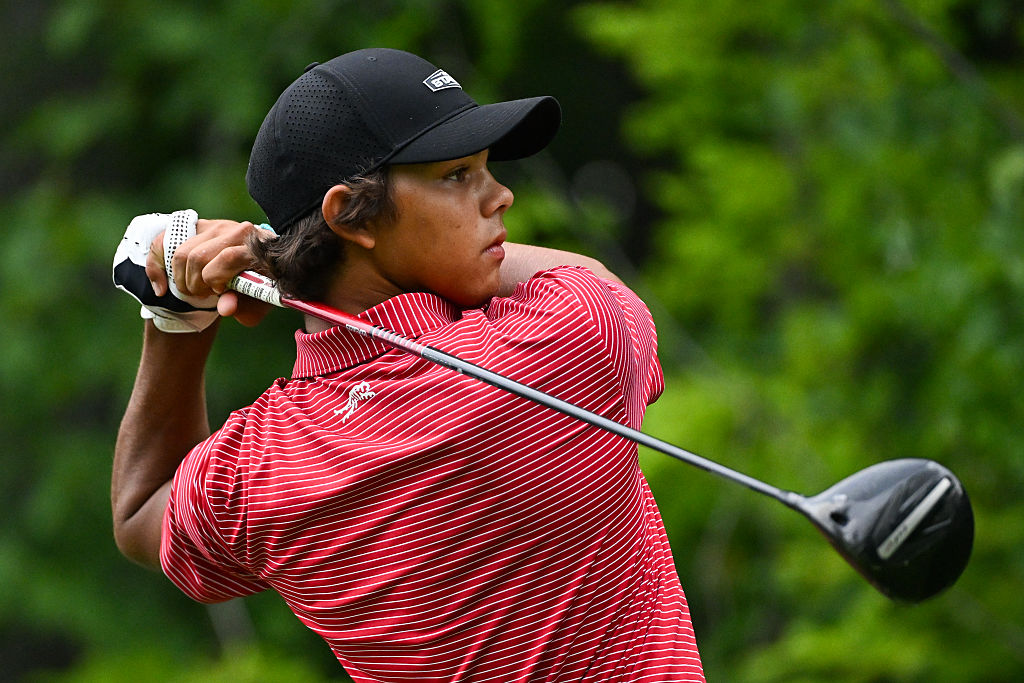
Koivun carries an NIL valuation (an estimation of how much a specific college sports player’s NIL is worth) of $1.75 million, backed by Betterment, Titleist, FootJoy, and Foresight Sports. Before Luke Clanton turned pro this spring, his valuation hit $2.37 million. Even in high school, 17-year-old Florida State commit Miles Russell carries a $1 million valuation with deals from TaylorMade, Nike and Liberty National Golf Club, among others. And of course, there’s the power of the last name. Charlie Woods and Kai Trump have NIL valuations at $3 million and $2.25 million respectively, showing that brands are willing to shell out the big bucks to be associated with them.
The new roster structure also makes the decision easier, with men’s and women’s golf teams at revenue-sharing schools now capped at nine players, down from rosters with no previous limits. However, those nine spots can all be fully funded, up from 4.5 scholarships for men previously, and essentially eliminating the walk-on spots that produced players like Jason Dufner, making college golf itself look more like a developmental league with a salary floor.
The professionalization of representation
The money flowing through college golf hasn’t gone unnoticed by brands or the representation industry, either. Agencies that previously waited until players turned pro are now signing golfers in high school. Nike signed Clanton to an apparel deal while he was still a Florida State junior, joining Sargent — also signed by Nike while at Vanderbilt — as the clearest examples of major brands committing to college golfers before they reach the professional ranks.
Excel Sports Management, WME Sports, CAA, and boutique golf-specific firms have all built or expanded amateur divisions, competing for players whose NIL valuations are already seven figures. It makes business sense: get in early, build the relationship, and be positioned when the professional contracts come due.
The fee landscape is still the wild west, with no national standard for NIL agent compensation. Many are charging 10 to 20 percent according to a source familiar with the matter — rates that coaches have publicly pushed back on, with one ESPN survey finding the median agent cut sits around 20 percent. Federal legislation in committee would cap fees at 5 percent, though nothing has passed.
“It used to be an alumni donor that gave the kid a car, and now it's the agents negotiating contracts at different colleges,” a former PGA pro knowledgeable of college golf told The Big Swing. “It's pretty wild, if you ask me. But if those are the rules and those are within the rules, then why not do it?”
Endorsement deals as transition contracts
The deals that companies like Nike, TaylorMade, and Titleist are signing with collegiate golfers aren’t necessarily traditional NIL arrangements, rather looking more like transition contracts that survive the turn professional.
For brands, the math is obvious. Signing a player at 19, before the professional market has fully priced them, costs a fraction of what a Tour-level signature demands. For the player, the deal means stability and a running start. But it also quietly closes a window — the gap between amateur and professional status has historically been one of the highest-leverage commercial moments in a golfer's career.
Jack Nicklaus knows something about giving that leverage away too early. The 18-time major champion recently won a legal battle to reclaim his own name and likeness — a dispute that produced perhaps the strangest headline in golf business history: Jack Nicklaus versus Jack Nicklaus Incorporated. His advice to today's young players, speaking to Jimmy Roberts on The Big Swing, was blunt: "Don't give it away. That's one thing that you own that is your most precious thing — is your name and your image and likeness. It's valuable, very valuable."
The warning carries weight because of what preceded it. Nicklaus spent his early career as Mark McCormack's third priority at IMG, behind Arnold Palmer and Gary Player. "I realized that as a priority, number three was not where I wanted to be," he told Roberts. He left in 1970 to go independent, saying, "It was much more rewarding because I ended up controlling what I wanted to do." Today's college golfers are making that same calculation at 17 and 18, often without the experience or the infrastructure to make it well.
The regulatory reckoning
For the players and agents navigating this new landscape, the rules are still being written in real time. The House v. NCAA settlement, finalized in June 2025, created the College Sports Commission as the central enforcement body for NIL, and its early track record is instructive.
The CSC has rejected 524 NIL deals worth $14.94 million since it began evaluating them, while clearing 17,321 worth $127.21 million — data current as of January 1, 2026. In just the first two months of 2026, NIL Go (the official platform for NCAA Division I student-athletes to report third-party NIL deals) declined to clear another 187 deals worth nearly $15 million, about half of all rejected deal dollars in the platform's eight-month history. The standard: deals must reflect legitimate activation of a student-athlete's name, image, and likeness, not guaranteed payments untethered from any promotional activity. Essentially, no pay-for-play disguised as NIL. Nebraska football is the most prominent example, with 18 players currently legally challenging the rejection of NIL deals worth a combined $7.5 million.
The long game
Nicklaus spent 60-plus years in business on a simple principle. "I always felt like I wanted to give the other guy a better deal than I got," he said. "I always want to make sure I can lift my head."
His ethos — of fair dealing, long relationships, and protecting what's yours — can feel almost quaint in a landscape where 17-year-olds are managing multi-brand portfolios and 19-year-olds are choosing between Tour cards and NIL income. But his core warning translates perfectly: your name is your most valuable asset, and figure out what it's worth before someone else does.
When Koivun and Russell appear in the same Upper Deck Young Guns card set as Nelly Korda, Hideki Matsuyama, and Lydia Ko (one still in college, one still in high school) the "amateur" label has become exactly what Nicklaus described: a legal distinction, not a financial one.
The goal for today's top collegiate golfers is to reach the PGA Tour on their own terms, coming in with an established brand, existing sponsor relationships, and the leverage that years of carefully managed amateur exposure can build. In 2026, for players who navigate it right, college golf is the first act of a long, financially lucrative career.

One last thing... Jimmy Roberts
An Outside View
What’s it like to live with a golfer when you don't play golf?
Editor’s Note: Essay originally published in The Met Golfer, February/March 2018 and is guest-written by Sandy Roberts. Special thanks to the Metropolitan Golf Association.
I’ve heard the speech more times than I can count: Why wouldn’t I want to visit the most beautiful places on earth? Spend quality time with my friends? Walk up and down hills for five miles and get a decent workout while doing something I love?
My husband doesn’t just love golf. He’s obsessed with it. From April to October there’s hardly a week that goes by without at least a round or two. To be fair, it’s part of his job, but that is only an excuse. His love of the game surpasses almost anything.
If you are reading this, you probably get it; I just don’t.
Why would I want to make myself frustrated, day in and day out? I can do that at home... my kids help me reach that goal on a daily basis. I don’t need a golf course.
Yet when March rolls around, he eagerly checks the weather every morning, and examines his over-scheduled calendar, looking for available days to play. Once the snow melts, it’s like Christmas morning all over again.
The preparations begin the night before. Clothing choices are debated and laid out, every available piece judged for its ability to help achieve peak performance on the links. A collared shirt, khaki shorts, windbreaker, arm sleeves, and—most importantly—a hat are all chosen with utmost care. Even the Advil gels (quick release!) are put on the counter, ready for ingesting at the first sign of morning back stiffness.
And then he’s gone. Hours and hours and hours and more hours. Who has all that time to play? In five hours I could do the laundry, shop for food, work out, meet friends for lunch, and even watch an episode of “The Crown” with time to spare.
Then there’s the matter of spending five hours with people you know really well, or maybe don’t know at all. Since he’s a reporter, I’d expect him to be inquisitive and come home with stories about his fellow players. Maybe there’s a juicy tidbit about a celebrity, or a funny story about their kids?
“What did you talk about all day?” I ask nearly every time he plays. You would think I would know better by now.
There is only ever one answer: “This and that, but mostly golf.”
How is this possible? I’ve never met people who can talk about one subject for five hours. Is that interesting to anyone? Truly?
I believe it is, because for the next 30 minutes every hole is described to me, every shot is dissected, and every par or birdie noted with flair. This is usually on a “good” day.
Somehow there are many more bad days. Steam pours out of ears, wine pours into a glass, and a golf lesson is booked as soon as possible. Video might even be emailed to a golf pro out of town. I hesitate to say this (pretend I am whispering here) but there is talk of NEVER playing golf again.
PLEASE DO NOT WORRY. This is a temporary condition that lasts only until it’s time to review the weather forecast the next morning.
Growing up, the only time I ever held a club was when we rented one for miniature golf. Even the scoring seemed confusing: why is being in negative territory a positive? As an adult I took one lesson, but gave up because the grip seemed so awkward and uncomfortable.
But last summer I decided to lift the veil of secrecy and walk 18 holes with my husband. It was a gorgeous August day and this particular golf course was situated right next to the ocean. There was a brief exchange of pleasantries with his foursome, and small talk about families and towns; but mostly the discussion was about golf. Good shots were lauded and bad shots were ignored. Near the end of the round, standing on the cliff of one magnificent hole overlooking the sea, beer in hand, nothing could have been more perfect.
A spectacular afternoon, with people who share your passion, in a beautiful setting... I guess I could learn to like this.
Past Briefs


Monthly and Annual Membership Options Available.
Member Pricing
$9.99 per month, OR $99 for one year.
Cancel Anytime.
Available for a limited time only, subscribe to our twice-weekly Golf Business Intelligence Brief for a discounted rate of $9.99/month or $99/year. Subscription renews at the same price each month or year, depending on the subscription selected.
Purchase Disclosure
By completing your purchase, you agree to enroll in a monthly or annual subscription to The Big Swing Golf Business Intelligence Brief at the current rate of $9.99 a month or $99 a year.Your subscription will automatically renew monthly at $9.99 or annually at $99 unless canceled prior to the renewal date.
You may cancel at any time through your account settings or by contacting customer support. All sales are final and non-refundable except where required by law.
Offer valid for a limited time and may not be combined with other promotions. Limit one per customer.
By subscribing, you agree to our Terms of Service and Subscription Terms.