
June 29, 2026
The Big Swing: Inside the new golf economy
In our past few newsletters, we’ve touched on the importance of golf’s stars competing in high-stakes tournaments week in and week out if the new PGA Tour model stands any chance of succeeding. The players clearly answered the call as Viktor Hovland outlasted Scottie Scheffler in a playoff this morning to win the Travelers Championship at TPC River Highlands.
It was a thrilling finish following a tight U.S. Open the prior week as Wyndham Clark outlasted Sam Burns by one stroke.
While the PGA Tour can’t guarantee drama every Sunday, The Big Swing can guarantee quality storytelling every Monday and ThursdayWednesday. In today’s newsletter, we look at how the USGA is trying to encourage more golfers to get an Official Handicap.

This and that...
Off-course golf to become 50-million-person market by 2030, per expert
Old Tom Capital co-founder Evan Roosevelt is more than bullish on off-course golf AKA alternative forms of the game beyond an 18-hole round. Not only has the golf-focused investment firm already invested in this growing space through TMRW Sports, Grass League and Blue Jeans Golf, Roosevelt believes the best is yet to come, telling The Business of Golf that off-course golf will become a 50-million-person market by 2030. While golf has seen an unprecedented surge since the Covid-19 pandemic in 2020, off-course golf participation has benefitted the most, growing from 14.3 million participants in 2014 to 37.9 million in 2025. Last year alone witnessed 10% growth.
Our take: The traditionally traditional golf industry is evolving to meet unprecedented demand, particularly from the game’s growing demographics highlighted by youth, girls/women and People of Color. And these newcomers aren’t engaging with the game like your grandfather did—they’re going to gamified simulators and driving ranges, wear golf-inspired streetwear brands, watch YouTube golf, listen to golf podcasts and watch golf shows like “The Hawk.” These alternative forms of the game also lower the steep barrier to entry marred by intimidating “country-club culture” as well as the financial and time investments to play an 18-hole round. Courses are adding tech-infused simulators or even par-3 or 9-hole options to complement their traditional 18-hole track to appeal to a wide audience. With overall golf interest showing no signs of slowing, Roosevelt’s estimation is more than justified.
Trump: East Potomac Golf Links “will have the ability to host Major Golf Tournaments” after redevelopment
Donald Trump’s interest and investment in the game of golf is well known. The U.S. President, who owns 16 courses around the globe, is excited about the future potential of East Potomac Golf Links in Washington, D.C.. With redevelopment set to begin in September, Trump posted on social media: “When completed, this Course will have the ability to host Major Golf Tournaments, including The U.S. Open, The Ryder Cup, The PGA Championship, and other top PGA Tour events.” The redevelopment is subject to a lawsuit in U.S. District Court alleging that the administration unlawfully dumped White House demolition debris on the public course and violated the National Environmental Policy Act.
Our take: Trump’s quest to host a men’s major golf tournament continues as he lays the groundwork for welcoming the game to East Potomac Golf Links. Trump courses have played host to three prior major tournaments: the 2015 Women’s British Open (Trump Turnberry Resort), 2017 U.S. Women’s Open (Trump National Golf Club Bedminster) and 2017 KitchenAid Senior PGA Championship (Trump National Golf Club Washington, D.C.) The 2022 PGA Championship was scheduled to be played at Trump Bedminster, but was relocated to Southern Hills GC in Oklahoma following the January 6, 2021 riots at the nation’s capital. The PGA Tour has since returned to Trump Doral this past spring for the inaugural Cadillac Championship. Whether or not Trump will get his wish to host a men’s major will be seen, but either way, it will be a while as locations for the U.S. Open are scheduled through 2051—though spots are available in 2043, ’46 and ’48. The PGA Championship is solidified through 2035 while the Ryder Cup has locations selected through 2037.
Mickelson set to miss all four majors for first time in career
Phil Mickelson is no longer listed in the Open Championship’s field on the tournament’s website, instead moving to the non-playing portion of exempt players. On June 26, The Telegraph reported the six-time major winner who ranks sixth all-time with $116.89 million in total earnings had withdrawn from the tournament following multiple reports of inappropriate conduct and harassment. Missing The Open for the first time since 2009, this year will mark the first in his career that Mickelson will miss all four majors.
Our take: Honestly, we’d be more surprised if Mickelson competed in The Open given the year—and week—he’s had. The 56-year-old has only played in one tournament this year (LIV Golf South Africa) in mid-March, while missing the other three majors and rest of LIV’s schedule while dealing with a “private family health matter.” Whether or not it’s tied to the recent allegations of inappropriate behavior toward a female staffer causing his departure at The Farms Golf Club and/or the investigative report from Skratch’s Alan Shipnuck detailing Mickelson’s history of inappropriate behavior and harassment, the legendary lefty’s presence at was in doubt at Royal Birkdale regardless. Having lost the bulk of his sponsors when he left the PGA Tour for LIV Golf in June 2022, Mickelson’s marketability is non-existent due to his actions on and off the course.
USGA Hopes Updated GHIN App Will Engage Game’s Growing Demos, Encourage More Official Handicaps
Seeking to evolve from a posting tool to in-round playing companion, app features like Rules AI make understanding the game easier, more accessible.
June 29, 2026
Mike Whan doesn’t care what golf companion app you use.
Whether it’s 18Birdies, TheGrint, Arccos Caddie, Golf Genius or USGA’s GHIN app, the USGA CEO just wants people to engage with the game of golf—and get an official handicap.
(It also helps that all of the apps utilize the USGA handicapping system.)
“Our goal is to make sure people love the game enough that they pass it down to the next generation and that grows with each pass,” Whan said at a GHIN media day event at Winged Foot Golf Club. “And we’re having this amazing time in the game right now, so we don’t really care how you get connected and play with other people.
“It’s all about whether or not people are engaging with the sport and if there’s areas that we can fill that gap, we’ll fill that gap.”
Luckily for Whan, the USGA, and anyone else involved in golf, the game’s engagement is greater than ever before.
Golf’s overall reach is an estimated 136 million as more than one-third of the U.S. population over the age of 5 played golf (on-course or off-course), followed golf on TV/online, read about the game, or listened to a golf-related podcast in 2025, according to the National Golf Foundation. Buoyed by the Covid-19 pandemic in 2020 and driven by growing demos including youth, girls/women and People of Color, that number is up 43% since record-keeping began in 2016.
Like Thor’s Mjölnir, the USGA wields a powerful weapon to convey golf’s greatness and encourage engagement in its Golf Handicap Information Network, more commonly known as GHIN. Offered by the game’s governing body in the U.S. and Mexico to golf associations worldwide, GHIN is the largest handicap management tool in the world, serving more than three million golfers and 15,700 golf clubs. Approximately 15 million golfers worldwide have a Handicap Index.
Despite the millions currently utilizing GHIN and/or employing a Handicap Index, there are millions more who aren’t. According to the NGF, 15 million golfers they call “core golfers” played eight or more rounds a year in the U.S. The USGA says 3.68 million golfers in the U.S. maintained a Handicap Index in 2025.
While the USGA doesn’t directly bill for annual memberships, state and regional Allied Golf Associations charge between $30-80 depending where you register. On top of that, the Enhanced GPS upgrade for the GHIN app is $49.99 for a 12-month subscription.
With millions who “play just for fun” and don’t see the value in having a Handicap Index, the USGA's biggest obstacle is proving that utilizing GHIN and having an official handicap makes the game even more enjoyable.
“There’s a delta of 12 million people who play eight or more rounds of golf a year who don’t have a Handicap Index,” said Tom Padula, USGA GHIN product lead. “Our team partners with the handicapping team and marketing team to talk about the value of the Handicap Index, so we’re really promoting that.
“There’s never been a huge focus on marketing GHIN, but now we’re leaning into that at the USGA.”
With Americans averaging five hours per day on their phones and 76% of core golfers having golf-specific apps on their phone, the USGA is leveraging its GHIN app to accomplish two goals: make the game more accessible and easier to understand for newcomers and encourage all golfers to have an Handicap Index.
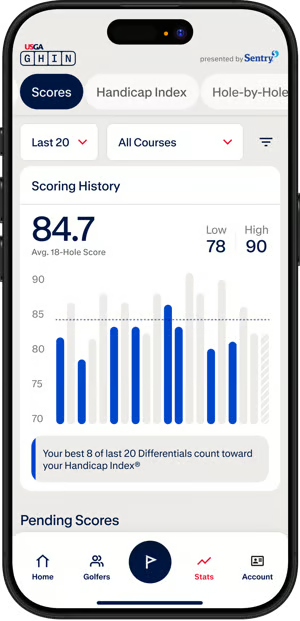
With the goal of evolving the GHIN app from a posting tool to an in-round playing companion, the USGA updated the app to offer an easier and more intuitive process to start a round, a new-look GPS to navigate the course during a round, green-reading heat maps to plan approach shots, and more data and insights highlighted by a post-round stats page (GHINsights) to see how your game is trending.
Arguably the most significant update to the app is its proprietary Rules AI platform launched in mid-May to “make the rules more accessible and understandable for golfers everywhere.” Existing within the GHIN app, users have the ability to ask specific rules questions and get answers for practical application on the course.
According to the USGA, the tool is “powered exclusively by up-to-date, verified USGA content” to ensure golfers receive answers rooted in the official Rules of Golf and informed by the practical judgement and nuance needed to apply them.
Rules AI has already begun rolling out to select golf clubs via the GHIN app, allowing the USGA to gather real-world insights and refine the user experience before expanding the release to all golfers. Members of Allied Golf Associations will continue to gain access to Rules AI over the next few months with it expected to be available to all GHIN users by spring 2027.
AI will also be working behind the scenes in the GHIN app to personalize experiences whether a user is a scratch handicap or new to the game.
“AI can do some things really well,” Padula said. “It can take large data sets and personalize it for golfers, so how can we create a different experience for you and me using AI looking at data? We kind of want to use AI without golfers knowing AI is in the app; we want it to feel interesting and personalized in the background.”
Originally launched in 2012, this is the first significant update to the GHIN app since 2020. The app is on the verge of public beta testing, following an alpha testing round where the USGA received feedback from friendlies and those in the industry.
The investment in the app is no surprise given AI’s utilization and acceptance in culture and other industries led by ChatGPT, Claude, Google Gemini and others.
The USGA, which recorded a record $333 million in revenue in 2025, invested $347 million into golf last year to support its four pillars: Unify, Showcase, Govern and Advance. The bulk of the USGA’s investment ($263.5 million) fell under Showcase, highlighted by its Opens and prize purses, while $20.8 million fell under Unify in support of GHIN, World Handicap System (WHS), handicapping and course rating.
Not only is the USGA utilizing AI like other organizations and industries, it’s also leveraging influencer marketing to highlight the app’s new features and benefits of a Handicap Index. The organization hosted 15 golf creators including Blair Wheeler, Hannah Rae and Roger Steele at the inaugural GHINvitational in Scottsdale, Az., and have been creating content explaining the app, rules and more to engage the game’s growing demos.
The investment in GHIN and the Handicap Index is the USGA’s most significant ever, following initial awareness and marketing efforts tied to the U.S. Open around the time of the pandemic.
“Five or six years ago, we started using the U.S. Open to sort of advertise and say, ‘Hey, come get a handicap,’” Whan said. “But we realized when people came in to get a handicap, the process was confusing and really most people bailed in the middle of the process.
“... We stepped back and decided to create a real easy pipeline so now you can go on USGA.org, go for a handicap and be done in three minutes. The first thing we had to do was make just getting it easier. The second thing we had to do was help people understand what it’s about.”

One last thing... Jimmy Roberts
A New Schedule, an Old Lesson
The dust has settled a little bit from Brian Rolapp’s announcement last week about the Tour’s plans for its new schedule. There’s a lot to chew on.
In some ways, it’s a big pivot. I’m probably like a lot of golf fans: there are things I like … and things I don’t, but I don’t think there’s any question. Things had gotten a bit stale and it was unquestionably time for a change.
I think it’s ironic that we’re going back to a model that - in some ways - existed years ago: a more compact schedule that doesn’t compete with football.
I’ve always thought the entire fool’s errand of OFFICIAL FALL GOLF, is something you can blame on the Tour getting drunk on Tiger Woods; the thinking that his influence on viewership had “super powers.” It kinda did. But the NFL was that theory’s kryptonite.
The thing I really love going forward is “match play.” Funny thing about that decision is the reason Match Play has been mostly absent from the Tour’s schedule over the years is because it can be a crap shoot.
Remember the very first WGC Match Play event back in 1999? I do. I was there at LaCosta. It featured a 36-hole final between Andrew Magee and Jeff Maggert. No hate here please … they were both fine players who earned their spots, but it was hardly the type of blockbuster matchup that promised to draw eyeballs … which … the promise of eyeballs … is what the Tour needs most if it’s going to land the big media deals it covets.
There’s one footnote to the new Tour Championship arrangement which I understand … but it makes me a little sad.
Since 2004, East Lake has been the tournament’s home. But starting in 2028, it will rotate among as yet to be determined sites.
In the 1990’s, the late Tom Cousins rehabilitated East Lake as the cornerstone of a revolutionary and unique community restoration project. It ended up dramatically changing the lives of thousands of people.
Rolapp has said that in moving forward he will respect tradition, but not be a slave to it. Personally, I think that’s the right idea. I’m just hoping that East Lake gets the respect it deserves. In my lifetime, it may be the best thing the Tour has ever been a part of.
Past Briefs

.jpeg)
Monthly and Annual Membership Options Available.
Member Pricing
$9.99 per month, OR $99 for one year.
Cancel Anytime.
Available for a limited time only, subscribe to our twice-weekly Golf Business Intelligence Brief for a discounted rate of $9.99/month or $99/year. Subscription renews at the same price each month or year, depending on the subscription selected.
Purchase Disclosure
By completing your purchase, you agree to enroll in a monthly or annual subscription to The Big Swing Golf Business Intelligence Brief at the current rate of $9.99 a month or $99 a year.Your subscription will automatically renew monthly at $9.99 or annually at $99 unless canceled prior to the renewal date.
You may cancel at any time through your account settings or by contacting customer support. All sales are final and non-refundable except where required by law.
Offer valid for a limited time and may not be combined with other promotions. Limit one per customer.
By subscribing, you agree to our Terms of Service and Subscription Terms.