
The Big Swing:
Inside the New Golf Economy
September 24, 2026

The Big Swing: Inside the new golf economy
We’ve been talking a lot about the Presidents Cup, which tees off today, but we don’t think enough attention is being paid to its economic impact on Chicagoland.
If you haven’t read Michael LoRé’s eye-opening piece from Monday, definitely check it out, but a record $175 million is projected for Chicago’s suburbs, well above the previous Presidents Cup record of $135 million set in Charlotte in 2022. If you’re out at Medinah for the weekend, make sure to sample some of Chicago’s finest cuisine… but definitely don’t put ketchup on your hot dog.

This and that...
Golf’s governing bodies put equipment bifurcation back on the table
The USGA and R&A have sent manufacturers proposals for three potential Model Local Rules aimed specifically at elite competition, covering the golf ball’s overall distance standard, driver-face spring effect and club length. The PGA Tour and DP World Tour requested the work, and manufacturers have until October 21 to respond. The Model Local Rules could be available for adoption from January 2028. Importantly, they would not alter retail equipment rules, while the broader golf-ball rollback remains scheduled for 2030.
Our take: The politics here have flipped from the last bifurcation debate: this time it’s the PGA Tour and DP World Tour asking the governing bodies to investigate elite-only restrictions. For manufacturers, the immediate commercial impact may be relatively limited, as OEMs already separately manage and extensively test equipment supplied to tour players. But the rules would formalize a potential gap between the equipment standards applied in elite competition and those governing the retail market. There is also an operational wrinkle: because these are Model Local Rules rather than universal Equipment Rules, each tournament committee would decide whether to adopt them. Without coordinated implementation, a player could theoretically face one equipment requirement one week and another the next, creating a new testing, inventory and servicing headache for tours, players and OEM tour trucks.
Presidents Cup player payments cross $25 million, but the rate hasn’t risen since 2022
The PGA Tour will pay out $8.5 million in participant stipends at the Presidents Cup at Medinah this week, taking total payments across the past three editions to $25.5 million, according to Front Office Sports. A PGA Tour spokesperson confirmed to FOS that each of the 12 players, captain and four assistant captains on both teams will again receive $250,000, unchanged from 2022 and 2024. That represents a significant shift from the model used before 2022. Instead of receiving cash stipends, each player, captain and assistant captain directed $150,000 to a charity of their choice, totaling $5.1 million per Presidents Cup. The current model distributes $8.5 million directly to participants.
Our take: The interesting part isn’t that Presidents Cup compensation is increasing, because it isn’t. The PGA Tour set the cash-payment benchmark at $250,000 per participant in 2022 and has held it there for three straight editions, even as prize money across professional golf has risen sharply. More notably, the Presidents Cup got there before its biggest team-golf counterpart: the PGA of America only began paying U.S. Ryder Cup players last year, providing each player with a $200,000 stipend alongside $300,000 to direct to charity, while Europe paid no player stipend at the 2025 Ryder Cup. The Presidents Cup didn’t follow the move toward paying players for team golf; it had already done so three years earlier, at a higher cash rate.
PGA Show expands its racquet-sports floor for a third year
The PGA Show's racquet sports section returns for its third year at the Jan. 26-29, 2027 show in Orlando. It will have 70-plus brands across more than 18,000 square feet, with brands like JOOLA, Franklin Sports and Paddletek returning, and USA Padel, Six Zero Pickleball and Pro Pickle attending for the first time. The show is also adding a dedicated education program, a Center Court Lounge for creators and a second Celebrity Pickleball Pro-Am. Registration opens in early October.
Our take: We’re not at all surprised by this move after the 2026 Show, when the racquet and pickleball floor space more than doubled in size from 2025. Private clubs and resorts are adding pickleball and padel courts to keep members and families engaged year-round, which means the same general managers and head pros who stock golf shops now buy paddles and court gear too. The PGA Show would rather keep that spending on its floor than lose it to a separate racquet trade show.
Inside WTGL's Business Plan: Four Revenue Lines, Two Networks, One Big Ceiling
Seven weeks before launch, TMRW Sports' Rufus Hack walks through how the women's league makes money, why it chose ESPN and ION, and what success looks like on opening night.
September 24, 2026
PALM BEACH GARDENS, Fla. — SoFi Center, tucked into the middle of Palm Beach State College's campus in South Florida, doesn't look much like a golf venue from the outside. Inside, on Sunday, it didn't sound like one either — smoke machines, walk-up songs and five teams of LPGA stars entering through a tunnel built for spectacle.
It was WTGL's inaugural media day, seven weeks out from the league's Nov. 8 launch, and the "carnival, festival atmosphere" TMRW Sports president of golf Rufus Hack had promised was fully on display. But with it comes the first real test of whether TMRW Sports can turn a made-for-TV men's golf format into something bigger.
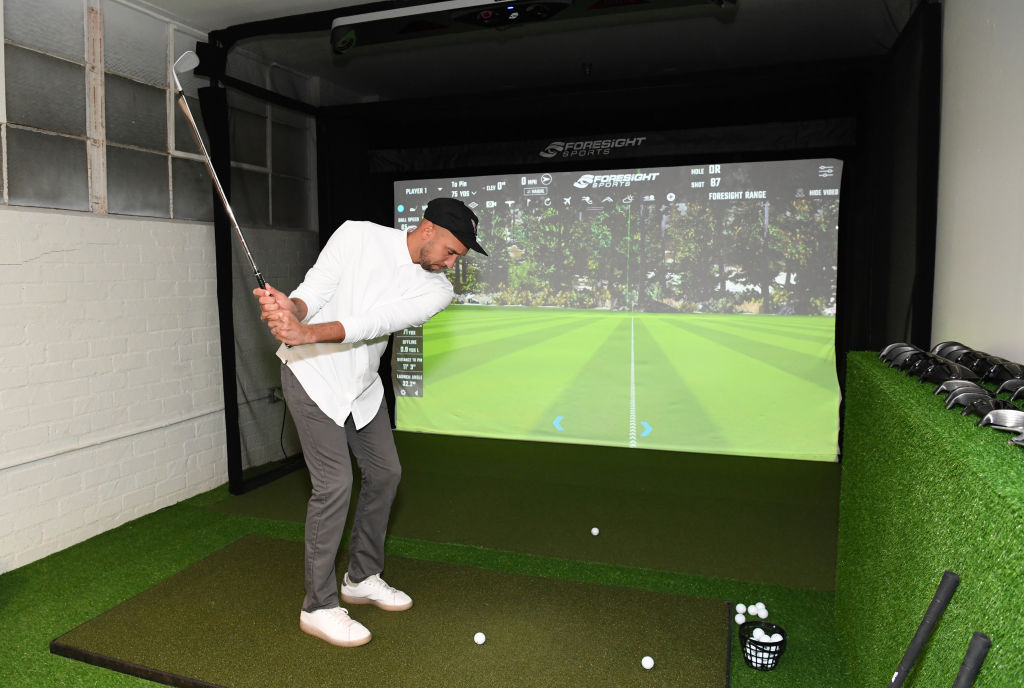
Media were treated to a full display of WTGL’s technology, including a few new holes, and demonstrations by players and journalists alike. First up, Lexi Thompson and Albane Valenzuela, hitting toward a 64-by-53-foot simulation screen showing a Swedish warship in front of snow-capped mountains, a new hole designed by Annika Sörenstam.
“I thought the environment was very electric. I've never been in a place like this before, and just walking in was so surreal because I was like, how can they even build all this,” said Yana Wilson of New York Golf Club.
“To be able to play screen golf like this, this is like screen golf on steroids. It's really cool to be in here, hitting a few shots, being a part of something like this,” added Alison Lee of Los Angeles Golf Club.
Not Starting from Scratch
Unlike many other upstart women’s professional sports leagues, TMRW Sports isn’t building WTGL from scratch. The technology, the operations, the “hammer” scoring system (all on full display during media day) were all stress-tested over two seasons of TGL. Hack, who joined the company as president of golf in August after running Sony Sports, called that foundation a head start.
But he was careful to draw a line: WTGL isn’t a spinoff. “It’s very much got the same distinct DNA, [but] its own distinct identity,” he told Big Swing Media.
The distinction matters in how the league gets sold to sponsors and media partners as a new property with its own value proposition, rather than a women’s version of an existing one.
Where the Money Comes From
Ask most league presidents about profitability for launch week, and you can expect a dodge. Instead, Hack laid it out for us. WTGL’s economics run on four revenue lines: team fees, sponsorship, media rights, and in-venue ticketing and hospitality.
The headline number, in his telling, isn’t any single figure but instead the appetite for the game. Though TMRW Sports and the LPGA only officially announced WTGL in January, TMRW has spent three to four years selling media and sponsorship for TGL, and Hack said the market response to WTGL specifically has outpaced it: enough demand to land two linear rights partners in ESPN and ION, and sponsorship interest from both existing TGL partners and brands new to the ecosystem entirely.
“We've got an incredible appetite amongst the sponsorship community to come on board,” Hack said. “We're very buoyant in terms of the media appetite. We've got some really, really strong sponsorship agreements in place.”
There's no fixed template for a WTGL sponsorship, and Hack said that's deliberate. Some brands want exposure to women's sports specifically. Some already have a TGL relationship they want to extend. Some — with TMRW now also running flag football — want a full portfolio across women's sport, golf and men's sport under one deal.
The pitch, as Hack framed it, is also about the authenticity of the activation environment within SoFi Center itself, which he argued holds up whether a brand buys in single-sport, mixed-sport or across the men's and women's properties.
The next six weeks, Hack said, are about converting that appetite into the "carnival, festival atmosphere" TMRW has already built at SoFi Center for TGL — which is, by his own account, the entire point of media day.
TGL enters its third season with a mature, disclosed commercial roster — SoFi as presenting and naming-rights partner, founding partners including Genesis, Best Buy, Businessolver, Hankook Tire and AT&T, plus categories from betting (FanDuel) to data (KPMG) to apparel.
WTGL, by contrast, is still in the pre-launch phase of building that same architecture: its confirmed backing so far runs through media rights (ESPN, ION) and capital, led by Alex Morgan's Trybe Ventures and an investor group that includes Mia Hamm, Abby Wambach and Aryna Sabalenka, rather than the brand-sponsorship layer. Hack said that pipeline is active, but as of media day, TMRW hadn't yet made public the kind of dedicated "founding partner" sponsor announcement it made for TGL at a comparable stage.
Why ESPN and ION
TGL launched with ESPN as its only media partner, and sources previously told Big Swing the network was interested in acquiring the rights to WTGL as well, making it no surprise to us when the deal was done. Adding ION as its second partner makes a lot of sense too, as Scripps Sports has been investing in and collecting the rights to women’s sports leagues such as the WNBA and NWSL as a major part of its overall strategy.
Hack said TMRW wanted broadcast partners that could take WTGL to “maximum reach” — a bet that putting these athletes in front of a broader primetime audience would be additive. ION brings reach and ESPN brings credibility, and together, Hack said, it’s a combination built to hit two audiences at once: core golf fans and the more casual sports viewer who may not have previously consumed women’s golf.
TGL's ratings have held roughly steady across two seasons, averaging 513,000 viewers per match in Season 1 and 488,000 in Season 2, with Tiger Woods proving to be the single biggest swing factor both times. Few leagues have a Woods-caliber draw, but WTGL’s deep bench of top-ranked players like Rose Zhang, Jeeno Thitikul, Lydia Ko and Charley Hull gives it a different kind of star power to lean on.
WTGL’s Nov. 8 debut airs at 3 p.m. ET on ESPN as part of “Women’s Sport Sundays,” the network's weekly women's sports franchise built to fill the void left by Sunday Night Baseball, which aired for 36 seasons on ESPN before moving to NBC this season. Since launching over the summer with WNBA, NWSL and AUSL programming, the block has expanded into fall to include volleyball, women's college basketball, MVPW boxing and now WTGL. Women's Sports Sundays programming has averaged as high as 1.3 million viewers per WNBA game this season, and a July doubleheader combining WNBA and AUSL drew 947,000 combined viewers. Those are evening windows versus WTGL's 3 p.m. slot so it’s a little trickier to compare, but they establish the scale of audience ESPN believes the day can draw. WTGL also gets an ABC doubleheader on Nov. 29, which will be the league's first appearance on broadcast television. The bulk of the playoffs will air on ESPN2, including both semifinal matches and all three possible finals games. Between ABC, ESPN and ESPN2, the league has a presence across nearly every tier of the Disney sports portfolio for its first season.
ION's regular-season WTGL matches air Tuesday nights in primetime, giving the league a dedicated evening slot rather than a companion afternoon window. It isn't replacing a specific program so much as joining ION's existing women's sports slate, which already includes the WNBA, NWSL and PWHL. The more useful benchmark may be the PWHL's national debut on the network in March when the New York Sirens vs. Montreal Victoire matchup drew roughly 133,000 viewers, a more realistic gauge for what a new property can expect in its first national broadcast than the Caitlin Clark and Indiana Fever–inflated WNBA numbers ION has posted in recent seasons.
Defining Success on Day One
It’s hard to define what success for WTGL might look like on Nov. 8, but we did ask Hack just that.
His answer doubled as a thesis on how TMRW is approaching every new-property launch: execution first, awareness second, numbers third. The product has to look and feel like a major sporting event — a phrase Hack tied directly to the league’s executive producer’s on-site comments. Only after that does the league turn to building awareness and engagement, which Hack described as an unavoidable maturity phase for any new sports property. Ratings and social engagement get tracked forensically, he said — but not as the day-one scoreboard.
“We want to create that drama, that energy around the event, and make sure it is executed to a world-class level, and then the second thing we obviously need to do is to drive awareness and drive engagement with the product,” Hack said. “Obviously, over time we're forensically going to be monitoring ratings and social engagement and all that type of good stuff. But ultimately, it's about launching Season 1 of WTGL.”
A Bigger Bet on Women’s Sports
TMRW Sports executives are bullish on WTGL, especially given the explosive growth of women’s sports in general. Hack pointed to two trends converging: strong participation and consumption growth in golf broadly, and what he called a structural — not cyclical — shift in commercial demand, viewership and excitement around women's sports generally.
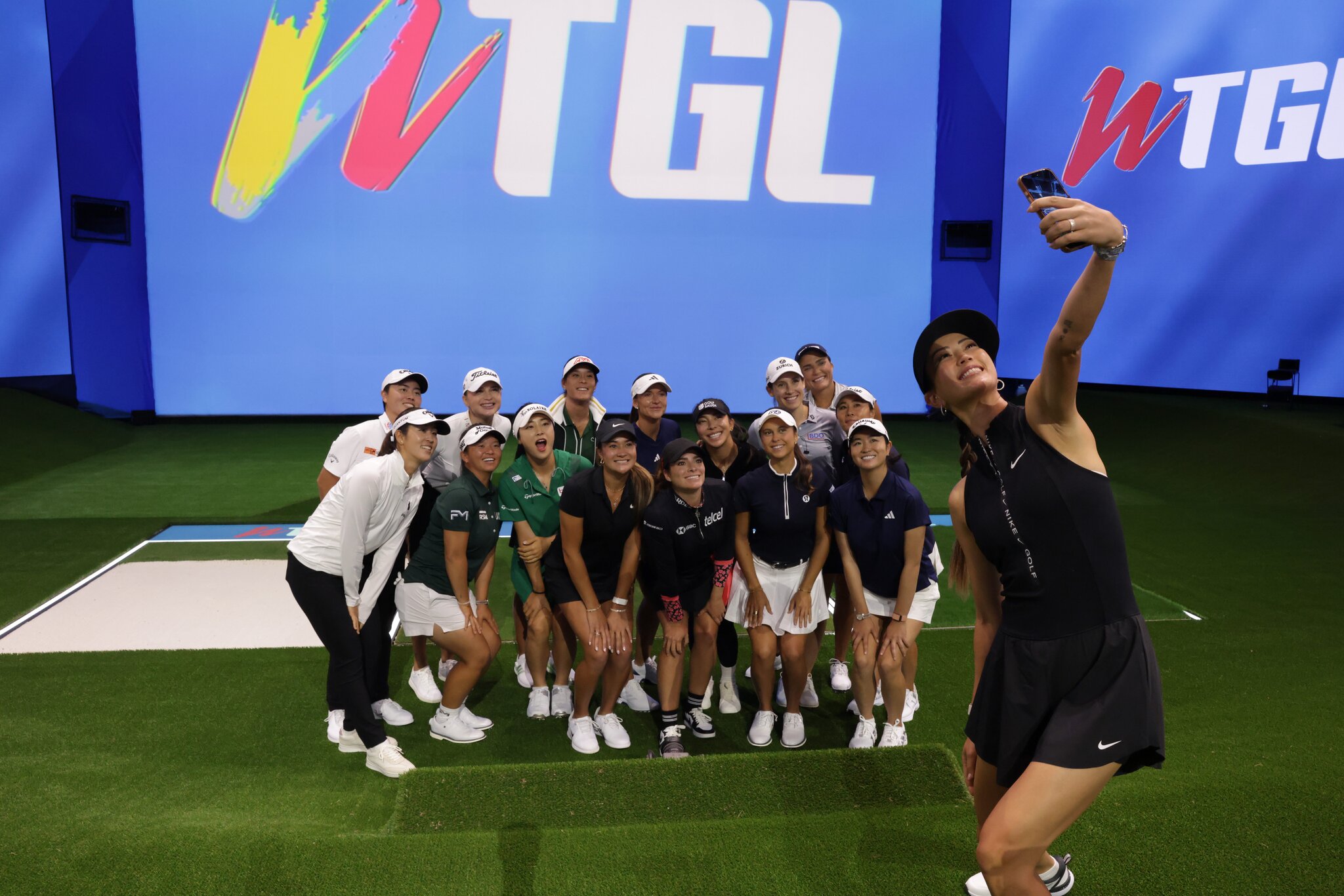
Hack said he'd caught part of that morning's practice session and had already seen the team format doing something he didn't expect this early: real camaraderie forming among players who'd normally compete as individuals. That enthusiasm was evident later in the day as well, when Michelle Wie West took a selfie with 15 other players in the upcoming league.
‘So Much More Headroom’
Asked what's surprised him most since taking the job, Hack pointed to the growth ceiling rather than the numerous challenges that come with running multiple professional leagues. TGL grew significantly from season one to season two, he said, and TMRW is betting on similar growth into season three — but even at current levels, he said the headroom for both TGL and WTGL feels larger than expected. The job now, as he put it, is staying "bold and ambitious" about how far the properties can go.
“It's probably the level of opportunity that we have to continue to grow TGL and WTGL in a non-linear fashion,” Hack said. “Even at the levels we're at now, it feels like there's so much more headroom to go further.”

One last thing... Jimmy Roberts
Baseball’s regular season comes to an end this week … I’m a Mets fan—no snickering, please—so once again, it’s been a year that’s bounced back and forth between constant disappointment … and abject misery. But as this team I’ve rooted for since I was seven years old plays a role of utter insignificance these closing weeks, there has been one thoroughly compelling storyline.
Howie Rose … the radio voice of the Mets for 20 years, and part of the broadcast team for even longer … is retiring.
If you’re a baseball fan—no matter how good or bad your team is—your radio guy … or gal … is a special person; baseball is a LONG season, and you spend a LOT of time with the person who narrates your often-times misguided passion … it actually works out to somewhere around 17 or 18 full days in the car or at the beach or on a walk. You get to know that person. They become a part of your life.
The thing with Howie, though, is that if you are a Mets fan, you understand one thing primarily … he is us.
He was a passionate Mets fan since the franchise’s very first day when he was a kid growing up in Queens. No one could be more authentic … or freakishly encyclopedic about its history.
He’s also an extraordinary broadcaster. Technically, he’s a complete stud.
But as Howie’s career comes to a close, the thing that has struck me is the tone of what you hear from all those who have risen to celebrate him. A chorus of people talking about how supportive he’s been to young broadcasters—how helpful.
That should really count for something in this day and age, so often bereft of kindness.
So he’s not only really good at what he does … but he’s gone out of his way to be a good man.
Even if you’re not a Mets fan … that sounds to me like someone worth celebrating. As Rose himself would say: “Put it in the books!”
.jpeg)
Become a member
*Available for a limited time only, subscribe to our twice-weekly newsletter for a discounted rate of $150 for your first year. Subscription renews at annual rate of $175 at the end of the first year.
Purchase Disclosure
By completing your purchase, you agree to enroll in an annual subscription to The Big Swing – Inside the New Golf Economy at the current rate of $150 for the first year (founding member offer). Your subscription will automatically renew annually at $175/year unless canceled prior to the renewal date.
You may cancel at any time through your account settings or by contacting customer support. All sales are final and non-refundable except where required by law.
Offer valid for a limited time and may not be combined with other promotions. Limit one per customer.
By subscribing, you agree to our Terms of Service and Subscription Terms.