
August 13, 2026
The Big Swing: Inside the new golf economy
Could we see live golf on Apple TV before we get Season 2 of Owen Wilson’s “Stick?”
The tech giant is in conversations with the R&A about acquiring the U.S. rights to the Open, per a report from The Guardian. NBC Sports has held the Open’s live rights since 2017, but that deal expires in 2028. Apple TV will also have some extra cash after agreeing to terminate its 10-year, $2.5 billion deal with Major League Soccer three years early in 2029.
MLS’ disappointment clearly hasn’t dampened Apple’s sports goals, however. The Open would add to its newer five-year, $750 million Formula One agreement in the U.S.. We’ll definitely be keeping an eye on this media cycle for the R&A’s rights.

This and that...
Two operators explore different roll-up theses
Walden Golf acquired Baytree National Golf Links, a Gary Player Signature Course on Florida’s Space Coast — the company’s second acquisition this summer after July’s $57 million purchase of three Phoenix-area clubs. The Walden Golf/Pinnacle Golf Properties partnership, which handles operations under a recurring structure, has now added more than 32 facilities to their combined portfolios since 2023. Founder Steven Schorr framed the strategy as focusing on areas where there’s demand for golf (like Arizona, North Carolina and Florida). Last month, GreatLIFE Golf took the opposite approach, adding River Run Golf Club in Berlin, Maryland (its 21st owned or leased facility, expanding a 54-course portfolio) and explicitly framing its strategy as hunting “underperforming golf facilities in growing markets.”
Our take: It’s the same asset class but opposite risk profiles. Walden is paying up for already strong, established properties in golf-demand markets and betting scale plus a dedicated operating partner sustains them. GreatLIFe is buying underperformers for cheap and betting its own operational playbook can turn them around.
Trackman deepens its LPGA footprint with a Solheim Cup role
Technology company Trackman is the latest official partner of the 2026 Solheim Cup (Sept. 7-13, Bernardus Golf, Netherlands), joining a sponsorship roster that includes PING, Skyscanner, Rolex, John Deere and Adidas. Trackman is already the technology partner behind the LPGA’s broader 2026 broadcast overhaul, where its shot-tracing capability was quadrupled from 2025 levels as part of the Tour’s move to full live coverage across every event. CEO Klaus Eldrup-Jørgensen called the Solheim Cup role a chance to "help bring even more precision, insight, and engagement to one of golf's most compelling international competitions."
Our take: This reads to us like Trackman working to build out end-to-end infrastructure across the LPGA ecosystem – broadcast tech, shot-tracing data, and now marquee-event visibility under one relationship. It’s a good time to enter the Solheim Cup – for an event that’s largely lived in the shadow of the Ryder Cup, the 20th edition marks the first time either event will take place in the Netherlands, and the 2026 event is the first run by IMG under a deal running through 2038.
.jpg)
Does the PGA Tour’s $30 Million Sponsorship Math Actually Work
As the Tour splits into two tiers for 2028, brands are being asked to pay two to three times more for a product that’s still being built. Industry veterans on both the media and brand sides have real doubts.
August 13, 2026
Mollie Cahillane | mollie@bigswingmedia.news
As the Tour splits into two tiers for 2028, brands are being asked to pay two to three times more for a product that’s still being built. Industry veterans on both the media and brand sides have real doubts.
If a brand has $30 million to spare, it could sign on as a title sponsor for the PGA Tour’s new Championship Series — two to three times what brands pay today, against purses starting around $20 million. We put the question to two industry veterans this month, separately, without either knowing what the other said: Does the math actually work? Neither gave us a clean yes.
“When you’re talking about going from $10 million to $15 or $20 million, that’s a normal step up,” one sports marketing executive who has negotiated sponsorship deals from the brand side told Big Swing Media. “But when you start talking about going from $10 to $20 to $30, that’s a lot.” In an era where every sponsor has to justify spend with measurable ROI, “it’s bigger and better” isn’t a pitch that closes on its own anymore, said the executive.
The structure, quickly
As a reminder, beginning in 2028, the Tour splits into two tracks. The Championship Series will feature roughly 23-24 events — the four majors, The Players, a reimagined postseason, and an international team event — running February through August. The Challenger Series runs concurrently as the pathway up, with promotion and relegation built in: Stay inside the top 90 and you carry over; finish outside it and you can be bumped down. Which specific events land in which tier, and how sponsors currently under contract get folded into the new system, are still being worked out. That uncertainty is central to the calculations happening behind the scenes, and shapes how Fortune 500 companies weigh the risk vs. reward.
The bull case
Both sources agreed the Tour is selling clarity. Under the old signature events model, brands didn’t always know a year out whether their event would be elevated or dropped. A formal tier removes that guesswork, and it’s a page straight out of Commissioner Brian Rolapp’s NFL background: fewer, bigger, better events, engineered scarcity, a guarantee that the best players show up and the leaderboard means something.
“I actually think the sponsors of the Championship Series are going to be in far better shape than the current Tour sponsors,” said a former network ad sales executive who has advised leagues and sponsors. “The ones I worry about more are the Challenger Series sponsors because I'm not quite sure you're going to get a lot there, and you're already seeing a couple of them waver or let their sponsorships go.”
Sponsor Snapshot
Where things stand: sponsors, confirmed and in flux
Confirmed 2028 Championship Series events (6 of ~23-24 announced)
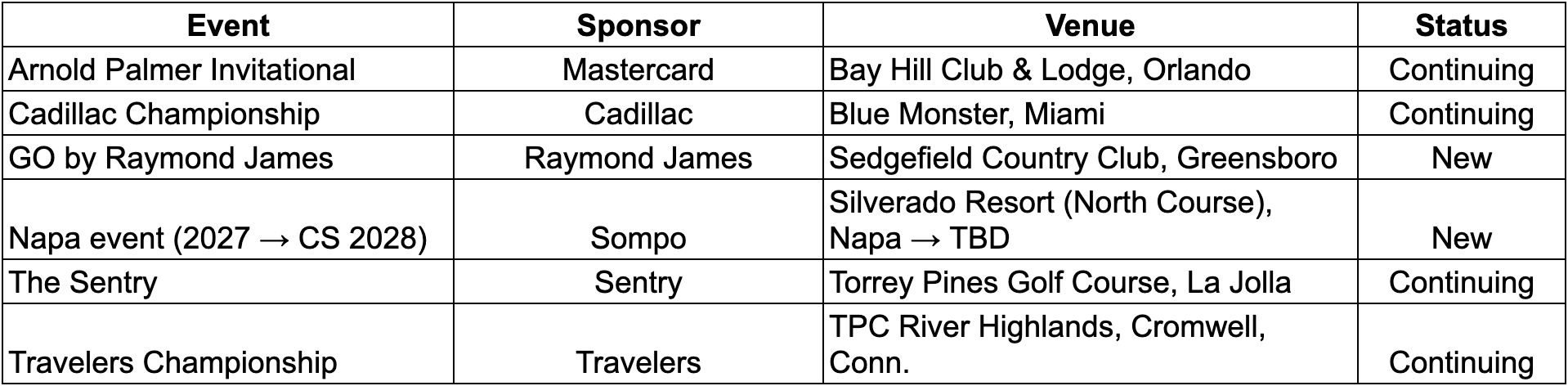
Also included automatically: The Players, the four majors, Olympic golf, the Presidents Cup (not individually sponsor-announced). Full schedule due early 2027.
The math problem
Justifying a 100% price jump requires the Tour to show value beyond the tournament itself, as a one-week buy alone doesn’t obviously clear $30 million.
“Any brand that's involved needs to make sure that there are some levels of guarantee or clarity on how much bigger it is, so that they can do the math,” said the former network executive. “Is it worth it or not? My suspicion is it is — there aren’t that many big events in sports that you can buy into with an audience the quality of PGA Tour golf.”
Both sources pointed to a few possible levers: the Tour has loosened its social media policy to let players create more content after lagging badly on social engagement; there’s a Tour-run content operation (PGA Tour Studios) that brands could plug into year-round rather than only utilize airtime during one event week; and for at least one new sponsor, there may be a business-development angle layered on top of straight media value.
“Having access to creating content, short-form and long-form, that these brands can then embed themselves within, and then distribute both socially and perhaps through streaming platforms,” said the former network executive. “Obviously, it's not live content, but it's content around the edges. I think that's really important too for these brands to be able to amortize their overall costs.”
Who’s actually exposed?
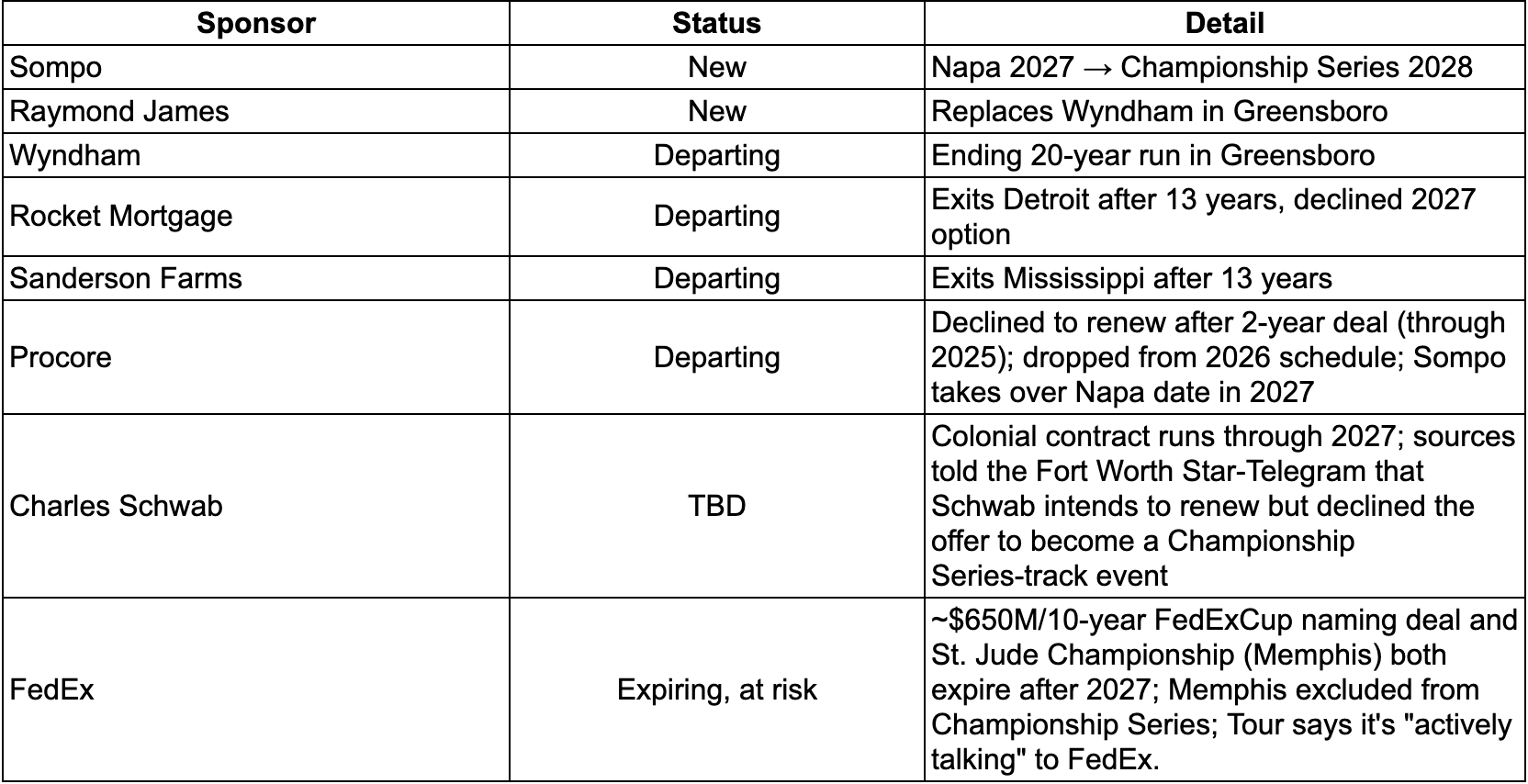
The turnover already underway provides a glimpse into some sponsors’ thoughts. Wyndham Hotels & Resorts is ending a 20-year run as the Greensboro title sponsor; Raymond James is stepping in on a new deal that graduates the event into the Championship Series in 2028. Rocket Mortgage’s 2026 Detroit event was its last after 13 years, and Sanderson Farms pulled its Mississippi sponsorship after 13 years. Sompo, a Japanese insurer, has signed on to sponsor a Napa event debuting in 2027 that moves into the Championship Series in 2028 — taking over the Silverado date after Procore declined to renew and the tournament was dropped from the 2026 schedule entirely.
Charles Schwab is a different case: its Colonial title sponsorship runs through 2027, and sources told the Fort Worth Star-Telegram that Schwab intends to stay. The company was apparently offered the chance to become an elevated, Championship Series-track event and turned it down, undercutting the industry assumption that Schwab wanted top-tier status but can’t justify the spend.
FedEx’s deal—the Tour’s biggest corporate partner—expires in 2027, as well as its sponsorship of the FedEx St. Jude Championship, which makes this week’s event its second-to-last as a postseason event. The PGA Tour confirmed last week that while Memphis (home of FedEx’s corporate headquarters) remains a target market, the city will not host a Championship Series event.
Rolapp previously said that the Tour hopes “to create more value for FedEx and everybody else,” and that the company’s current contract would be honored. Last week, FedEx issued a statement saying it's "disappointed" but "encouraged" by talk of other opportunities for the market — likely meaning a Challenger Series slot, where sponsorship would run $5-15 million instead of the $20-30 million top-tier price point.
"For nearly 40 years, FedEx and the PGA Tour have partnered to create unforgettable moments for golf fans while making a meaningful impact in Memphis and through St. Jude. As we look ahead to this week's FedEx St. Jude Championship and the start of the 2026 FedExCup Playoffs, we are focused on delivering an exceptional experience for fans, players and the Memphis community,” the PGA Tour and FedEx said in a joint statement to Big Swing Media. “While discussions about the future continue, both organizations remain focused on the broader FedEx-PGA TOUR partnership and the opportunities to build on a relationship that has successfully evolved for decades."
Set against that is a broader worry: Does pushing toward fewer, more expensive deals price out the midsize brands who used to fit comfortably into golf sponsorship? Both executives expect national brands to gravitate toward the Championship tier for the eyeballs, while the Challenger Series could become a better fit for regional or locally headquartered sponsors — think the John Deere-in-Illinois model, more tied to a specific market versus a national audience.
What does a smart brand negotiate for?
From the ad sales side, sponsors paying up should be asking for more of everything proportional to the price jump — bigger on-site activation rights, real ratings guarantees, and assets that extend past the single event week. The advice from the brand-marketing side was about deal structure: This is a fundamentally unproven inventory, so push for shorter initial terms with performance-based escalators — prove the value over three years, then let pricing step up — rather than locking into a five-to-10-year deal at full price on faith alone.
“[Leagues] tend to self-inflate what they have because of the confidence they have going into this change,” said the sports marketing executive. “Because of that confidence, you tend to overprice. This happens all the time in media negotiations with advertisers and networks, right? You go in there, and your CPM [cost per thousand impressions] is too high. You're asking too much in the upfront, and you get agencies that just say, ‘Forget it. No, we're not even talking to you. We're done.’ If that happens, and while you think you're playing for a position of strength in that waiting period, things start to slide. You're losing opportunity.”
The media rights ripple
PGA Tour media partners including CBS, NBC and ESPN will need clarity on which events land where well before the upfronts, since premier events command higher ad rates — both sources (and we at Big Swing Media) expect this to be a bigger topic at the upfronts than in past years. It’s extremely likely that the media partners are going to market with golf as part of a larger sales package, and cross-guaranteeing across tiers, already a common cross-sport practice, is also likely.
“This Challenger Series is just yet another source of sports rating points that goes into the advanced algorithm planning that they do,” said the ad sales executive. “The tiering essentially creates a very formal pricing ladder that just didn't exist before, and that's a good thing. But on the Challenge series, lower cost, lower exposure isn't necessarily a great thing.”
Once the broadcast schedules shake out, expect real scrutiny from the networks: If the aggregate inventory they're getting turns out to be worth less than what they're currently paying for, they'll push back — on price or on other terms — since, as one source put it, the Tour "is never going to give money back" once it's been given. “The networks might have some leverage to do something different or extend their deal, but there’s going to be a lot of scrutiny by the networks after the series are set and they know what they’ve got. If it’s more, great, certainly they’re not going to pay more money.”
The Rolapp bet
It’s obvious to those in the sports media world that Rolapp is running his NFL scarcity playbook on golf — and one source flagged an unresolved tension in doing so: The NFL's strategy leans on marquee media markets, but golf's best venues aren't in major cities. A New York viewer will watch a great field in North Carolina regardless of geography. Whether that “major markets matter” logic even applies to golf is still an open question. The other risk circles back to confidence, with leagues assuming demand will follow the new tier, only to watch buyers walk to competitors while they wait for the market to come around.
As the former ad sales executive put it, Rolapp’s PGA Tour strategy is “vintage — build scarcity, build excitement, and people will pay for it, and it'll be worth it." Whether that logic transfers cleanly from professional football to golf remains to be seen over the next 18 months.
“The underlying part of the story is really all about Rolapp and the changes he's willing to make, where he's cut his teeth and why he believes so firmly that this is all the right way to go,” said the former network executive.

One last thing... Jimmy Roberts
Nobody Gets It All
You may recall we recently had John Smoltz and Steph Curry on the show. One’s a Hall of Famer … the other is clearly headed there.
AND … they both are—or have been—scratch golfers … at times even better than that!
It’s kind of amazing, right? People are so good at ONE thing … who seem so effortlessly good at something ELSE … this as the rest of us struggle with just “the ONE thing.”
It doesn’t seem fair.
But that’s life. Wasn’t it enough that Frank Sinatra could sing the way he did? Then he had to go out and win an Oscar for acting?
Here is the plain fact: These people are just different than us.
Did you know Jack Nicklaus originally went to Ohio State with the understanding he was going to play basketball …
Nicklaus said he probably would’ve sat on the bench, but when the starters on that team—which, by the way, won an NCAA Championship—included Hall of Famers Jerry Lucas and John Havlicek … it doesn’t exactly make Nicklaus a poser.
Before she crushed it in golf … including three U.S. Women’s Open titles … Babe Didrikson won a pair of Olympic gold medals in track and field.
Jackie Robinson? He lettered in four sports … baseball, basketball, track, and football at UCLA.
It’s a LONG roll call of these “multi-tool” players … Thorpe and Sanders and Jackson … but as much as talent made them different, you could argue that it was actually attitude … a relentless dedication … that allowed them to accomplish what they did. If you’ve spent any time around Curry or Smoltz, that would seem undeniable.
There’s a lesson here, though, for the rest of us plain folks: We might never accomplish the kinds of things these special people have … but if we take a page from their playbook, maybe we can find the best versions of ourselves.
Oh, and the model doesn’t always hold true: Bob Dylan is one of my all-time favorites … arguably the best songwriter of our generation. But his singing?
Ehh.
A reminder that nobody gets it all.
Past Briefs

Monthly and Annual Membership Options Available.
Member Pricing
$9.99 per month, OR $99 for one year.
Cancel Anytime.
Available for a limited time only, subscribe to our twice-weekly Golf Business Intelligence Brief for a discounted rate of $9.99/month or $99/year. Subscription renews at the same price each month or year, depending on the subscription selected.
Purchase Disclosure
By completing your purchase, you agree to enroll in a monthly or annual subscription to The Big Swing Golf Business Intelligence Brief at the current rate of $9.99 a month or $99 a year.Your subscription will automatically renew monthly at $9.99 or annually at $99 unless canceled prior to the renewal date.
You may cancel at any time through your account settings or by contacting customer support. All sales are final and non-refundable except where required by law.
Offer valid for a limited time and may not be combined with other promotions. Limit one per customer.
By subscribing, you agree to our Terms of Service and Subscription Terms.