
August 6, 2026
The Big Swing: Inside the new golf economy
Our Brooklyn-based reporter Mollie Cahillane put more than 200 miles on her new Subaru this week traveling between New York City and LIV Golf New York (which, like the World Cup’s New York New Jersey Stadium, is located squarely in New Jersey).
The commute was worth it, especially given the last-minute addition of LIV Golf CEO Scott O’Neil to Tuesday’s media plan Monday night, a sign of how quickly the league’s announcement of a new investor came together. Eric Trump, who manages the Trump Organization’s golf portfolio, was on the ground at Trump National Golf Club Bedminster on Wednesday, and his father is expected to attend the event this weekend, a source confirmed to Big Swing Media.

This and that...
Callaway posts a clean beat and gets a tariff break
Callaway Golf reported Q2 2026 revenue of $612.6 million on Tuesday, up 2% year-over-year and ahead of forecasts, with adjusted EPS of $0.39 against analyst expectations of $0.35 and adjusted EBITDA up 36% to $125 million. Golf ball revenue grew 15%, pushing U.S. market share to a record 23%-plus. The company also revised its full-year tariff cost estimate down to roughly $43 million after new Section 301 tariffs landed at 10-12.5%, rather than the 20% it had budgeted for — making the company now in line for close to $50 million in total refunds across three tariff phases. Callaway raised full-year EBITDA guidance to $246-260 million and finished the quarter debt-free after paying off $1.4 billion, ending in a net cash position. Shares dipped slightly after-hours anyway, though they remain near a 52-week high.
Our take: We’re looking closely at the tariff line — a $7 million-plus swing from budgeted to actual exposure, plus refunds still working their way back, shows how much margin volatility in golf retail right now is being driven by trade policy rather than consumer demand.
Troon buys its way to an even bigger golf management footprint
Troon, already the world’s largest golf and hospitality management company with 900-plus locations across more than 45 states and 35-plus countries, acquired Bobby Jones Links, an Atlanta-based club management firm running 34 facilities in 13 states. Terms of the agreement weren’t disclosed, but the company will continue to operate under its current branding and its co-founders, Whitney Crouse and Steve Willy, will stay on as CEO and COO. It’s Troon’s 13th acquisition since 2018.
Our take: Troon wasn’t necessarily interested in Bobby Jones Links for its name recognition, but instead the 30-plus management contracts and the relationships behind them. If Troon continues with its rapid pace of consolidation, it may run out of independent multi-course management companies to buy.
Shot Scope ditches the subscription model for GPS
Golf technology company Shot Scope launched an Apple Watch app offering hardware-free on-course GPS, shot tracking and over 100 tour-level statistics for a one-time $149.99 payment rather than a recurring fee — undercutting rivals that can run $300-500 over five years on a subscription basis. The app also serves as a gateway into the wider Shot Scope ecosystem, giving golfers access to a suite of free features on the mobile app and web dashboard designed to lower scores.
Our Take: It’s a product launch building on the brand’s LM1 Launch Monitor debut earlier this year at the PGA Show, but it’s also a direct shot at the golf-tech subscription model broadly. Shot Scope is betting that owning the device (or in this case, the software) outright is a stronger pitch to price-sensitive recreational golfers than the SaaS-style pricing most GPS and analytics apps have converged on.
Golf LIV-es to Fight Another Day
The league will remain on Fox after securing an unnamed lead investor
August 6, 2026
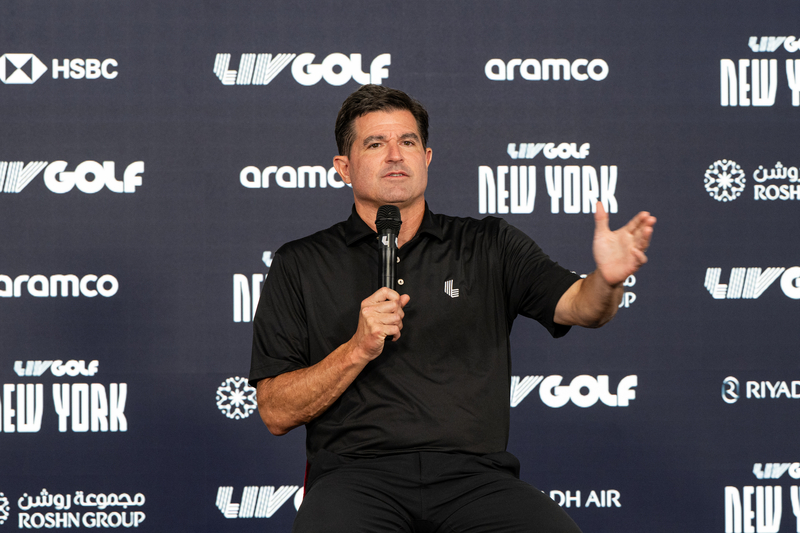
BEDMINSTER, N.J. — LIV Golf is staying on Fox Sports after the league secured a new investor to carry it into 2027 and beyond, LIV CEO Scott O’Neil told The Big Swing in a conversation after Tuesday’s press conference in Bedminster.
It’s a simple answer to one of many questions following O’Neil’s announcement that a lead investor has signed a term sheet — already approved by LIV’s board — “which will carry and fund LIV going forward.” Of everything left unresolved about LIV’s future — who the investor is, how much they’re putting in, and whether the Team Championship will take place in Detroit in a few weeks — the media rights deal is one asset outsiders can see and measure.
Fox Sports declined to comment when reached by The Big Swing.
An investor of weight
The topline news from Bedminster was the term sheet itself, which O’Neil called “very good news.” In a statement accompanying the announcement, he framed the lead investor as the anchor of a broader syndicate, not the whole solution: "We're also seeing strong interest from more than a dozen additional parties to potentially serve as minority investors, creating a multi-partner model built for long-term stability and growth."
Beyond that, he gave reporters almost nothing. When asked directly about the investor's identity and the size of the commitment, he said the league is "keeping the details of the deal, the investor, and much of what you might want to know in this second phase out of the media,” while also describing the party as an “investor of weight.” Asked when a definitive agreement would be signed, O’Neil confirmed only that a timeframe has been agreed internally without naming it. In a statement following his comments, O’Neil said the league intends to enter a transaction in September, likely tied to the roughly $300 million LIV has been seeking since the Saudi Public Investment Fund confirmed in April it would stop funding the league after this season.
When asked point-blank whether a finalized deal means a 2027 season, O’Neil responded: “And ‘28 and ‘29 and ‘30,” the clearest runway LIV has offered publicly since the PIF news broke.
O’Neil was similarly candid about what the new capital buys the league structurally: LIV will become majority player-owned, which he described as unprecedented “in the history of sports.” Players are being walked through equity and vesting for the first time, and the league is returning some NIL rights to them as part of the arrangement. That framing does deserve a caveat: Professional Bull Riders was founded in 1992 by 20 riders who each put up $1,000 to build an athlete-owned tour. It stayed fully rider-owned before Spire Capital Partners acquired a majority stake in 2007, and what was then WME-IMG bought the tour outright in 2015.
The more precise version of O’Neil’s claim: an outside investor granting majority equity to players already competing in an established league, through a recapitalization rather than a founding round — a mechanism PBR’s riders never needed, since they built their tour themselves.
The Fox problem
LIV’s Fox Sports deal, signed in January 2025, hasn’t been a ratings juggernaut for the media company. The league averaged 338,000 viewers across 17 Fox telecasts in its first season on the broadcast network, with cable windows on FS1 and FS2 mostly drawing under 100,000 viewers.
This year’s Riyadh opener drew an average of 23,000 viewers over four days on the two cable networks and Fox Business, barely above the 19,000 it drew over three days the year before. For comparison, the final round of the PGA Tour’s RBC Heritage on CBS drew 4.36 million viewers — roughly 190 times the 2026 Riyadh average, and roughly 13 times LIV’s season-long average across all 17 Fox broadcasts. Fox’s rights fee to LIV has been described in reporting as “modest,” with the actual dollar figure never disclosed.
Fox’s own promotional materials reflect that seemingly low priority. The company’s PressPass properties page, which lists every league and event Fox actively markets to press and advertisers, includes college basketball, college football, the World Cup, IndyCar, MLB, NASCAR, the NFL, NYRA horse racing, soccer and the UFL. LIV Golf isn't publicized on the page, even though the deal is active and, according to O'Neil, isn't going anywhere.
Given that track record, a new investor group could have had every reason to treat the Fox deal as a renegotiation point, or even as an exit ramp toward a cheaper streaming-first model (the kind of move a lot of struggling media properties make when ratings don’t justify the linear-TV overhead).
The new money appears aimed at stabilizing what’s already built — media rights deal included — while the more urgent work like closing the investment, sorting out the Michigan event, and retaining stars like Bryson DeChambeau and Jon Rahm plays out elsewhere.
The bigger picture
None of this resolves a major underlying issue for LIV: a media deal with weak ratings and an undisclosed, likely modest rights fee that was never going to be the mechanism that closes a roughly $250-to-$350 million funding gap — the amount LIV has reportedly been seeking since the PIF, which had put an estimated $5 to $6 billion into the league since 2022, confirmed it would stop funding LIV after this season.
Staying on Fox won't meaningfully move LIV's revenue line either way, but it likely signals to players, partners and its own new investor that at least one part of the business is staying put.
[Editor's note: LIV's comments to The Big Swing on its Fox Sports deal were made in a pull-aside conversation following Tuesday's press conference and are paraphrased, not a direct quote.]

One last thing... Jimmy Roberts
Never Too Late
The road to success – at any age – is paved with hard work and belief.
I know I’m inviting disaster by saying this, but I’m playing the best golf of my life. Over the last few years I’ve steadily gotten better. I guess it makes sense: I’ve taken the game a little bit more seriously in recent years, and I’ve also taken it as an article of faith that my best days are ahead.
But let’s be real here: Even though I think of myself as young – which I suppose I am in relation to some others – the (sad) fact is I know fewer and fewer of the words to popular songs these days, and I couldn’t even imagine playing golf without popping a few Advil.
The dark realization that I may have been deluding myself about what lies ahead for me in the game was very depressing – until I considered my friend David Novak and his life in golf.
In July, he became the oldest person ever to win the club championship at Shinnecock, taking down a two-time champion in the final who was 22 years his junior. A couple of weeks later, he finished birdie-eagle across the street at National to shoot his age – 69.
"I had 10 days of Walter Mitty golf," he says.
Well, yes and no. David is a 1.2 Index, and it’s not exactly shocking for people with that type of credential to win a club championship. But as the great broadcaster Paul Harvey used to say: Now – the rest of the story.
Novak, the son of a government surveyor, lived in 23 different states by the time he was in seventh grade and didn’t really take up the game seriously until he was 40. He had just moved to Wilton, Conn., to run sales and marketing for PepsiCo and joined Silver Spring Country Club.
"I was only allowed to play once a month," he says, "so I spent all my time on the range. That first summer I couldn’t get the ball off the ground. It was terrible."
Although he slowly improved, Novak’s handicap still languished between 10 and 12 for a few years. "I practiced so much," he says, "I thought I should have been better."
When he became CEO of YUM Brands, he found himself traveling more and practicing less: not exactly a prescription for improvement.
"I went out to play in the AT&T one year at Pebble Beach," he says, "and I bet I shot 120 – or at least it felt like that. I wanted to quit the game."
The Pivot Point
The pivot point came when he started working a few years ago with Jason Goldsmith – not a golf professional, but a performance coach who helped him with his "process." Among other things, he helped him to stop being “outcome focused.”
"I was thinking about what I wanted to happen instead of thinking about what I needed to do to make it happen."
Splitting his life into three parts – family, work, and golf – he committed to the third element with the same kind of passion he had for the first two, and seemingly always with an instructor by his side. "I’m a golf professional’s dream," he says. "I hate hitting balls alone."
The Shinnecock championship was a fairy tale. When his grandchildren (how many club champions are old enough to even have grandchildren?) asked if they should “go watch Ogo” – that’s what they call him – his wife Wendy, who’d been battling health issues, sent them off to the July 4th parade.
"You guys go," she told the kids. "I’m gonna go watch my man."
"When I won, everyone was crying," Novak says. "My wife, my daughter, I even think Silas (Anthony, his opponent) was crying."
So how did a guy who grew up playing baseball and was the 13th seed in the tournament get “paint on the board” at one of the most famous golf clubs in the world?
"It’s about the questions you ask yourself," says Novak, who these days is a celebrated author and podcaster and has made a second career out of examining leadership. "It’s not about: am I ever going to reach my potential? It’s gotta be about: how am I going to reach my potential? Then you have to work hard – really hard – and put your ego aside. You can’t worry about what other people think."
In the end, it’s simpler than you might think:
“You become what you think you are.”
To me, David’s journey is fascinating – because it’s remarkable, but also because of something much more important.
It gives all of us hope.
Essay originally published in The Met Golfer, November/December 2022. Special thanks to the Metropolitan Golf Association.
Past Briefs


Become a member
*Available for a limited time only, subscribe to our twice-weekly newsletter for a discounted rate of $150 for your first year. Subscription renews at annual rate of $175 at the end of the first year.
Purchase Disclosure
By completing your purchase, you agree to enroll in an annual subscription to The Big Swing – Inside the New Golf Economy at the current rate of $150 for the first year (founding member offer). Your subscription will automatically renew annually at $175/year unless canceled prior to the renewal date.
You may cancel at any time through your account settings or by contacting customer support. All sales are final and non-refundable except where required by law.
Offer valid for a limited time and may not be combined with other promotions. Limit one per customer.
By subscribing, you agree to our Terms of Service and Subscription Terms.