
July 16, 2026
The Big Swing: Inside the new golf economy
Whether you call it The Open, The Open Championship or The British Open, this week is one of the most historic and prestigious in the game of golf.
First played in 1860, The Open is the oldest golf tournament in the world. As the game’s best tee off at Royal Birkdale in England vying for the iconic Claret Jug, this week we take a look at how the golf industry is growing and diversifying.

This and that...
Mollie Cahillane & Michael LoRé
American Century Championship draws largest audience since 2004
The American Century Championship delivered the largest final round audience for the celebrity golf tournament since 2004, averaging 1.5 million viewers on NBC and Peacock, according to official Nielsen Big Data + Panel and digital data from Adobe Analytics. Not only was it the event’s largest TV audience in more than two decades, but a record 86,038 spectators attended the 54-hole event played July 10-12 at Edgewood Tahoe Golf Course in Lake Tahoe. Combined Saturday and Sunday coverage averaged 1.3 million viewers on NBC and Peacock—the best weekend viewership for the event since 2006, and up 44% from last year.
Our take: We touched on the popularity of the ACC and the business benefit it provides NBC Sports, which owns, operates and produces the event, it originally launched as a programming replacement during MLB’s labor strike in 1990. Golf’s unprecedented popularity, crossover appeal and mainstream acceptance is certainly paying dividends as audiences are keen to watch athletes and celebrities like three-time winner Mardy Fish, Annika Sörenstam, John Smoltz, Steph Curry, and Nate Bargatze tee it up. If this doesn’t speak to how much golf has grown, I don’t know what does. Coincidentally, we dive into the game’s growth and diversification in today’s feature.
Bryson DeChambeau hopes new 3D-printed irons solve major struggles
Bryson DeChambeau is debuting 3D-printed irons this week at the 154th Open at Royal Birkdale. The two-time U.S. Open winner utilized a single 3D-printed 5-iron at The Masters, where he missed the cut by two strokes after shooting 76-74. Nicknamed “The Mad Scientist,” DeChambeau continues to tinker with his clubs as he searches for success at majors in 2026 after also missing the cut at the PGA Championship (76-71) and U.S. Open (70-75). DeChambeau, who said it takes about nine irons to 3-D print an entire set of irons, confirmed his new clubs have been approved by the USGA.
Our take: It wouldn’t be a major championship if DeChambeau didn’t tinker with his bag setup. Honestly, can you blame him? Golf’s most polarizing personality is stuck in a precarious position as he balances his growing YouTube fame and fandom while trying to remain competitive at the game’s highest level. Needless to say, he’s finding more success with the former as his major struggles have been met with plenty of criticism. Golf Channel analyst Brandel Chamblee recently criticized the LIV Golf star’s priorities, saying: “It's almost like he went from chasing Scottie Scheffler and Rory McIlroy to chasing Grant Horvat. It's like he wants to outdo every YouTuber in the game of golf instead of outplay everybody in the game of golf." Could 3-D printed irons bring Bryson back into contention? We’ll find out Thursday and Friday.
The Open prize purse increases by $75K but still trails other three majors
The prize purse for the 154th Open has been increased by $75,000 from the 2025 edition bringing this year’s total to $17.75 million. While it seems like a gaudy number, it pales in comparison to golf’s other three majors as The Masters ($22.5 million), U.S. Open ($22.5 million) and PGA Championship ($20.5 million) all increased their purses by at least $1 million for this year.
Our take: There’s more money in professional golf than ever before. That’s obviously great for the players, though some, including Cameron Smith, who signed a reported $140-150 million contract with LIV Golf in 2022, have spoken out that there’s potentially too much money and the bubble may soon burst. The R&A, organizers of The Open, seem to have a similar sentiment as they weren’t keen to significantly increase the prize purse in a financial arms race with the other majors, PGA Tour signature events ($20 million prize purse each) or LIV Golf, which has paid out $32.3 million in prize money at each event this year. “Prize money is but one component of that comparison,” said Mark Darbon, CEO of The R&A at his pre-tournament press conference. “At the same time, we’re trying to find a model that gets the balance right.”
Golf’s Growing Demos Galvanized by Authenticity and Community
Brands like Eastside Golf, Buena Gente Golf, Malbon Golf, Students Golf, and Paré Golf aren’t only speaking to the game’s growing demographics, they’re speaking for them.
July 16, 2026
Michael LoRé | mlore@bigswingmedia.news
Brands like Eastside Golf, Buena Gente Golf, Malbon Golf, Students Golf, and Paré Golf aren’t only speaking to the game’s growing demographics, they’re speaking for them.
Stephen Malbon sat in the clubhouse at The Preserve Golf Club in Carmel, Calif., discussing the inspiration behind The Crosby Collection, a 2024 limited-edition apparel and footwear capsule launched by adidas and Malbon Golf inspired by Bing Crosby’s popular Clambake event.
Begun in 1937, the Crosby Clambake would bring together musicians, actors, celebrities and pro golfers including Dean Martin, Paul Newman, Sam Snead, Bob Hope, Jack Lemmon and Ben Hogan for a competition around the sport they all love.
To celebrate the launch of The Crosby Collection, Malbon, the lifestyle brand inspired by golf launched in 2017, and adidas hosted a modern-day Clambake in January 2024, bringing together the likes of Josh Allen, ScHoolboy Q, Metta World Peace, Harry Crosby, Kader Sylla and Tania Tare for a day of golf competition, community and celebration on California’s Monterey Peninsula.
The diverse, star-studded lineup wasn’t done as a flex, it represents the game’s present and future.
“If you’re a golfer, you’re a fan of the pros and you follow them, but they’re not getting new people who aren’t golfers to pay attention,” Malbon told me that evening. “Tiger (Woods) did, obviously, but Rory McIlroy isn’t getting a million people to start playing golf because he wins at Augusta. That’s not going to move the needle the same way.
“My son, Remington, he’s 12, and one of the biggest reasons he plays golf is because Michael Jordan plays golf. Steph Curry plays golf, too. He loves basketball. He loves wearing Jordans.”
While it’s hard to attribute how many people picked up golf clubs after McIlroy finally completed his career Grand Slam by winning The Masters in 2025—and defended his Green Jacket earlier this year—the impact of non-professional golfers’ passion for the game hasn’t only been measured, but it can be seen, heard and felt.
More than one-third of the U.S. population over the age of 5 (136 million) followed golf on TV or online, read about the game or listened to a golf-related podcast in 2025, according to the National Golf Foundation.
Not only is golf more popular than ever, but, more importantly, it’s cooler and more mainstream than ever.
The impact of CC Sabathia, Justin Timberlake, DJ Khaled, LeBron James, Mark Wahlberg, ScHoolboy Q, J.R. Smith, Curry and other famous non-golfer athletes and celebrities engaging with the game has shown oft-overlooked communities and demographics that the once traditional and intimidating game and culture where they rarely saw themselves is, in fact, for them and everyone.
According to the NGF, the 7.7 million Asian, Black and Hispanic golfers who played on a course in 2025 is a high-water mark for the industry, and their 26% representation among the 29.1 million on-course golfers in the U.S. is also a record high. Since 2019, there has been a net gain of nearly 2.9 million golfers of color, outpacing broader U.S. population diversification trends. There’s even greater diversity away from the course, with 8.5 million People of Color making up 45% of the 18.9 million Americans who exclusively participate off-course.
“Golf has become a lot more approachable now,” said Ray Maté, who has spent 25 years in the worlds of skateboarding, fashion and footwear building brands rooted in the streetwear community. “The reason why it’s more approachable now is because a lot of these pockets and regions are moving within their communities. If it’s not skateboarding, it’s fashion. If it’s not fashion, it’s some local guys like in the New York area there are a lot of Filipino golfers graduating from streetwear and transitioning into a similar community in the game.
“... The comfortability portion is very important and as we see golf move into a place where People of Color are elevating how the golf space looks, it’s making it appealing to the younger generation and women too.”
One of the most important aspects of comfortability and confidence in golf is associated with fashion. While the more traditional country club style still has its place in golf, the game is evolving and diversifying through streetwear-inspired fashion and influences encouraging authenticity, representation, culture and community.
Brands like Eastside Golf, Buena Gente Golf, Malbon Golf, Students Golf, Metalwood Studio and Paré Golf aren’t only speaking to the game’s growing demographics, they’re speaking for them.
Olajuwon Ajanaku originally launched Eastside Golf with friend and former Morehouse College teammate Earl Cooper in June 2019 as a way for Ajanaku to support his dream of playing professionally after he was unable to secure a sponsorship from an existing brand. He designed Eastside’s Swingman logo—a Black man mid-backswing in a hoodie, jeans and hat with a large gold chain—to resemble himself.
Not only did Ajanaku see himself in the logo, but so did others including President Barack Obama, Victor Cruz and Sabathia. It’s what’s helped Eastside Golf secure $3.4 million in seed funding in 2024 and partnerships with Mercedes-Benz, Nike, Shopify and State Farm.
“When people saw our logo, it didn't even matter what color they were or what race they were—they saw themselves,” Ajanaku told The Big Swing. “It’s just like, ‘damn.’ When you really break it down, it is a Black man playing golf wearing jeans and a sweatshirt with a gold chain and hat on with some white sneakers, but he’s playing golf. He wants to dress the way that he wants to, look the way that he wants to, but enjoy the game that he loves.
“A lot of people feel like, ‘I got to fit into this mold’ or ‘I got to be this certain type of person.’ … Making people more comfortable on the golf course was definitely something that we’ve done because making people feel like they have a chance to belong to the game being themselves is something that I didn’t grow up with.”
Due to the game’s barriers to entry at the grassroots level, particularly the high costs needed for success and advancement, the professional ranks lack diversity. Out of the approximately 400 card-carrying members on the PGA Tour in 2020, there were just four players with Black heritage. Of the 582 members of the LPGA and Symetra (now Epson) Tours, 55% were white, while just 2% were Black or African American.
The lack of opportunities for players of color in the U.S. can be traced to countless systemic barriers, including a “Caucasian-only clause” that existed in the PGA of America from 1934-61, which was part of the association’s bylaws preventing non-whites from membership and competing on the PGA Tour. Many prestigious clubs and courses were also selective in membership. Founded in 1932, Augusta National didn’t admit its first Black member until 1990 and its first female members until 2012.
Ajanaku said Eastside Golf purposefully doesn’t scream Black and diversity. Rather, it promotes being your authentic self, regardless of your race or ethnicity. It’s why their motto is “Be Authentic.”
“I almost felt like the logo gave a lot of people permission to be themselves,” he said.
Like Eastside, Jonathan Madera launched Buena Gente Golf in 2022 because he felt unseen and overlooked in the golf industry and the game’s culture.
While Lee Trevino’s legacy brand Super Mex Golf has been the industry’s most prominent Latino fashion representative, it didn’t resonate with the Puerto Rican Madera and other non-Mexicans in the game.
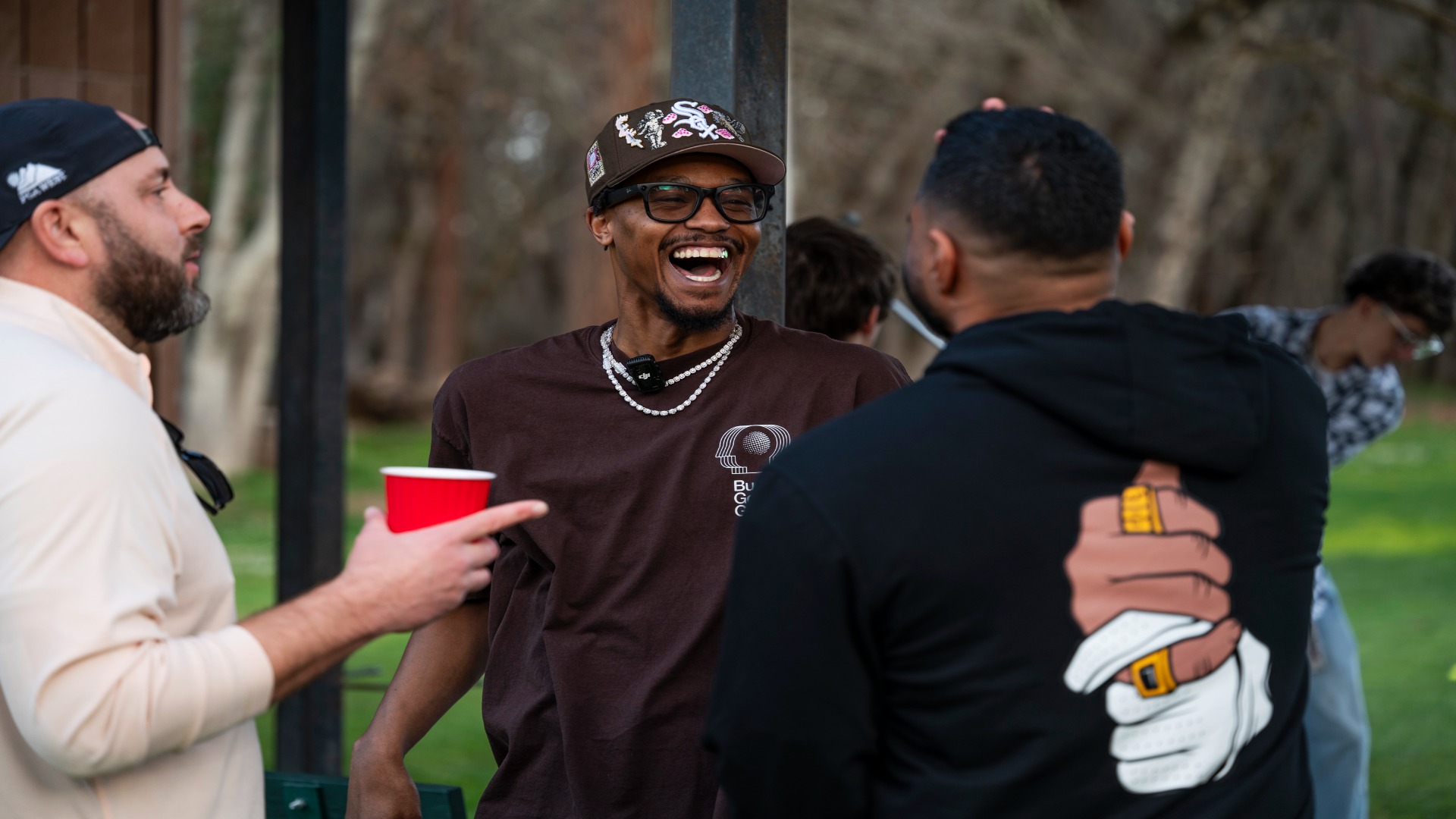
Buena Gente, which translates to “good people” in Spanish, isn’t necessarily just for Latinos and Hispanics. It’s galvanizing all peoples and communities to come together to enjoy the game, whether it’s through its apparel and collections featuring the brand’s Grip logo of interlocking brown hands wearing gold rings or its El Jangueo hangout events that are as much about golf as they are music, food and networking.
“It’s a golf apparel brand for Latinos, but over time, I started seeing that other people like the mission behind this, whether they were Latino or not,” Madera said. “Yes, of course the majority of our followers and customers are Latinos, but what’s really cool is to see how people have been supporting this kind of gathering around this mission saying, ‘This is cool. I see me wearing this even though it’s a brown hand, but it just feels very familiar to me. It feels familiar to my upbringing with my neighbors and my friends.’
“It’s been really cool to not feel like we’re creating something just for us.”

One last thing... Jimmy Roberts
Funny What Stays With You
Essay originally published in The Met Golfer, June/July 2026. Special thanks to the Metropolitan Golf Association.
Baseball, basketball, football, hockey, soccer, tennis … of course golf. You name it. I’ve been to a LOT of sporting events over the years.
That’s not really anything extraordinary. It’s kind of like a lawyer saying he’s been in a lot of court rooms.
Much of what happened in those arenas and stadiums … on those fields and courses feels like it just blends together in a slurry of memories, but with the Open back at Royal Birkdale once again, I find myself thinking fondly about one which sticks out.
The 1998 Championship - also at the Southport links - started in an unusual way. At least it did for me.
Tuesday of that week, I walked a practice round with Tiger Woods and Mark O’Meara. Nothing really unusual about that. You cover golf, it’s the kind of thing you do.
Woods was a burgeoning phenomenon. At that point he’d only won a single major - the 1997 Masters - but he was wildly popular and an ascendant figure. O’Meara had three months earlier at the age of 41, become the oldest first-time Masters winner in history.
The crowds following the two close friends - the last two Masters champions, and an appealing May/December friendship story - were preposterous; a human sea of thousands pressed up against the gallery ropes to get a look.
As the two good friends approached the 18th green, I was walking with O’Meara and talking about something - I have no recollection of exactly what. We were still chatting as he started putting and I remarked that the greens looked like they were really slow compared to what you might see on the PGA Tour in the United States.
“You think so,” he asked handing me his putter? “Why don’t you give it a try?”
I didn’t make the putt, but I didn’t embarrass myself either. It was over before I knew it. And then I looked around at the thousands of people watching. I’m glad I didn’t look before. There isn’t any point to the story (my wife says I do that a lot,) it was just a cool moment among the tens of thousands I’ve spend on the road and one I like to think about occasionally.
O’Meara went on to win that week in a playoff over Brian Watts. He became quite a story. So too did a 17-year old English amateur. Justin Rose would go on to become a major champion, Ryder Cup stalwart, Olympic gold medalist, and for a time, the number one player in the world, but that week was his debut on the world stage. He played surprisingly well and the British crowds were delirious in support of what they proudly hoped might be the game’s next young star.
As he played the 18th that Sunday, I was behind the grandstand speaking with Sir Michael Bonalick, who was then the chairman of the R&A, when an enormous roar erupted. It was so loud and exuberant that both of us were startled.
Rose jarred a 40-yard wedge from the left rough for eagle. He finished fourth.
He was on top of the world. The next day he was on a British Air flight into London when the pilot made an announcement that the plane was approaching “Heath - Rose.”
Rose soon turned pro and embarked on a journey which couldn’t have been more different. He missed 21 straight cuts. But that week at Birkdale was his day in the sun … and it was glorious. He would have many others.
The last thing that makes the week stick out in my mind is the way it ended. I was working for ESPN and the network was auditioning an aspiring broadcaster to serve as an expert analyst alongside me on our SportsCenter segments.
Ian Baker Finch had won the last Open Championship played at Birkdale in 1991, but a couple of years later fell into a horrific slump - one that eventually drove him away from playing professional golf.
He would go on to have a distinguished career as a broadcaster with CBS, but this week was an emotional confluence of circumstances. It was not only his debut as a broadcaster - a man seemingly turning the page - but it was the first Open he hadn’t played in 14 years, and as he no doubt contemplated the collapse of his game, here he was at the site of his greatest moment in the sport. There was a lot going on for him.
After O’Meara won, I sat down with him for what was then a tradition on SportsCenter: “The Sunday Conversation,” an extended interview with the sports star of the week.
Just as we were about to start, the door burst open, and there was Ian, overwhelmed with emotion. He wanted to come and congratulate O’Meara personally. They were now connected as not only Open champions … but Birkdale Open champions, a club that included a pretty impressive roll call: Arnold Palmer, Lee Trevino, Tom Watson, Johnny Miller, Peter Thompson, and others.
I felt more than a little uncomfortable being in the room, but there didn’t seem to be any graceful way to extract myself, so I tried to somehow disappear into a corner. It was a wonderfully raw and human moment.
All these years later, as the memories of everything feels like it blends together, Birkdale seems to stand out - not so much for what remains in the record books, but because of the small moments that lay beneath the bold headlines that define it more broadly in history.
Past Briefs
.jpeg)

Monthly and Annual Membership Options Available.
Member Pricing
$9.99 per month, OR $99 for one year.
Cancel Anytime.
Available for a limited time only, subscribe to our twice-weekly Golf Business Intelligence Brief for a discounted rate of $9.99/month or $99/year. Subscription renews at the same price each month or year, depending on the subscription selected.
Purchase Disclosure
By completing your purchase, you agree to enroll in a monthly or annual subscription to The Big Swing Golf Business Intelligence Brief at the current rate of $9.99 a month or $99 a year.Your subscription will automatically renew monthly at $9.99 or annually at $99 unless canceled prior to the renewal date.
You may cancel at any time through your account settings or by contacting customer support. All sales are final and non-refundable except where required by law.
Offer valid for a limited time and may not be combined with other promotions. Limit one per customer.
By subscribing, you agree to our Terms of Service and Subscription Terms.