
June 4, 2026
The Big Swing: Inside the new golf economy
Women’s golf takes center stage this week as the U.S. Women’s Open tees off at Riviera Country Club, marking the first time the championship has been held at the Los Angeles venue, not to mention the return of Michelle Wie West.
But this week’s newsletter heads the opposite direction to Ireland – specifically, why it has quietly become one of the most coveted golf destinations in the world for American travelers, and what the supply problem at the top of the market means for the broader industry.

This and that...
Mollie Cahillane & Michael LoRé
Sentry Fills the Torrey Pines Sponsorship Gap
The PGA Tour’s event at Torrey Pines Golf Course in San Diego is no longer nameless, with Sentry Insurance assuming title sponsorship beginning in the 2027 season. The Sentry had long been the Tour's season-opening event in Hawaii — canceled this year due to a water dispute on Maui — and won't return to the islands in 2027. The (new) Sentry at Torrey Pines will run January 25-30, 2027, concluding on a Saturday to avoid conflict with NFL conference championship games, and will serve as the kickoff to the PGA Tour's 2027 season on CBS.
Our Take: Sentry CEO Pete McPartland has been one of the Tour's most publicly loyal sponsors, stepping up during the LIV conflict without seeking subsidization, and agreeing in 2022 to extend a two-year deal into a decade-long commitment. For the Tour, landing Sentry at Torrey closes a gap that — as we noted two weeks ago — was a real commercial vulnerability.
WTGL Just Got a Lot More Star Power
TMRW Sports and Alex Morgan's Trybe Ventures are majorly expanding the WTGL’s investor group, adding world No. 1 tennis player Aryna Sabalenka, two-time Olympic hockey gold medalist Hilary Knight, and five WNBA stars, including Diana Taurasi, Napheesa Collier, Breanna Stewart, Nneka Ogwumike and Gabriela Jaquez. They join previously announced investors Morgan, Mia Hamm, and Abby Wambach as part of Trybe Ventures' lead capital position in the league, which is set to debut in the winter of 2026-27. The financial architecture is taking shape too, with WTGL team franchises selling for approximately $20 million (compared to the $35 million average for the men's TGL's original six franchises). Alexis Ohanian and Arthur Blank have already committed as the first two team owners.
Our Take: The investor roster is a deliberate cross-sport strategy, as Sabalenka, Taurasi, Stewart and Knight are among the most commercially recognizable women athletes in the world — and none of them are known for their golf game. WTGL is positioning itself as a women's sports property first and a golf product second, which is a different play from the LPGA to reach new audiences. The $20 million franchise valuation is an interesting number for investors: either it's an entry-level price for a property with significant upside, or it reflects genuine uncertainty about the women's product. Given the investor names attached, the market seems to be leaning toward the former.
Rahm vs. DeChambeau: Two Very Different Bets on LIV's Future
The contrast between LIV Golf's two biggest stars right now says a lot about where the league stands. At his press conference at LIV Andalucia this week, LIV’s No. 2 star Jon Rahm confirmed he is not part of the league’s push for new investors, and made clear he has no interest in being involved. "I know nothing about business," he said. "My job is to play golf, and I'll say it is hard enough as it is." Rahm added that he doesn't have "the free time that Bryson has" to attend investor meetings, citing three young children and one on the way. DeChambeau, by contrast, has been actively participating in LIV's fundraising pitch to potential backers, saying he's "giving all" he can to make it happen. DeChambeau's contract expires after this season, giving him clear incentive to fight for a league he'd need to re-sign with. Rahm, however, is still under contract for an unknown number of years.
Our Take: Rahm’s quote is disarmingly honest, but the business read underneath it is more complicated. Rahm saying "stay in your lane" while under a long-term contract he can't exit is likely a player who has decided his leverage is better preserved by staying out of a messy fundraising process than by attaching his name to an uncertain pitch deck. DeChambeau is fighting for his next contract, while Rahm is playing out his current one.
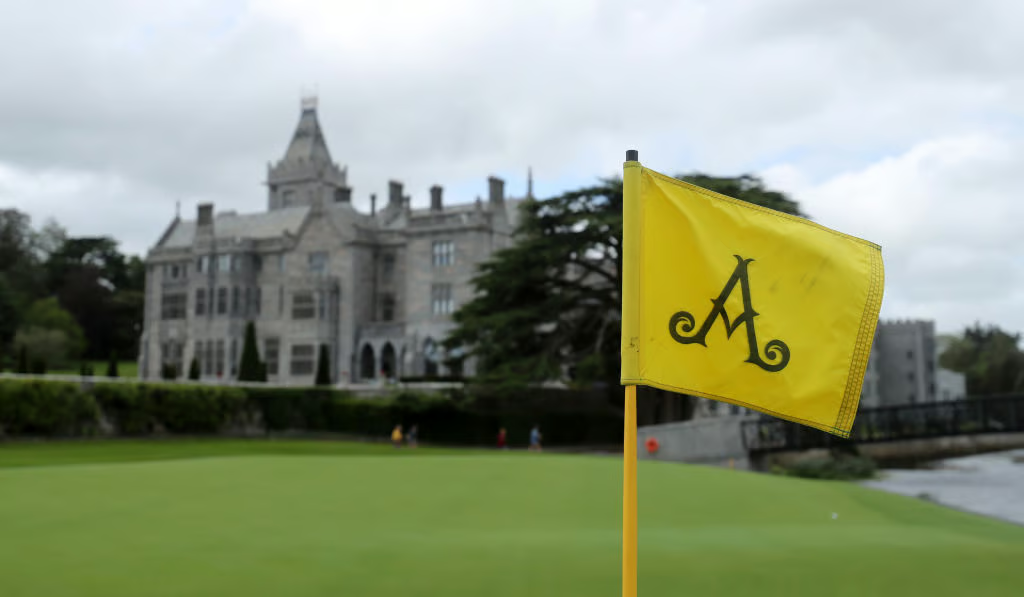
The Emerald Fairway: How Ireland Became America's Most Coveted Golf Destination
With record tourism numbers, a supply problem at the top, and a €300 million Ryder Cup on the horizon, Ireland's golf economy has never been stronger.
June 4, 2026
Mollie Cahillane | mollie@bigswingmedia.news
Marty Carr has been in the business of Irish golf for 37 years, watching the industry grow from a niche offering to one of Ireland's most significant tourism sectors. The son of amateur golfer J.B. Carr — the first Irishman to play in the Masters — has seen green fees climb, new courses open, and American demand grow to the point where it now outstrips what the island can comfortably accommodate.
"From the East Coast," he said, "it's easier to get to Ireland than to get to Bandon Dunes."
Bandon Dunes — the Pacific Coast links resort in rural Oregon — is the gold standard of American golf travel, selling out tee times months in advance and commanding green fees north of $400. The idea that hopping across the Atlantic to play Portmarnock or Royal County Down can be the more accessible option speaks volumes about where Ireland sits in the global golf economy.
Follow the Money
Golf generates approximately €717 million (roughly $830 million) annually for the Irish economy — roughly €1 in every €200 spent on the island — a 117% increase since 2014, according to a June 2025 report by the Sport Industry Research Centre at Sheffield Hallam University. More than 220,000 international golfers visit Ireland's 400-plus courses each year, generating close to €500 million in revenue, with Americans making up somewhere between 70 and 80 percent of that market.
Price isn't a deterrent for these visitors. According to Fáilte Ireland, Ireland’s national tourism authority, the average golf tourist spends three times what the average leisure tourist spends. Green fees at the top 10 courses in the country average €325, topping out with Adare Manor that can run north of €500.
"The golf sector is the highest spending sector," said Carr, whose company, Carr Golf, manages and maintains courses across the island. "There's definitely a much, much higher spend customer."
Tourism Ireland promotes non-stop service from 23 U.S. cities, with U.S. Customs and Border Pre-Clearance available at both Dublin and Shannon airports — a logistical advantage that makes the trip feel less like international travel and more like a domestic one. Courses like Adare Manor, Old Head, and Hogs Head have invested heavily in the full experience — clubhouses, on-site accommodations, and hospitality infrastructure that can compete with any resort in the world."
"There's been a huge investment in the infrastructure for golf," Carr said. "I think the product is something unrivaled in relation to presentation, the courses, and the service levels. And when you walk off that 18th hole, your experience with your caddy, your experience with your driver, your experience in the pubs — it's hands down different."
Supply and demand, Irish style
Ireland's golf economy has grown so successfully that it now has a supply problem. Trophy courses like Portmarnock, Royal Portrush, and Royal County Down (venues that frequently appear on every American bucket list) are overwhelmingly private members clubs.
"One of the big challenges is that the demand for golf probably exceeds the supply of the trophy golf courses," Carr said. "You have increasing demand and you have reducing supply."
Portmarnock, Carr's home club, limits outside play to 7,000 visitor rounds per year at a green fee of approximately €500. Once that allocation is gone, it's gone. With an estimated 120,000-plus American golfers making the trip annually, according to Carr, and most of them gunning for the same short list of marquee tee times, the math simply doesn't work.
The result is a market that has engineered itself into a luxury scarcity model. It's reminiscent of Augusta National, which generates enormous commercial power because it controls access so tightly. While Ireland's most coveted courses aren't trying to be Augusta, the effect is the same: scarcity drives desirability, desirability drives pricing power, and pricing power drives the broader market upward.
And so far, the market has absorbed it. "There doesn't seem to be that much price resistance," Carr says. "Prices have gone up in the States as well. If you look at Bandon, or Kiawah, or Sea Island — it's become very expensive as well. The industry is very evolved. It seems very mature."
Off the beaten fairway
The repeat visitor is changing the market. Having ticked off the trophy circuit, Americans are now spreading out into Donegal and other parts of the northwest and to corners of the island that weren't on most itineraries five years ago.
"People are beginning to go off the beaten track and experiment," Carr says. "The product in the northwest has come on leaps and bounds. It's less expensive, it's not as busy."
St. Patrick's Links in Rosapenna, Donegal — a renovation of a former town course — now sits in the world's top 50. The Galgorm Collection — Northern Ireland's largest luxury hospitality group — has committed to a £30 million investment in Bellarena Golf Links on the Causeway Coast, marking the first new championship links course built in Northern Ireland in more than a century, with construction expected to begin this year (pending planning approval) and a 2029 opening target. Carr Golf itself recently acquired Seapoint Golf Links beside Baltray, according to Carr, investing €5 million in the upgrade — a direct bet that the second-tier opportunity is real and growing.
"These courses are never going to have visitor access as restricted as the trophy courses," Carr said. "There's a great opportunity for some of these new entrants to invest, upgrade, and take up some of the slack."
The biggest catalyst of all arrives in September 2027: the Ryder Cup at Adare Manor in County Limerick, the competition's 100th anniversary edition. The Irish government projects economic benefits greater than €300 million — more than double the €143 million the 2006 Ryder Cup at the K Club generated, and surpassing the €262 million Rome delivered in 2023 (though Fáilte Ireland's own pre-event study estimates a more conservative €161-190 million). As of late 2025, one in ten hotel rooms in Ireland had already been booked for Ryder Cup week; and as of last week, more than 35,000 people from 87 countries had applied to volunteer.
"The passion of Irish people for golf makes Ireland really stand out internationally as a golfing venue," Irish Minister for Sport Patrick O'Donovan said at the Ryder Cup dates announcement earlier this year. "For Ryder Cup week, the eyes of the sporting world will be on the beautiful village of Adare."
Why They Come Back
Ask Marty Carr what makes Ireland different — really different, in the way that keeps American golfers coming back year after year and spreading out from Portmarnock to Donegal — and he doesn't start with the courses, but with the people.
"I think it is all about the welcome, to be honest," he says. "People in places like Kenmare, they really appreciate your business, they really appreciate you being there. We do tourism well — it's in our DNA."
It's a harder thing to put in a spreadsheet than green fee revenue or Ryder Cup economic projections. But for an industry built on repeat customers — golfers who come once, fall in love, and start planning the next trip on the flight home — it may be the most durable competitive advantage Ireland has. The courses are world-class, the access is getting easier every year, and the Ryder Cup is coming.
And from the East Coast, at least, it's easier to get there than Bandon Dunes.

One last thing... Jimmy Roberts
Coming Up Aces
Make or even witness a hole-in-one, and you’ll have a tale to tell, too.
Essay originally published in The Met Golfer, July 2024. Special thanks to the Metropolitan Golf Association.
Golf has such great stories, but I think my favorites involve “ones”.
Three years ago, Charles Moran – 32 at the time – was playing as a guest at Winged Foot on Labor Day weekend when he got his first-ever hole-in-one.
Thrilling, but it soon got better.
The next day, he played his home track, Westchester Country Club, and had another one!
Crazy, right? I’d never heard of such a thing.
Until a few weeks ago, when I read about Sam Flood. Sixty-three years old and playing at Ridgewood, his home course in New Jersey, he had his first ever ace. The next day – you guessed it – he followed it up with his second.
Holes-in-one on consecutive days; Chat GPT says the odds are 5 million to 1.
Which is really nothing compared to what Frank Bensel, the former, long-time teaching pro at Century Country Club in Purchase, N.Y., did at the 2024 U.S. Senior Open.
With his son Hagen – yep – on the bag, Bensel aced Newport Country Club’s fourth and fifth holes in the second round. Odds? 17 million to 1.
I love this stuff.
I’ve only had one in my life – 155-yard 7-iron in 1996 at the Karsten Course in Arizona – but I’ve been around a bunch of them, and wherever they are and whomever they involve, one thing is absolute: they are electrifying to witness.
I still get the giggles thinking as much about standing on the tee at Tamarack Country Club in Greenwich, Conn., watching some random 80-year-old guy in front of me drill one, as I do remembering calling one on live TV from Steph Curry two years ago in Lake Tahoe at the American Century Championship. (Although in the case of the latter, more than a million people got to hear me lose my mind.)
A hole-in-one is likely the singular thing in golf that needs no context to entertain, but so often does just that.
And so many of them have a story.
Maybe the most infamous one happened at a certain exclusive club on Long Island: a guest hits his tee shot on a short par 3, the green of which is partially obscured by a dune.
The group arrived at the putting surface and, not immediately seeing the guest’s ball, embarked on a search. Suddenly, as everyone was about ready to give up, the guest called out that he had found his tee shot in the rough near the green. Nobody thought much of it until one of the caddies went to pull the pin, and there in the bottom of the hole was a ball … a ball which was the same brand and had all the same markings as the ball everyone had been looking for. Oops.
The ball the guest said he found clearly wasn’t the one he hit, so instead of the hole-in-one he actually would have earned, he got an invitation to never again come back because, apparently, he was trying to cheat.
According to the PGA of America, the odds of an average golfer recording an ace in his or her lifetime are 12,500-1. But if you’re not average?
Jack Nicklaus has 21. Tiger Woods has 20. According to his bio in the LIV media guide, Phil Mickelson has 47!
Do you need any more evidence that these people are just different than us?
Since its founding 75 years ago, Golf Digest has been keeping track of holes-in-one in all their various glory.
According to the magazine, the youngest player to ever pull off the feat is a boy of 4 years and 195 days. The oldest, a 103-year-old man.
The magazine recognizes Mancil Davis, a pro from Texas, as the player with the most aces ever with 51. (GOLF Magazine presided over a lie detector test for Davis, which he passed.)
An ace for golfers is the holy grail, for so many, a white whale they just keep on chasing.
But there’s a measure of good news if you’re still “ace-less.”
According to the National Hole in One Registry, 60% of all holes-in-one are made by players 50 and over, their average handicap – 14.
Yet another wonderful thing about this game: The promise of something to look forward to as you get older in a culture where the curve isn’t always bent in that direction
Past Briefs

Become a member
*Available for a limited time only, subscribe to our twice-weekly newsletter for a discounted rate of $150 for your first year. Subscription renews at annual rate of $175 at the end of the first year.
Purchase Disclosure
By completing your purchase, you agree to enroll in an annual subscription to The Big Swing – Inside the New Golf Economy at the current rate of $150 for the first year (founding member offer). Your subscription will automatically renew annually at $175/year unless canceled prior to the renewal date.
You may cancel at any time through your account settings or by contacting customer support. All sales are final and non-refundable except where required by law.
Offer valid for a limited time and may not be combined with other promotions. Limit one per customer.
By subscribing, you agree to our Terms of Service and Subscription Terms.