
June 22, 2026
The Big Swing: Inside the new golf economy
Hope all the dads reading today’s newsletter had as great of a Father’s Day as Randall Clark did. Wyndham Clark’s father surprised his son by taking a red-eye flight from Denver to New York City to watch his son win his second U.S. Open.
“Here’s never been there to see me win,” Wyndham said. “Not only that, to finally have him there for a win is amazing, but especially on Father's Day.”
Talk about a memorable moment for the Clark family. Hope your Father’s Day was equally as special.

This and that...
Wyndham Clark wins 126th U.S. Open, record payout of $4.5 million
Wyndham Clark went wire-to-wire to win the 126th U.S. Open at Shinnecock Hills Golf Club in Southampton, N.Y. Not only did Clark win his second U.S. Open, but he took home $4.5 million of a record $22.5 million prize purse. The USGA bumped up the 2026 U.S. Open prize money by $1 million, which matched the total Masters payout in April, where Rory McIlroy earned $4.5 million for his win. Clark’s share a $200,000 increase from J.J. Spaun’s $4.3 million prize for winning the 2025 U.S. Open.
Our take: It seems every newsletter we highlight a winner on the PGA Tour or LPGA taking home a record share from a record purse. Thanks to the creation of LIV Golf, increased media rights and supporting sponsorship dollars, golf is richer and more lucrative than ever before. With more eyeballs fixated on the game, the stakes continue to be raised to keep audiences engaged. At some point, the bubble has to burst, right? Even Cam Smith, who left the PGA Tour to go to LIV in August 2022 for a reported $140 million, thinks the money has gotten out of control, telling The Mirror US: “This has been an awesome four or five years for us golfers, for everyone around the world. It’s changed a lot of things, but I think realistically, it’s time for everything to come back to the way it was.”
Rory McIlroy to skip Travelers Championship, final Signature Event of year
Six-time major winner Rory McIlroy will miss his third Signature Event of the year as he isn’t listed in the field for this week’s upcoming Travelers Championship at TPC River Highlands. McIlroy, who finished T32 (+6) at the 126th U.S. Open, also skipped the RBC Heritage and Cadillac Championship earlier this season. He’s only played nine PGA Tour events this year, highlighted by winning his second consecutive Masters Tournament in April.
Our take: McIlroy has previously stated he enjoys the benefits of being able to set his own schedule, and we certainly can’t blame him for easing up on his play and travel after finally completing his career Grand Slam last year. With that being said, the 37-year-old is still one of golf’s biggest stars, so not having him in the field for the Travelers Championship is a blow for the final Signature Event of the year. Despite McIlroy’s absence, Scottie Scheffler, Cameron Young, Jordan Spieth and defending champion Keegan Bradley still bring star power to this no-cut, limited-field event. Expectations are that McIlroy will tee it up next at the Genesis Scottish Open ahead of the Open Championship.
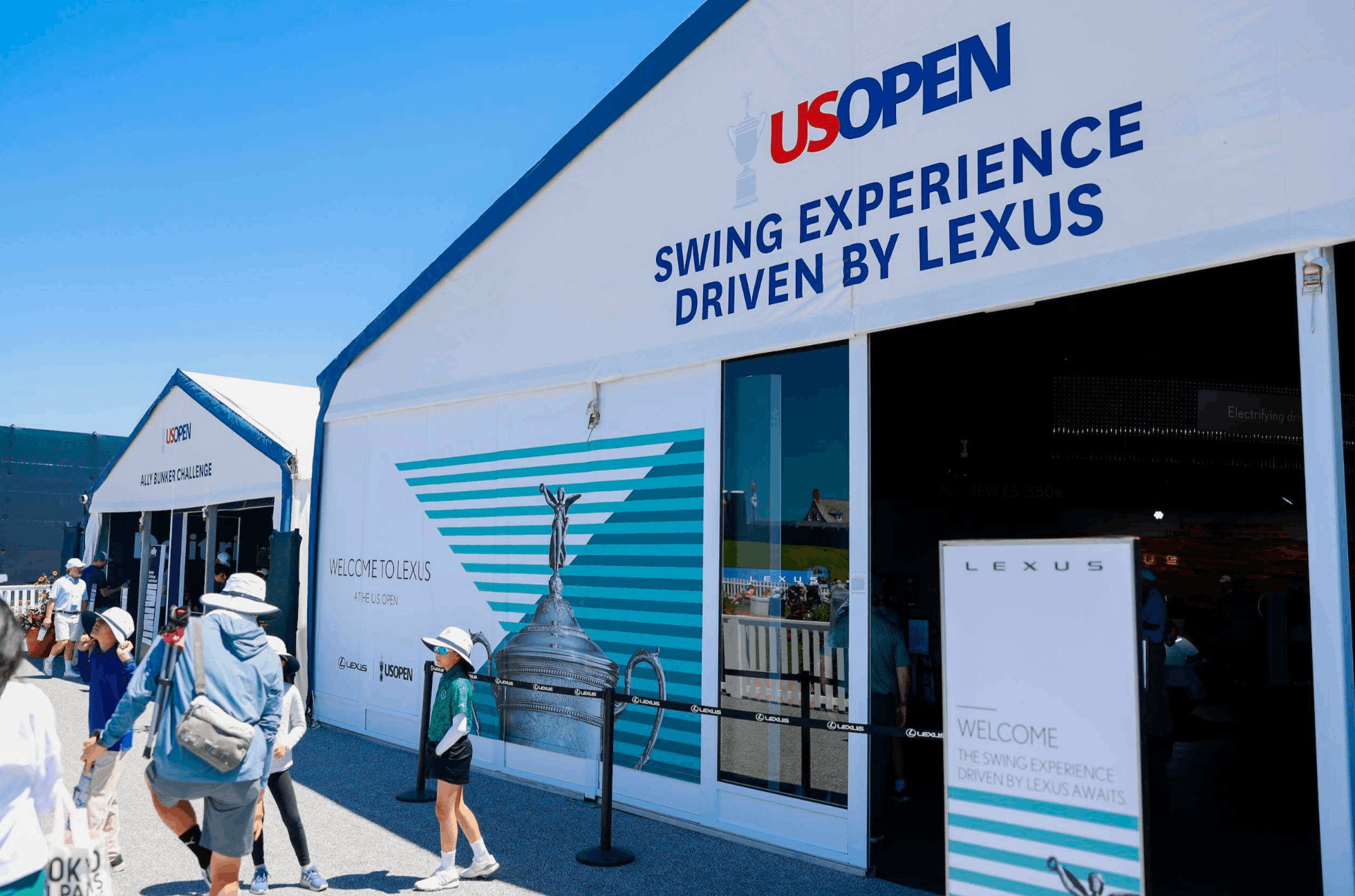
Luxury Auto Makers Race to Engage Golf’s Audiences, But Is It Worth The Rising Cost?
Whether partnering with the game’s leading organizations or as title sponsors of tournaments, golf sponsorship is getting more expensive.
June 22, 2026
Wyndham Clark arrived for the final round of the 126th U.S. Open on June 21 in his typical Sunday soft pink as he continues to honor his mother, Lise, who passed away from breast cancer in 2013.
The wire-to-wire winner also showed up at Shinnecock Hills Golf Club in style in the new 2026 Lexus GX.
Clark, a Lexus ambassador since June 2024, wasn’t the only one pulling into the parking lot at the Southampton, N.Y.-based club behind the wheel of a Lexus. As part of its long-term partnership with the USGA dating back to 2006, Lexus said it supplies a fleet of approximately 250 courtesy vehicles for all U.S. Open participants as well as USGA staff to use throughout the week. A source confirmed Lexus pays the USGA an additional $2 million to the cars they let them use.
“Courtesy” vehicles by name only, the fleet of shiny, new cars flooding the streets around Shinnecock are strategic advertising opportunities for luxury auto makers like Lexus to make their products and brand as visible as possible at one of professional golf’s most significant events.
“We want to make sure every athlete is taken care of, but also that there’s a high likelihood our newer product is on broadcast,” said Nicole Peterson, Head of Experiential Marketing & National Partnerships at Lexus. “We’re planting these little seeds along the way so that you keep seeing this new product.
“We’re breadcrumbing our audience throughout championship week and then hopefully they’re like, ‘Scottie Scheffler looks really great in that new GX, maybe I should look into that.’”
Whether it’s Lexus at the U.S. Open, Mercedes-Benz at The Masters or BMW, Cadillac or Genesis at their respective PGA Tour events, luxury automakers have been driving golf sponsorships for more than 60 years.
Not only was Buick the first automaker to serve as title sponsor of a PGA Tour event in June 1958 by organizing and sponsoring the Buick Open at Warwick Hills Golf and Country Club in Grand Blanc, Mich., it also marked the first corporate sponsorship of a PGA Tour event.
Today, the auto category is one of the most highly coveted in professional golf as luxury manufacturers race to engage affluent audiences within the sport.
But are the game’s rising sponsorship costs worth the investment? One veteran automotive marketing executive doesn’t think so.
“If you look at the U.S. Open last week, what does Lexus really get out of it?” the exec questioned. “Rory McIlroy parks his car in the parking lot, they see a Lexus and they walk in. Is that worth 10, 15, 20 million a year? Personally, no, I don’t think so.
“... But there’s a saying I have and it’s FOMO, but with two Ms—Fear Of Marketers Missing Out. There’s an element of FOMO that because everyone else is doing it, we need to do it too.”
Auto sponsorships in golf typically fall into one of two categories. Umbrella deals like Lexus has with the USGA (since 2006) and PGA of America (since 2024) are typically cheaper and involve multiple tournaments and properties, offering auto makers the ability to showcase products via courtesy fleets, on-site activations and hospitality hosting.
There’s also title sponsorships like the Genesis Invitational or BMW Championship tied to a single event that are more expensive given the increased opportunities for branding, marketing and exposure; you can’t talk or write about the tournament without mentioning the title sponsor.
While exact figures aren’t public, reports estimate luxury auto brands like BMW, Genesis and Cadillac pay an estimated $15-20 million per year as title sponsor of their respective PGA Tour events.
That financial investment has only increased as the Tour designates eight tournaments per year as limited-field Signature Events featuring top-ranked players competing for more money and more FedExCup points than its other events. It’s no coincidence Honda ended its 42-year sponsorship of the annual Tour stop at PGA National in 2023 when the event wasn’t deemed a Signature Event.
Arguably, the leader of the pack, at least in terms of value and ROI, is Mercedes-Benz, one of four Champion Partners of The Masters since 2008.
The final round of the 2026 Masters averaged nearly 14 million viewers on CBS as McIlroy won his second consecutive Green Jacket, marking the network’s most-watched Masters final round in 11 years. Buoyed by limited commercials and The Masters’ prestige, professional golf’s first major doesn’t need to rely on on-course drama to still garner interest. Final rounds averaged approximately 11.2 million viewers over the past decade.
“You cannot equate what Mercedes-Benz gets at Augusta with what Genesis gets in California or what Cadillac gets in Florida or BMW gets wherever they are year to year,” the automotive marketing exec continued. “It’s not equivalent, but there’s this inherent pressure—if you want to be a luxury player to have some positioning in golf and that’s when the Tour gets their hooks in you and it’s all over.”
Significant schedule changes expected to start in 2028 will only drive sponsorship costs higher as PGA Tour CEO Brian Rolapp looks to create a two-track tiered system while prioritizing larger, untapped markets. Decreasing the number of events, and thus sponsorship and activation opportunities, creates a scarcity and bidding war for brands.
“Now he’s using this scarcity as kind of a weapon on the sponsors: ‘You’re going to miss out, guys. We only have so many events. If you don’t want it, then Lincoln will take it,’ or whatever,” the exec said.
Not only are Rolapp and the Tour benefitting from golf’s record popularity, but live sports are a brand marketer’s dream, offering the ability to engage with a highly engaged and emotional audience in real time. It’s why brands don’t blink twice at paying $8 million to $10 million for a 30-second ad during the Super Bowl, which draws 100+ million viewers.
While golf viewership doesn’t compare to the Super Bowl or NFL, it offers sponsors from financial services to luxury automotive the ability to “reach a premium audience”—the words used on the advertising page of the Tour’s website. It goes on to explain: “This audience is high net worth, big spenders, highly educated, and brand loyal.” The numbers back it up with 52% of the Tour’s audience age 55+, 47% more likely to be a business decision maker, and 87% of its audience boasting a household income of 150K+.
While traditional and affluent golf fans and participants unsurprisingly are a target demographic for luxury auto brands, golf’s emerging categories leading the game’s expansive growth since the Covid-19 pandemic highlighted by youth, women and people of color are also becoming a priority for sponsors.
There were more than eight million female on-course golfers age 6+ in 2025, according to the National Golf Foundation. Since 2019, the net gain in female golfers is 2.5 million, a 46% increase. The 7.7 million Asian, Black and Hispanic golfers who played on a course in 2025 is a high-water mark for the industry, while their 26% representation among traditional golfers is also a record high.
That’s why brands like Lexus are leveraging a multi-faceted approach to increase brand desire and favorability to the growing spectrum of golf viewers and participants, utilizing on-site activations and experiences like a long drive contest at the U.S. Open and content series featuring Lexus golf and non-golf ambassadors.
“I don’t think luxury brands are won or lost on awareness,” Peterson said. “I think most consumers probably already know who Lexus is, so the real question is whether they aspire to own a Lexus or feel an emotional connection to the brand by way of the partnership.”
Cadillac returned to the PGA Tour as title sponsor of the Cadillac Championship in April 2026 after a 10-year hiatus, having previously sponsored the World Golf Championships (WGC) at Trump National Doral from 2011-16. Paying upwards of $20 million annually, Cadillac’s significant investment was quickly rewarded as the inaugural Cadillac Championship was designated a Signature Event in its first playing earlier this year.
One industry executive said Cadillac parent company General Motors is trying to buy influence with President Donald Trump who imposed a 25% tariff on foreign-built vehicles and many imported auto parts.
“Our investment in the Cadillac Championship continues our brand’s legacy with the PGA Tour, while connecting with luxury customers through culturally significant events, like Monterey Car Week, U.S. Open and Formula 1,” a Cadillac spokesperson said. “Through luxury sporting events, Cadillac creates experiences that celebrate performance, craftsmanship and innovation on a national stage.”
While Cadillac recently returned to the PGA Tour, BMW has served as the title sponsor of the BMW Championship, the penultimate FedExCup Playoffs event, since 2007 and a Worldwide Partner of the Ryder Cup since 2006.
Genesis, the luxury automotive subsidiary of Hyundai Motor Company, joined the golf sponsorship race two years after its founding in 2017 as title sponsor of the Genesis Invitational. The Korean company has also lent its name to the Genesis Scottish Open since 2022 and has been the Official Automobile Sponsor of numerous Presidents Cups. In June 2024, Genesis became the first Founding Partner of TGL, and in June 2025 became the first global Official Vehicle of the PGA Tour and PGA Tour Champions through 2030.
Auto brands will say golf is synonymous with their values of prestige, luxury, performance and precision, but will that be enough to justify spending more money than ever before for one week per year?
“It’s a bit odd on the automotive (side),” the auto marketing exec said. “You can either say it’s great or you can say it’s a total torch of money because there are no ratings guarantees when you’re a sponsor.”

One last thing... Jimmy Roberts
Mementos
It’s not just stuff – it’s tangible evidence of intangible ties.
Essay originally published in The Met Golfer, June/July 2022. Special thanks to the Metropolitan Golf Association.
As my fingers hit the keyboard, it’s just a few days before I head north to Brookline (don’t tell me what happened!), but going to the U.S. Open doesn’t make me think of Nicklaus or Woods. It doesn’t make me think of (Orville) Moody or (Steve) Jones – they won it too.
It makes me think of Ralph Roberts. He never won it.
Golf is rife with stories of fathers and sons – or fathers and daughters, among the endless familial permutations. It’s a game of connection because maybe kids see their parents playing and want to emulate them, and what greater joy is there for a parent than helping their child learn something for which they themselves have a passion?
For more than a half century now, the U.S. Open – barring weather issues – has been decided on Father’s Day. It’s easy to think of that as a shrewd marketing move by the USGA, but the fact is, it was probably more of a happy accident.
Until 1964, the national championship concluded with 36 holes on Saturday. That year, Ken Venturi nearly expired winning at Congressional in the heat and humidity of Washington, D.C. Over the years, the popular theory is that the USGA, wanting to avoid the prospect of anything so potentially dangerous happening again, changed the format to four 18-hole rounds.
While safety was likely an issue, money – as always – was somewhere in the equation. Two days of network television coverage instead of one meant greater rights fees. Voila! The Open – played on the third weekend of June because it provided the most daylight for a large field playing cautiously on a punishing setup – would now end on Sunday.
A Father's Connection
As I head off to cover my 33rd U.S. Open, there is a nagging sadness because to me, the defining connection among all those national championships was my dad.
One of my greatest joys was to arrive at the Open site – usually on Monday – and head straight to the merchandise pavilion and buy him a golf shirt and sweater with that year’s championship logo stitched on the front. I’d send it to him overnight, so that the rest of the week – in those days before you could order just about anything online – he could proudly parade around his club wearing it. I think my mom must’ve washed those shirts for him every night of Open week.
For him it was the ultimate conversation piece, with it leading just where he wanted it to go:
“Hi, Ralph. Wow – how’d you get that shirt? The U.S. Open is all the way on the other side of the country!”
“My son got it for me,” I’m sure he said with delight. “Have I told you about him?”
One of the most powerful emotional memories I have of my dad’s passing 15 years ago was helping my mom clean out his closet and coming across all those U.S. Open shirts and sweaters. It was a bittersweet reminder of how golf connected us, and thinking about it now reminds me of how much I still miss him.
The Next Generation
And now I find myself on the other side of the equation. My kids don’t buy me shirts – yet – but the game is part of our connective tissue.
My oldest, an adult who has the best swing in the family, called me the other day to tell me about blasting out of a bunker for a birdie he made at Oak Hill. And my youngest, a talented athlete, has lately become obsessed with the game. He’s 18 and there are so many things we can’t talk about.
But we can talk golf.
A couple of weeks ago, I was heading down to my middle son’s college graduation. Pretty emotional time. I was packing and opened a drawer and stumbled on something that stopped me cold in my tracks.
As a once-young father, I used to bring pictures of my kids with me to the U.S. Open, and a guy in the media center would then make up credentials with those photos that I could bring home and give to my boys. And there in my desk was the face of my soon-to-be college graduate – a beaming 3-year-old on his Olympia Fields credential.
He’s the one who doesn’t play golf. But the game still connects us.
Past Briefs

.jpg)
Become a member
*Available for a limited time only, subscribe to our twice-weekly newsletter for a discounted rate of $150 for your first year. Subscription renews at annual rate of $175 at the end of the first year.
Purchase Disclosure
By completing your purchase, you agree to enroll in an annual subscription to The Big Swing – Inside the New Golf Economy at the current rate of $150 for the first year (founding member offer). Your subscription will automatically renew annually at $175/year unless canceled prior to the renewal date.
You may cancel at any time through your account settings or by contacting customer support. All sales are final and non-refundable except where required by law.
Offer valid for a limited time and may not be combined with other promotions. Limit one per customer.
By subscribing, you agree to our Terms of Service and Subscription Terms.