
September 3, 2026

The Big Swing: Inside the new golf economy
Where are golf’s next dollars moving (or leaving)?
We dig into the sport’s fastest-growing tourism market: how Vietnam turned a government tourism strategy into a billion-dollar business, with Greg Norman and Chris Campbell walking us through who’s actually financing it. Plus, why a maturing South Korean golf economy is exporting demand right into it.
Three more stories about where the money is: a fledgling women’s league locking down network distribution, a creator-media darling learning how fast trust evaporates, and a big-box retailer betting that cheap simulator time buys loyal golfers for decades.

This and that...
Good Good Golf’s CEO and president are out after Callaway ad: report
Matt Kendrick, Good Good’s co-founder and CEO, and Joe Flannery, who’d been named president just days before the controversy broke, have departed the company, according to an internal memo first reported by Business Insider. Co-founder and early investor Nahid Giga is stepping in as interim CEO, while Alex Puchala remains COO and CFO overseeing day-to-day operations. The shakeup follows Callaway ending its partnership with Good Good, Dick's Sporting Goods and Golf Galaxy pulling Good Good merchandise, and Golf Channel canceling "Big Break x Good Good," all triggered by a since-pulled promotional video in which co-founder Garrett Clark shoved fellow creator Alexis Miestowski to the ground.
Our take: A creator-media company’s entire value proposition is trust with its audience and brand partners, and Good Good watched both evaporate inside two weeks. Losing the CEO and a president who probably didn’t have time to unpack his desk shows that Good Good’s ownership and investors have realized the problem isn’t going away — and it’s a reminder of how quickly a $45 million-funded media brand can go from golf’s hottest property to a brand partner’s biggest liability.
WTGL locks in ESPN and ION as its inaugural broadcast partners, unveils full rosters and launch date
TMRW Sports and the LPGA’s new Women’s Team Golf League signed a multiyear U.S. media rights deal with ESPN and Scripps Sports’ ION ahead of its season opener on Sunday, Nov. 8 from SoFi Center in Palm Beach Gardens. ESPN will carry matches across ABC, ESPN and ESPN2, while ION expands its existing women’s sports programming slate with over-the-air reach into more than 128 million households. WTGL also lifted the veil on the league’s structure: Five teams will compete in a round-robin regular season — every match carrying playoff implications — building to single-elimination semifinals and a best-of-three finals; a full match-by-match schedule is still to come.
Our take: TGL spent a full season proving indoor team golf could hold a network audience, and now WTGL gets to skip that proof-of-concept phase and go straight to a multiyear ESPN deal before playing a single match. It’s a meaningfully faster runway than the men's league got, and also expands the LPGA roster’s reach beyond the majors and the Solheim Cup.
Youth on Course expands retail partnership with Dick’s Sporting Goods
Youth on Course, the Monterey, California-based non-profit focused on removing economic barriers to golf, tapped Golf Galaxy, Dick’s Sporting Goods and Dick’s House of Sport as official retail partners. The move converted a 25-store summer 2025 pilot into a permanent, year-round program, after the pilot alone generated more than 64,000 simulator rental hours across more than 175 Golf Galaxy and 35 Dick’s House of Sport locations, traction the organizations are building on with 25 additional Dick's stores across 16 states, bringing the combined footprint to more than 200 locations. Members book $5-an-hour simulator time and one complimentary PGA Teaching Professional lesson through Dick's existing ScoreCard and Game Time Booking systems. Separately, the Dick's Sporting Goods Foundation committed a three-year, $300,000 Sports Matter Grant — $100,000 annually — to add 72 public golf courses to Youth on Course's network around Houston by 2029.
Our take: Dick's brands own the indoor, year-round touchpoint through 200-plus combined locations; Youth on Course converts that engagement into actual tee times through its course network. Regarding the Houston grant, simulator hours may build interest, but public course access is what keeps a kid in the sport long-term. Neither organization has shared whether the pilot's 64,000 simulator hours moved the needle on rounds played among members, but early results were clearly promising.
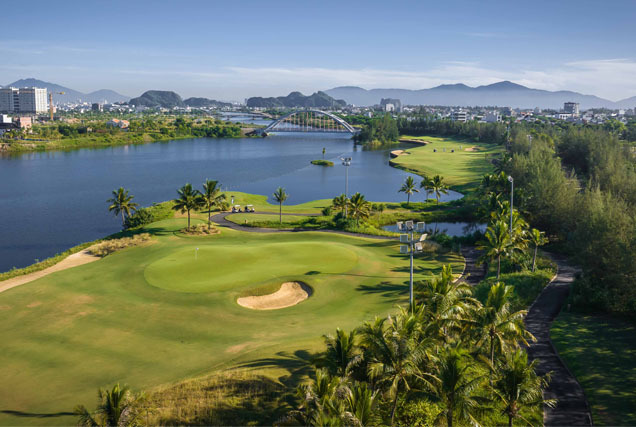
Southeast Asia’s Golf Bet: How a Developing Country’s Tourism Strategy Became a Billion-Dollar Business
Local developers, a 200% surge in course construction, and a government treating golf as infrastructure: Greg Norman and Chris Campbell on how Vietnam built a golf boom without the sovereign-wealth playbook that built LIV.
September 3, 2026
Mollie Cahillane | mollie@bigswingmedia.news
Ask Greg Norman whether Vietnam’s golf boom is the next LIV — another sport reshaped by a sovereign wealth fund with a point to prove — and you’ll get an answer before you even finish the question.
“No, no, no, no, no. [They’re] diametrically opposed,” Norman, who serves as Vietnam’s official Tourism Ambassador, told Big Swing Media. “One is not even close to being related to the other.”
It’s a fair question, since the Shark knows better than almost anyone what state-directed capital can do to a golf property, having spent years as commissioner of the tour built on Saudi Arabia’s Public Investment Fund. Vietnam’s golf numbers, on their face, look like the kind of growth that comes with government backing: golf tourism revenue exceeded $1 billion in 2025, according to Vietnam’s National Tourism Administration (VNAT), up from $600 million in 2022. It makes up 8% to 10% of Vietnam’s total tourism revenue, and its trajectory is in line with the 200% increase in golf course development Norman said has followed since the market began rapidly expanding in 2014.
But according to Norman and Chris Campbell, president of Greg Norman Golf Course Design (GNGCD) and Norman’s right-hand man, the money behind Vietnam’s build-out is a fairly ordinary (if unusually fast-moving) emerging-market growth story: local developers, foreign capital arriving as partners and a government that thinks golf is worth the paperwork. Today, Vietnam has around 80 courses, a significant gain from the 66 it had just two years ago in 2024. GNGCD alone has 14 courses under contract in Vietnam and four currently under construction — a pipeline that reflects just how fast the market is moving.
A region in flux
Vietnam’s golf demand surge didn’t spring from a vacuum — golf’s popularity has been accelerating unevenly throughout the region, and Korea shows both halves of that story at once.
It’s still, in Norman’s words, “number two in the world with golf popularity now… I think they’ve nipped Japan.” But size and momentum aren’t the same thing: according to the Korea Golf Course Business Association, nationwide rounds played peaked at 50.8 million in 2022, then declined three straight years — 47.72 million in 2023, 47.41 million in 2024 and 46.41 million in 2025 — even as the number of operating courses grew from 514 to 524 over the same span. A large, mature golfer base is cooling off at home just as rising costs push more of those golfers to look beyond Jeju Island for cheaper rounds abroad — precisely the demand Vietnam is poised to catch.
Japan, in Norman’s telling, is a market one stage further down the same curve. A 1980s golf boom in the country led to investment pouring into Australian course construction; now, many of those Japanese courses built 35 to 40 years ago need renovation, and GNGCD is all too happy to step up to the plate.
Vietnam, by contrast, is still in the land-grab phase, but even within Southeast Asia it’s not the leader. “Thailand’s definitely got miles ahead of Vietnam just in terms of establishment with golf,” Campbell said, calling it the region’s clear frontrunner.
Singapore, he said, has built the best blend of tourism and domestic play, helped by an outsized expat population anchored by its role as a financial and maritime hub. Vietnam’s status, in Campbell’s words, is “the newcomer on the scene” — closing the gap quickly, helped by its own expat wave, particularly Australians, which is positively affecting a lot of the golf courses the company builds and operates.
Norman doesn’t see a ceiling on regional demand overall, pointing to Asia-Pacific’s roughly two-thirds share of world population and an aging, increasingly wealthy demographic with time and money for golf travel. “I don’t see it slowing down… outside of another pandemic or a [global financial crisis] or something like that.”
Follow the money
If the money isn’t coming from a sovereign wealth fund, then who’s backing the investment? Mostly, Campbell said, from Vietnam itself.
"Most of the developments we've done are [with] Vietnam developers," he said. BRG [Banking, Real Estate and Golf] is the clearest example, with roughly a dozen courses to its name and, per Campbell, one of the country's largest development footprints. Foreign capital shows up, but as a partner rather than a controlling force: GNGCD's early BRG Da Nang project was financed through an Australian investment partnership, one of the first of its kind in the country. "We've seen Vietnam really create a lot of diversity in their investment platform from other countries," Campbell said, “and I think that's a big part of what's driving the growth today."
The government's role has been procedural rather than financial, according to Campbell — but no less consequential. A dedicated vetting and permitting division out of Hanoi has spent five to seven years refining how it evaluates projects, and it shows: "Almost every golf course that's been built in the last 10 years in Vietnam is of extremely high quality. You would be hard-pressed to find another country in the world that is producing the quality of golf that Vietnam is today."
Norman and Campbell's relationship with Vietnam dates back to 2005 — "you're going back 21 years," as Norman puts it — and the early years were spent convincing officials, up to the prime minister, that golf was an economic development tool rather than a rich person's amenity. "This has a forward-reaching effect from employment to economics to hospitality to education," Norman said. "It took multiple, multiple sessions with high-ranking officials... to get them to understand this blueprint opportunity."
One overlooked beneficiary of that shift: golf's equipment and maintenance supply chain. "The OEMs, like the Toros and the Jacobsens of the world, and those Rain Birds of the world" have found a market they "probably never even thought about 25 years ago," Norman said — alongside cart makers like E-Z-GO and Yamaha.
The one constraint anyone named is the real estate cycle that so much golf development there is bundled with — not land or labor, which Norman said are cheap and abundant in Vietnam. "There has been some fluctuation in the real estate market," Campbell said. "We've seen it affect the golf business as it does everywhere in the world... how long that's going to sustain is anybody's guess." It's a caveat worth remembering the next time someone cites the Vietnam government and industry stakeholders’ 200-courses-by-2030 target as a foregone conclusion.
Both men consider that target realistic. "I think it's very feasible," Norman said, pointing to the track record since 2014. Campbell credits the government's vetting apparatus directly: consistent oversight, he argues, is what's allowed volume and quality to rise together rather than trading off against each other, helped along by a growing domestic golfer base. Nearly every first-tier course now carries an academy, and cities like Hanoi, Ho Chi Minh City and Da Nang have solid membership rolls, giving courses a revenue base that doesn't evaporate in the off-season or during the next external shock.
What’s next: tournaments, a bigger wildcard and the rise of China
Two Asian Tour events have already been played at GNGCD courses in Vietnam, and Norman facilitated a significant investment into the Asian Tour to help promote the region’s growth. Campbell wouldn’t be surprised to eventually see a DP World Tour — or even a PGA Tour — event in the country.
Norman, characteristically, has a bigger ask: that the strategic alliance between the Asian Tour, the PGA Tour and the DP World Tour treats Asia-Pacific’s growth as a genuine opportunity rather than a satellite market, given what he’s personally witnessed playing and promoting golf across the region since the late 1970s.
“I just hope through the lens of this tri-party agreement, they do recognize that opportunity, and they do bring further growth, development opportunities through bringing the best players in the world there,” said Norman. “I will go to my grave supporting that, defending that, and instilling the values that are in there, because it is there. I've seen it, no matter whenever I played anywhere, I saw the enthusiasm for golf over the decades, and it hasn't waned one bit.”
The bigger swing factor for the region, though, is China. Beijing has maintained a moratorium on new golf course construction for years, a policy Norman watched take hold after early involvement in Chinese golf development that ran from Hainan Island to Shanghai, Shenzhen and Guangzhou (he later served as an advisory coach to China's Olympic golf team for the 2016 Rio Games). Now, he said, there are "rumblings" — embassy conversations, calls from senior government officials in the region — that the door could crack open again, spurred partly by what other countries, Vietnam foremost among them, have proven is possible. "That'll only light up the golfing world," Norman said, "from manufacturing to OEMs to everything across the board, as China opens up again."
We’re not going to attempt to predict that timeline, but it does serve as a measurement to the scope of what’s underway. Other countries in similar latitudes, per Norman, are already studying Vietnam as a case study in what a golf-friendly economy can build in roughly a decade, once a government decides golf counts as infrastructure.

One last thing... Jimmy Roberts
LAST WORD: Fall, Football, and Fairways
Essay originally published in The Met Golfer, November/December 2026. Special thanks to the Metropolitan Golf Association.
Nothing tops the combination of my two favorite sports during the best season of the year.
I don’t know if you remember this television commercial that ran about 10 years ago around the end of summer. Two parents are riding gleefully up and down the aisles of an office supply store in a shopping cart as their middle school child stands by glumly watching them. The music playing as the two adults fill the cart with school supplies: “It’s the Most Wonderful Time of the Year.” Completely agree, fall absolutely is the best time of the year, for more than one reason, neither of which has anything to do with my kids.
The Perfection of Fall Golf
Take golf. The grass is its happiest. My shirt doesn’t stick to my back like a wet paper towel because the temperature in fall is Goldilocks perfect: not too hot… not too cold… JUST right. And if I’ve used my summer well, my swing doesn’t feel like something from an alien disco.
So there’s that, but there’s more to why these first two months of fall are especially so incomparable. Autumn is football season – more specifically the heart of college football season – one of my two favorite sports. (Can you guess the other?)
What could be better? And occasionally college football and golf intersect.
Where the Gridiron and the Green Meet
The thought first occurred to me when I was visiting my son in college in Ann Arbor, Michigan, not long ago. “The Big House,” which seats well over 100,000, is one of the most iconic venues in college football. But for home games, they park cars on the university’s Alister MacKenzie golf course – MacKenzie would be the guy who designed Augusta National and Cypress Point. It's a little like using the Mona Lisa as a placemat. Whatever. Go Blue!
Actually, a number of America’s great courses are college courses, including:
- Ohio State’s Scarlet (MacKenzie/Jack Nicklaus)
- The course at Yale (C.B. MacDonald)
James Nicholas of Scarsdale has a unique perspective on the two sports. He played both at Yale, although during his season-and-a-half playing football for the Elis, he only touched his clubs once… when he missed making the gridiron traveling squad one week.
“It’s the best time of the year, no doubt,” he says as he was preparing for the DP World Tour’s qualifying school. “Throw on a pullover if you’re sweeping the dew, then before you know it, it could be 70 degrees. And the grass is just SO healthy. I prefer Sundays to Saturdays though.”
This is to be expected from a man whose grandfather was an orthopedic pioneer and did Joe Namath’s knees.
Teeing It Up with the "Old Ball Coach"
Whenever I think of golf and college football, I think back to the time I teed it up in a pro-am with Steve Spurrier, the 1966 Heisman Trophy winner. The “old ball coach” – who once was a 3 handicap – and I were partners and were in contention when we came to a par 3.
I stepped up to the tee, and Steve said – with a little too much intensity – “What club you got there, Jimmy?”
“It’s a 7, coach,” I said as I settled confidently into my pre-shot routine.
“That’s too much club, Jimmy!” he barked at me. “Too much club!”
“No, I’m good, coach,” I answered just a moment before I pured one… right over the green.
I looked over, and in an instant, I was transported to “The Swamp,” Florida’s Ben Hill Griffin Stadium, where the field is named for Spurrier. There was the man who, as Gators head coach, led Florida to the 1996 National Championship. He was standing by the side of the tee box seething, gritting his teeth. I was half expecting him to rip off his visor and toss it at his feet, kind of his signature move. Wow, I thought, that’s all it took for me to completely understand what it’s like to throw an interception in the SEC.
The Ultimate Autumn Synergy
I’ve had lots of other thoughts run through my head when I think about the subject. PGA Tour winner George Burns played college football at Tennessee before transferring to Maryland to play golf. Nice double dip if you ask me.
And along with the Masters, what’s the best event in golf? The Ryder Cup, which is played in the fall and is kinda like a college football game. You don’t think so? Wait until the matches are at Bethpage in 2025. It’s gonna be like Miami–Notre Dame from the ’90s… on steroids.
"In the end fall rules because college football and golf get to share it."
Tell me – what could possibly be better than a morning round on a brisk and glorious Saturday followed by extended couch time in front of the fireplace watching a buffet of college ball?
Yep – the most wonderful time of the year.
Past Briefs

Become a member
*Available for a limited time only, subscribe to our twice-weekly newsletter for a discounted rate of $150 for your first year. Subscription renews at annual rate of $175 at the end of the first year.
Purchase Disclosure
By completing your purchase, you agree to enroll in an annual subscription to The Big Swing – Inside the New Golf Economy at the current rate of $150 for the first year (founding member offer). Your subscription will automatically renew annually at $175/year unless canceled prior to the renewal date.
You may cancel at any time through your account settings or by contacting customer support. All sales are final and non-refundable except where required by law.
Offer valid for a limited time and may not be combined with other promotions. Limit one per customer.
By subscribing, you agree to our Terms of Service and Subscription Terms.