
September 10, 2026

The Big Swing: Inside the new golf economy
We’re knee-deep in women’s golf this week as the Solheim Cup gets underway in the Netherlands, and we have more about the business and commercial implications further down in the Brief.
While the Solheim Cup remains the biggest women’s golf property, WTGL is getting closer to its November launch date, and its broadcast partners are slowly revealing their plans. On Wednesday ESPN announced it’s expanding its marquee Women’s Sports Sundays franchise into Fall 2026, and buried within the larger press release we learned that WTGL will have a slot in the weekly broadcast alongside college volleyball, the NWSL, WNBA playoffs and MVPW boxing.
Women’s Sports Sundays drove strong ratings for ESPN (the WNBA alone averaging over 1 million) since sliding into the slot formerly held by Sunday Night Baseball. Putting WTGL on the company’s flagship network during its busy slots shows that ESPN has high hopes for WTGL in its inaugural season.

This and that...
LIV Golf files for Chapter 11, sets up a player-owned relaunch for 2027
The time is finally here: LIV Golf filed for Chapter 11 bankruptcy on Tuesday in the U.S. Bankruptcy Court for the District of New Jersey, formalizing Saudi Arabia’s Public Investment Fund’s exit after more than $5 billion in funding since 2022. Under a Restructuring Support Agreement with BC Partners Credit, the league also secured $49.6 million in debtor-in-possession financing provided by PIF (subject to court approval) and plans to emerge in early 2027 as a smaller, majority player-owned circuit — a 75-player field, a 36-hole cut, Monday qualifiers and events spanning Australia, South Africa, Mexico, England, Hong Kong and the U.S. Stars Jon Rahm, Bryson DeChambeau, Dustin Johnson, Cameron Smith, Tyrrell Hatton and Bubba Watson are listed among the league’s largest unsecured creditors, each owed between $3 million and more than $5 million. Per BBC Sport reporting, none of them are obligated to sign onto “LIV 2.0” despite existing multi-year contracts.
Our take: Filing Chapter 11 lets LIV walk away from the guaranteed money that was the pitch for jumping tours in the first place — a sign that leverage in this saga has shifted from players to whoever’s next writing the checks. It also reopens an uncomfortable question for the PGA Tour’s Strategic Sports Group investors, who paid $1.5 billion partly to neutralize LIV as a competitive threat: what was that leverage actually worth, now that the threat is in bankruptcy court?
U.S. Ryder Cup team scraps its points formula again for the third rewrite in three cycles
On Wednesday, the PGA of America unveiled new qualifying criteria for the 2027 U.S. Ryder Cup team, replacing the prior money-list-influenced system with a dedicated points table: majors worth 3,000 points, The Players Championship 2,850, signature and postseason events 2,250 and regular Tour stops 1,500 — earned only within a defined window from The American Express through the BMW Championship. The top six qualify automatically, and captain Jim Furyk fills six more spots after the Tour Championship
Our take: A stable qualifying formula could appeal more to broadcast partners that are trying to build a season-long selection storyline to sell to sponsors. A third consecutive rewrite does make that narrative harder to package, and is awkward timing for a Tour that needs to take advantage with LIV in bankruptcy court.
Pinehurst gives 11th course opening date
Pinehurst Resort’s upcoming 11th course, designed by Bill Coore and Ben Crenshaw with Ryan Farrow handling the shaping, is set to open March 2027 in the resort’s Sandmines development area. It’s the same reclaimed-mining-land zone that produced the Tom Doak/Angela Moser-designed No. 10, which opened in 2024 and already ranks as a top North Carolina public-access course. Pinehurst didn’t disclose a construction budget.
Our take: Pinehurst’s strategy treats course count with the same importance as design, stacking multiple bucket-list-caliber courses onto one reclaimed site to support longer average stays and repeat “collect them all” trips, leaning on the resort’s USGA anchor-site status to keep justifying the capital.
Srixon leans on AI-assisted design for its second-generation ZXi irons
Srixon opened presale Sept. 8 on its second-generation ZXi irons — four models spanning ZXi7 Players, ZXi5 Players Performance, a new ZXi5+ Players Distance and ZXiU Utility — built with i-FORGED construction. The line's new "MainFrame iQ" system uses AI-assisted design and thousands of simulated impact scenarios to engineer a more efficient face structure, reducing face mass and repositioning weight for faster ball speeds, higher MOI and more consistent performance across the face. Irons are manufactured at Endo Manufacturing in Japan, with complimentary personalization available on presale orders through Oct. 16.
Our take: This is an R&D-marketing story, as Srixon is selling the design process itself — thousands of AI-simulated impacts engineering the face — as a major proof point, the same way carmakers now market wind-tunnel simulation hours. It’s worth watching whether "AI-designed" becomes a standard spec claim across the iron category the way "forged" and "multi-material" already have.
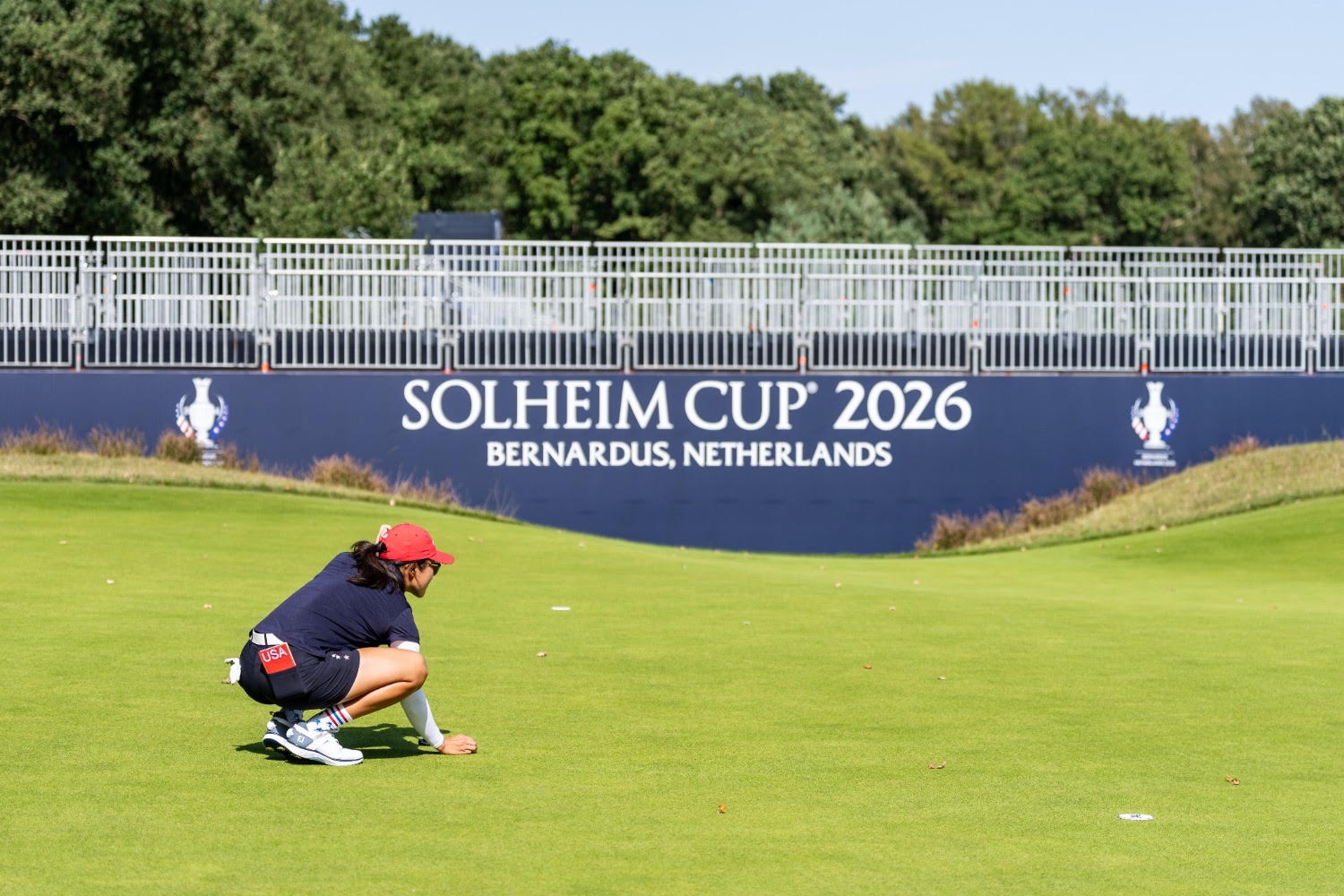
The Solheim Cup Is Selling 2028 Before 2026 Even Ends
As this week's event goes fully car-free in the Netherlands, the LPGA and LET are already selling partnerships and tickets for Valhalla 2028. The numbers behind that confidence — and where they come from — tell a more complicated story than a simple Ryder Cup comparison
September 10, 2026
Mollie Cahillane | mollie@bigswingmedia.news
As this week's event goes fully car-free in the Netherlands, the LPGA and LET are already selling partnerships and tickets for Valhalla 2028. The numbers behind that confidence — and where they come from — tell a more complicated story than a simple Ryder Cup comparison
Before this year’s Solheim Cup is even over, the LPGA and Ladies European Tour (LET) are selling sponsorships and tickets for the one two years away.
The 20th edition of the event is underway at Bernardus Golf in the Netherlands, and it’s the first “car-free” Solheim Cup on record — roughly 4,000 bikes and 60-plus buses standing in for the usual acreage of parking lot, moving fans and staff around the Dutch countryside instead.
The LPGA and the LET already have partnership packages on sale for the 2028 edition at Valhalla Golf Club in Louisville, Kentucky, two years out, and tickets for that event go on sale Sept. 14, the Monday immediately after this year’s competition wraps. Selling that far ahead — commercially and on the business side — is a confidence play: a property monetizing its next chapter before finishing this one.
But is that confidence earned? The women’s event naturally draws comparisons to its men’s equivalent, the Ryder Cup — is the Solheim Cup closing the commercial gap, and if so, on what terms?
The Ryder Cup runs under a single, durable partnership between the PGA of America and Ryder Cup Europe, carries seven global sponsors including BMW, Hilton and Capgemini, and has reported sponsorship revenue growth of 153% between 2018 and 2023. The Solheim Cup has historically leaned on two global partners — Rolex and PING, which have bankrolled the event since 1990 but kept their names off the trophy.
Outside sports-marketing commentary has drawn a clean line between the two. In a 2024 column for Landmark Media, ex-IMG marketing and comms strategist Sarah Gwynn argued that the Solheim Cup’s ownership — split, in her framing, across the Solheim family, the LET, the LPGA and a rotating cast of host national federations — is the real reason it hasn’t landed the kind of transformative sponsor Barclays became for the Women’s Super League. Investment, she argued, could help the event “break the cycle.” It’s a reasonable theory for managing fragmented governance, but it’s also not quite how the people who run the event describe it.
The Ownership Myth
According to a person intimately familiar with the Solheim Cup’s commercial operations, the “LPGA/LET/host nation” federation three-way split runs more caricature than reality. The event itself is run jointly by the LPGA and the LET, with the LET bringing in host national federations when the Cup is played outside the U.S. That’s described internally as standard practice, consistent with how the LET runs much of its own global schedule, which includes national opens and federation partnerships across multiple continents. When the Solheim Cup lands stateside, as it will in Valhalla in 2028, no federation is involved.
The commercial architecture follows that same geography-first logic. Global partners that carry across every edition regardless of host — Rolex, Skyscanner and PING, still tied to the Solheim family more than three decades in — are sold jointly by the LPGA and LET. Local and regional deals are handled by whichever side is hosting: the LET, working through IMG, sells locally when the Cup is in Europe; the LPGA takes the lead when it’s in the U.S.
That amounts to two organizations dividing labor by geography, quite a different structure than the three-way fragmentation critique assumes, and a valid counterargument to a Barclays/WSL comparison.
Show Us the Money
Both sides disclose less about the financials than most business reporters would like, but we’ve managed to dig up some numbers. The Ryder Cup’s NBC/USA Network media rights extension runs through 2033 without a public dollar figure attached, though the broader initial deal through 2031 was widely reported as a 15-year, $440 million agreement (with NBC paying $55 million to the PGA of America for the U.S. media rights to each Ryder Cup). The Solheim Cup has no public or reported standalone broadcast rights valuation at all; it’s bundled into the LPGA’s tour-wide domestic rights package, the same way the Ryder Cup is bundled into its own.
In 2024, the last Solheim Cup year, the LPGA brought in a record $252 million in revenue in 2024, a gain of nearly $44 million from 2023. In events alone, the LPGA brought in more than $163 million in tournament revenue in 2024, an increase of more than $40 million year-over-year. In 2024, the LPGA also brought in nearly $56 million from television and media as well as another $22.1 million from corporate sponsorships.
On sponsorship, Adidas and Trackman joined the Solheim Cup this cycle. The LPGA describes this year's partner count as comparable to last cycle's, though it said it doesn't have direct dollar comparisons in hand since the LET runs this edition's commercial side — and declined to offer even a range for what a Solheim Cup partnership costs. The source close to the commercial side described the Solheim Cup as one of the biggest properties the LPGA sells, and London-based data and analytics firm GlobalData estimated that total 2023 Solheim Cup (the last time the event was held in Europe) sponsorship revenue was $5.16 million, with an average annual sponsor deal coming in at $343,000 to $344,000.
The firm reported three deals were over $500,000 a year (Rolex, Reale Seguros and Visit Costa Del Sol — the latter two are local Spanish sponsors tied to that host cycle only) — plus BMW at an estimated $400,000 a year. Any Ryder Cup figures are a mix of one outlet citing actual financial filings, a former PGA of America president's recollections, and analyst or government estimates — nobody currently running either event has put a number on the record.
What has moved, clearly, is attention: the 2024 Sunday singles drew 657,000 average viewers on NBC, more than double the prior cycle. Ticket pricing and revenue for this year are being held until after the event; the closest available comparison is 2026 grounds passes starting around €125 against 2025 Ryder Cup daily tickets that topped $750 at Bethpage — but again, different currencies, different markets, and not really an apples-to-apples number even before you adjust for either.
Follow the Bigger Money
The growth probably isn't coming from a structural fix, which raises the big question: what's really driving it? The likely answer sits above either event: Deloitte's annual women's sports forecast put the category's global revenue over $3 billion for the first time in 2026 (up from $1 billion in 2024), with sponsorship doing most of the lifting ($1.35 billion, including partnerships and merchandising). The LPGA's own sponsor base has more than doubled since 2019, past 1,200 active partners tour-wide, with sponsors reportedly seeing returns as high as 400% in media value. Remember, women under 35 are the fastest-growing demo in golf, according to the NGF.
Whatever the exact numbers, the direction is the same one lifting the Solheim Cup: a rising tide in women's sports sponsorship that has less to do with how any one event divides its commercial rights and more to do with where investors have decided the growth actually is.
The Road to Valhalla
The calendar itself is one of the strongest assets for future Solheim Cups. After the Netherlands, the event heads to Valhalla, a venue that’s already hosted a Ryder Cup and multiple PGA Championships — and a bet that its atmosphere translates. Europe gets it back in 2030, host still unannounced, with a U.S. return following in 2032, and the LPGA says venue news is forthcoming.
Selling partnership packages for the next edition two years out, with tickets following the day this year’s competition ends, is either high confidence or good salesmanship, though probably a combination of both, and a clear sign the property isn’t worried about stagnating growth.
“The sky's the limit for this property,” said the commercial source. “It's the rare opportunity to get to be a part of a team, and it's a team sport for a week, and you just see [the athletes’] personalities shine. Similarly, what we see on the men's side when they host the Ryder Cup every year, the passion that comes out among the fans, we expect the first tee on Friday to just be rocking and an incredible atmosphere, and we believe we can continue to grow from here. There's incredible runway in front of us with the Solheim Cup. It’s one of the biggest events in women's golf, and one of the biggest events in golf.”

One last thing... Jimmy Roberts
No Way!
Essay originally published in The Met Golfer, November/December 2024. Special thanks to the Metropolitan Golf Association.
After more than 30 years of trying to get my wife to play, she has finally taken up the game as a 'No Holer.'
If you’ve been reading this column for a while, you likely know more about me than you might care to. You know I love golf, but it doesn’t always love me back. You know I feel a good halfway house should be an essential part of the landscape. And you know that my wife doesn’t play golf. For three plus decades, despite my urging (whining?) she has aggressively resisted taking up the game. So much so that she once took to this space to explain herself.
Let’s just say – to rip off the Bard – she thought it was much ado about nothing.
I have to say, I got more feedback on that column than any I’d ever authored, which is both a sad commentary on my writing and a celebration of hers.
But in a “we interrupt your regularly scheduled programming”-worthy bulletin reserved for things like the Jets having won the Super Bowl, there comes a shocking news flash:
Yep. My wife has taken up the game.
I think she was just tired of hearing me whine.
At Father’s Day dinner, Sandy told me that she had been secretly enrolled – all club personnel at Westchester Country Club had been sworn to not tell me – in a program called the “No Holers.”
No Holers?
Perhaps you’ve heard of dip-your-toe-in-the-water programs like this. The idea is to introduce the game to people who aren’t as weirdly obsessed as some of us, so that they might develop an affection for the game in a healthy fashion. (Which means nobody I seem to know.)
And so, after 25 years of membership at our club, we now finally have a piece of crystal to put on the shelf.
Men who take up the game as adults might face frustration – that’s universal – but it can be a reasonably hospitable journey. That hasn’t always been the case for women. So three years ago, Jenny Sullivan, an assistant pro, modified a kids’ program and slipped into every women’s tennis email chain at the club to do some recruiting.
“Between jobs and raising a family, a lot of women just don’t seem to have a lot of time,” Sullivan says, “but they want to be active and competitive, so tennis makes sense. Okay, I figured, how do I get women to play golf in the same amount of time they play tennis?”
It’s called “No Holers” because you start in the short game area and learn the game from the green backwards with just two clubs: a putter and a wedge. At first, you actually play no holes.
After the 30-minute lesson at the short game area, the next step is to start on the par-3 course, 25 yards from the hole. As soon as a player can complete nine holes in 36 strokes or less, they move back to 50 yards. Same deal, 36 or better, and they move back to 75 yards.
The goal is to graduate and become “Some Holers,” a crew of women who play a loop of four holes on Westchester’s South Course.
“It’s a safe space,” Sullivan says. “There are no dumb questions. How to hold the club, what to wear. It’s a blast.”
I don’t know what kind of beast I’ve unleashed here, but my wife really seems to like the program. I know this because she came home the other day screaming at how miserable this game was making her.
“There’s a lot of hope and promise when I’m on the first tee,” she reflected to me one evening. “But then it all goes downhill from there.”
Yep... sounds about right.
A couple of weeks later, I was informed she would be mostly unavailable on a random September Thursday because she was playing in the “No Holer” member-guest.
It was lunch, logo’d golf merch, and of course... a handicapped competition on the par-3 course from the skill-appropriate tees.
Genius. The concept was both amusing and wonderful. I was all ready to welcome her home and hear her stories of fun and woe, but there was none of the latter. She won.
And so, after 25 years of membership at our club, we now finally have a piece of crystal to put on the shelf.
It says: “No Holers Champions.”
Oh my god – like I said: What kind of monster have I created? Careful what you wish for.
Past Briefs
.jpg)
%20(1).jpeg)
Become a member
*Available for a limited time only, subscribe to our twice-weekly newsletter for a discounted rate of $150 for your first year. Subscription renews at annual rate of $175 at the end of the first year.
Purchase Disclosure
By completing your purchase, you agree to enroll in an annual subscription to The Big Swing – Inside the New Golf Economy at the current rate of $150 for the first year (founding member offer). Your subscription will automatically renew annually at $175/year unless canceled prior to the renewal date.
You may cancel at any time through your account settings or by contacting customer support. All sales are final and non-refundable except where required by law.
Offer valid for a limited time and may not be combined with other promotions. Limit one per customer.
By subscribing, you agree to our Terms of Service and Subscription Terms.