
November 9, 2026
The Big Swing: Inside the new golf economy
What a difference a week makes at LIV Golf.
Last Monday, we reported that roughly 15 players had tentatively committed to a proposed successor league. Seven days later, the $300 million rescue deal has collapsed, LIV has announced plans to wind down, and BC Partners is reportedly exploring another way in by acquiring LIV’s bankruptcy financing.
Elsewhere this week, we follow the money behind golf’s tariff refunds and examine Revelyst’s latest move into the European golf technology market.

This and that...
BC Partners Explores Another LIV Rescue as Wind-Down Begins
LIV Golf’s future has taken another turn, days after the league announced plans to wind down operations.
According to the Financial Times, BC Partners is seeking to acquire approximately $50 million in bankruptcy financing provided by Saudi Arabia’s Public Investment Fund. The loan, known as debtor-in-possession financing, helps fund LIV through Chapter 11. Acquiring it would give BC Partners significant influence over the restructuring process as it explores a possible successor competition.
The reported move follows the collapse of the original $300 million recapitalization proposal backed by BC Partners Credit, the private equity firm’s credit business.
Negotiations over player commitments and financial terms had failed. The Financial Times reported that some players sought the restoration of cancelled financial guarantees and the ability to withdraw from commitments.
LIV subsequently terminated its restructuring agreement, although it remains open to alternative proposals. BC Partners’ latest approach is preliminary, and neither PIF nor LIV has publicly agreed to the proposed loan purchase.
Our Take: The loan could give BC Partners another way into LIV, but it doesn’t solve the problem that sank the original deal. The firm still needs enough recognizable players willing to compete on financially acceptable terms. Gaining influence over a bankruptcy process is one thing. Turning what remains into a commercially sustainable golf league is another.
Revelyst Acquires European Golf Technology Distributor
Revelyst, the company behind Foresight Sports and Bushnell Golf, has acquired Optimum Golf Technologies, a longstanding European distributor of its products, in a move designed to strengthen its international golf technology business.
The transaction closed October 23 and was announced November 4. Financial terms were not disclosed.
Optimum, which has worked with Foresight for more than 15 years, will be renamed Revelyst Golf Technology Europe. Its leadership team and employees will remain in place.
The deal brings an established distribution and simulator-installation business directly into Revelyst’s golf platform, which also includes GolfLogix and PinSeeker. Revelyst says the acquisition will support its strategy of integrating hardware, software, subscriptions and
gaming products.
Our Take: This is about more than expanding Revelyst’s European footprint. Bringing installation and technical support in-house gives the company greater control over the customer relationship after a simulator is sold. Servicing, recalibration and ongoing support also create opportunities for additional revenue beyond the initial hardware purchase. That’s an attractive extension of a business historically associated with selling equipment.
Where Did the Tariff Refunds Go?
More than $100 million in tariff refunds received by major golf companies like Acushnet, Callaway and DICK’S have helped offset costs and boost earnings, but the savings have yet to translate into lower prices for golfers
November 9, 2026
Gianni Magliocco | gianni@bigswingmedia.news
In a single quarter this year, DICK’S Sporting Goods received approximately $59 million in tariff refunds. That’s a substantial amount of money coming back through the door. But did it make a new driver any cheaper?
The refunds covered DICK’S wider retail business, including $2 million attributable to Foot Locker. They were not $59 million in golf-equipment refunds. Still, they offer a useful starting point for a question facing the industry.
After the Supreme Court ruled that tariffs imposed under a presidential emergency-powers law were unlawful, importers began getting their money back. Titleist parent Acushnet said it had received all its refunds. Callaway had collected $42.6 million by the end of September.
But the tariff bill kept coming.
As one set of duties was refunded, others remained or took effect. Both manufacturers continued to face import costs, and Callaway cited selective price increases as one reason its profit margins improved. It did not link those increases to the refunds.
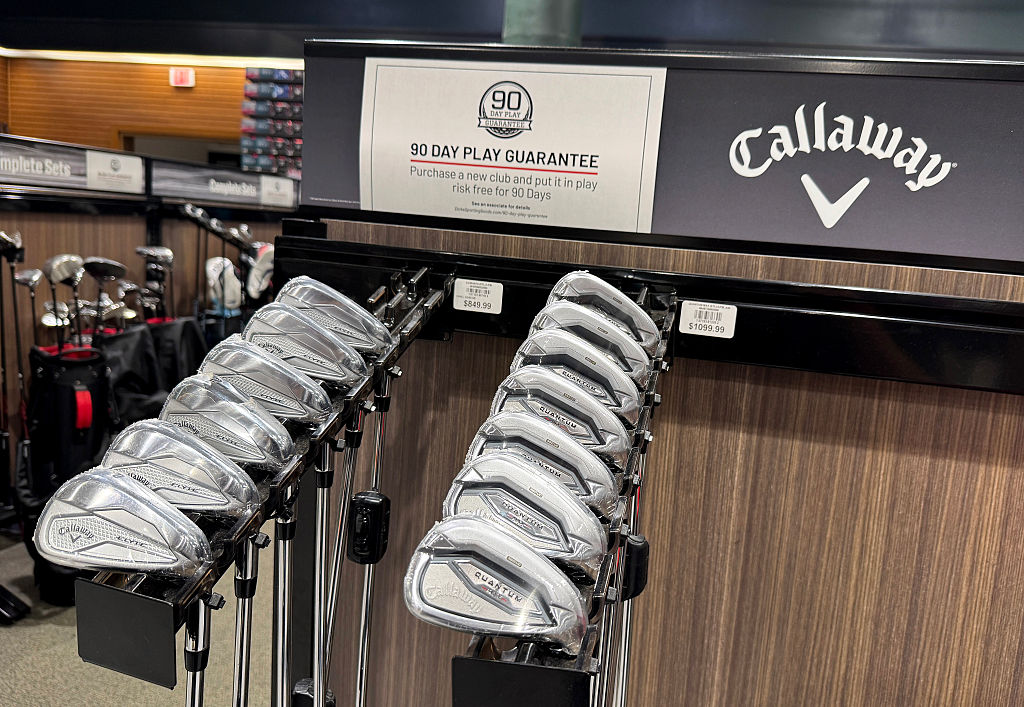
Big Swing also examined prices on six Titleist and Callaway products. Some equipment became more expensive, including a replacement driver launched after the Supreme Court ruling. But there is a difference between establishing that prices rose and establishing why.
So where did the returned money go? And is there any evidence it reached the golfer standing in front of the price tag?
Why the Refunds Happened
A tariff is a tax on an imported product. When a shipment of golf clubheads reaches a U.S. port, the importer files a customs entry showing what arrived and the duties owed. That paperwork matters when the government later has to give money back.
On February 20, the Supreme Court ruled that the International Emergency Economic Powers Act, or IEEPA, did not give President Donald Trump the authority to impose tariffs. Customs stopped collecting those duties four days later.
The Court had not outlawed tariffs generally. It had ruled against the law used to impose these particular ones.
The U.S. Court of International Trade subsequently ordered refunds. Customs built an online system called CAPE, short for Consolidated Administration and Processing of Entries, to handle the enormous volume of claims.
By October 2, approximately $126 billion in duties and interest had been sent to the Treasury for payment, according to the trade court. Customs had estimated that $166 billion in IEEPA duties had originally been assessed nationwide.
But the tariff bill did not disappear.
On February 24, a new 10% surcharge took effect under Section 122, a different trade law. A trade court ruled that surcharge unlawful in May, but the ruling was stayed on appeal. Collection continued until the surcharge expired on July 24.
Meanwhile, the government strengthened tariffs on certain imported metals and products made from them under Section 232. New Section 301 duties took effect the same day the temporary surcharge expired, covering imports from numerous trading partners, with exemptions for certain products.
The government was returning money collected under one tariff program while continuing to collect duties under others.
For an importing golf company, a refund on an earlier shipment did not necessarily mean lower costs on the next one.
The Manufacturers: Acushnet and Callaway
Both manufacturers recovered substantial amounts while continuing to face tariff costs. But neither company’s financial disclosures established what those refunds meant for the price a golfer paid.
For Acushnet, the parent company of Titleist and FootJoy, the money was already in the bank by August. Chief Financial Officer Sean Sullivan said the company had submitted and received all its IEEPA tariff refunds.
But receiving money and reporting a benefit to profits are different things.
By the end of September, Acushnet said the refunds had added approximately $33.8 million to adjusted EBITDA, a measure of earnings before interest, taxes, depreciation and amortization, with certain adjustments. That figure included the effect of additional employee incentive compensation tied to the company’s results.
Sullivan expects the full-year net benefit to settle at approximately $30 million.
The expected decline reflects additional incentive-compensation expense still to be recorded.
There was another side to the company’s tariff story, however.
Even with the refunds, Acushnet reported an approximately $29 million headwind from higher tariff expense in the first nine months of 2026.
The two amounts measure different things. One is the net accounting benefit from refunds; the other is a cost the company continued to face. They cannot simply be subtracted from each other. Asked to break down the $29 million by tariff authority, or distinguish costs incurred before and after the IEEPA ruling, Acushnet told Big Swing it had not broken out those figures.
Callaway, meanwhile, had received $42.6 million in IEEPA tariff refunds by the end of September.
The company recognized $44.3 million in refund-related benefits through September, including approximately $1.7 million in interest.
Unlike Acushnet, Callaway excluded those benefits from its adjusted earnings, which remove certain unusual items to give investors another view of underlying performance.
Meanwhile, the company expects approximately $43 million in gross tariff expense for 2026, compared with $34 million last year.
There is an important distinction from Acushnet. In its latest filing, Callaway said the refund benefit recorded against the cost of its products had more than offset incremental tariff costs through September.
The company also pointed to cost reductions and selective price increases as contributors to its improved margins.
The Retailer: DICK’S
DICK’S gives us the clearest look at what can happen once tariff money reaches a retailer. Even here, though, the number needs unpacking.
During its second quarter, DICK’S Sporting Goods received approximately $59 million in refunds across its wider retail business, including the Foot Locker operations it acquired in 2025.
About $57 million related to the DICK’S business, which includes Golf Galaxy. The remaining $2 million related to Foot Locker. None of those figures isolates golf equipment.
From there, the accounting becomes more complicated.
DICK’S also reports adjusted results, which leave out certain unusual benefits and expenses. It excluded approximately $38 million of the refunds from those results because they related to tariff costs recorded in the previous year.
That left approximately $21 million included in its adjusted second-quarter results.
Merchandise margin is what a retailer makes on the goods it sells after paying for those products, but before other business expenses.
Of the refund benefit included in adjusted results, approximately $19 million helped the merchandise margin of the DICK’S business. Another $2 million benefited Foot Locker’s merchandise margin.
A more useful answer came from Chief Financial Officer Navdeep Gupta, who explained what happened next.
“We have reinvested these benefits into the business to remain competitively priced,” Gupta said. He added that the money helped offset higher fuel, supply-chain and other inflationary costs.
CEO Lauren Hobart separately said the refunds, alongside contributions from other parts of the business, helped absorb promotional pressure in athletic footwear and apparel.
That does not mean the refunds were handed directly back to shoppers, and DICK’S made no such claim. It also does not tell us what happened specifically in golf.
What it shows is that a refund can have more than one destination. At the retail level, it can support margins, absorb another rising cost or give a company more room to compete on price.
Whether any of that showed up on a driver or iron set is a different question.
Did Any of It Reach the Shelf?
The obvious place to look is the price tag.
Big Swing examined six Titleist and Callaway products: a driver, an iron set and a premium golf ball from each manufacturer. We compared launch prices with dated pricing evidence from the tariff period, where available, then checked prices or replacement models in early November.
The historical prices Big Swing could verify showed no uniform increase during the tariff period.
Callaway’s Elyte driver launched at $599.99 in January 2025. A Golf Galaxy promotional email archived in August 2025 was still advertising it at that price.
Callaway’s Apex Ai200 irons were a possible exception. A standard seven-piece set launched at approximately $1,400, while an October 2025 Callaway promotional email advertised the model at $1,449. However, the advertisement did not specify the set configuration, preventing a direct comparison.
Titleist’s 2025 T150 irons, introduced after the tariffs were already in force, remained essentially unchanged from their roughly $1,499 launch price.
The driver comparison, however, tells another story.
Titleist’s GT2 launched at $649. Its replacement, the GTS2, reached stores on June 11, 2026, after the Supreme Court ruling, at $699. That was an increase of nearly 8% for a standard flagship driver.
Callaway’s Elyte was replaced by the Quantum Max, priced at $649.99, also approximately 8% above its predecessor. That price had been announced in January, before the ruling.
The golf balls offer an equally interesting comparison.
Titleist’s 2025 Pro V1 launched at $54.99 per dozen. By early November, Golf Galaxy was advertising that same generation at $57.99, an increase of approximately 5.5%.
And Acushnet’s own third-quarter filing provides another piece of evidence. The company reported higher average selling prices for its Pro V1 models compared with the same quarter last year.
That is what Acushnet received on average for those products, rather than what a golfer paid at retail. It also does not establish when the shelf price changed, or whether higher average selling prices reflected list prices, discounting or sales mix.
Callaway’s Chrome Tour reached the same $57.99 price through a different route. Its previous generation launched at $54.99 per dozen, while the new version arrived in January 2026 at $57.99.
Two competing premium balls had reached the same price, although Callaway established its new price before the February ruling.
These comparisons have limits. A replacement driver isn’t identical to its predecessor, a product’s manufacturing location doesn’t necessarily establish its tariff exposure, and six examples cannot represent the entire market. Nor do the prices establish that manufacturers passed tariff costs on to golfers or withheld the benefits of refunds.
Still, the observable price increases are real. What remains unproven is their connection to the money returned.
There was also a notable absence from the companies’ latest earnings calls.
Neither Acushnet nor Callaway was directly asked whether its tariff refunds had lowered retail prices for golfers. Neither company volunteered a connection between the refunds and cheaper equipment.
Callaway discussed selective price increases, but not as a consequence of receiving the refunds.
The money moved through the companies’ accounts. The retail evidence does not show a direct path from those refunds to lower shelf prices.
The Unresolved Wrinkle
Even after billions have been returned, the refund story is not finished.
By early October, approximately $126 billion in IEEPA refunds had been sent to the Treasury for payment. But the government is appealing court orders extending certain refunds to importers who never brought their own cases, particularly where their customs paperwork has already been finalized.
Acushnet, which has received all its IEEPA refunds, declined to say whether it considers them final and not subject to repayment, or whether it has filed its own action at the Court of International Trade.
On October 8, the Court of International Trade certified a class of importers who had not sued individually. That opened another possible route to recovering their money. It did not award them refunds.
And there is a second set of tariffs in dispute.
The 10% surcharge introduced under Section 122 in February was ruled unlawful in May. An appeals court put that ruling on hold, allowing collection to continue until the surcharge expired in July.
Unlike IEEPA, there is no established general refund process for those payments. That appeal remains unresolved.
What Comes Back, and What Doesn’t
The refunds went to different places. At Acushnet, they boosted adjusted earnings while other import costs remained. At Callaway, they improved reported results and more than offset incremental tariff costs through September.
At DICK’S, including Foot Locker, the benefits helped support merchandise margins, competitive pricing and other costs across a much broader retail business.
What this reporting could not establish was a direct reduction in the price a golfer pays.
Washington returned the money. That, by itself, did not put cheaper clubs on the shelf.

One last thing... Jimmy Roberts
Forward Thinking
Essay originally published in The Met Golfer, September 2011. Special thanks to the Metropolitan Golf Association.
“What kind of enjoyment are you going to get from the game if you’re hitting hybrid, or worse, 3-iron (gulp!) into many, if not most, of the par fours?”
Okay, guys. Gather round. Time to fess up and confront that golf failing of ours that has the tandem whammy of not only killing the game, but killing our games as well. It’s time to check our over-inflated male egos—which have been submerged in gooey, counterproductive testosterone—at the grill room door, and please, PLEASE...play the right tees.
I’m just as guilty as the next fool. We—and let’s admit it, this is a guy thing—arrive on the first tee, and in those few minutes where we decide on the teams and the game, we somehow gravitate back to the blue tees, and sometimes (egads!) beyond! So here we are, a bunch of 15-handicappers playing far beyond where we belong, and then we’re sincerely and inanely left wondering why we shot 95 and it took nearly five hours to do so?
To quote my 11-year-old son: “Really...I mean, really?”
“Most people,” says Davis Love III, “play way too far back. I have no idea why. All the way back is for very low-handicap players.”
The average male golfer in the United States carries a Handicap Index of 16.7, which means he shoots something around 93 or 94. Yet playing the white tees for too many in this group would be something akin to wearing a skirt. You know the ethic: ‘Real men play it all the way back.’
This kind of logic has always escaped me. What kind of enjoyment are you going to get from the game if you’re hitting hybrid, or worse, a 3-iron (gulp!) into many, if not most, of the par fours? The round then takes forever because that hybrid often ends up O.B., or in the bunker, drawing out the agony even further.
This has got to stop. If not for your sake, then for the three groups backed up behind you—each member of which has promised to be home by the time the kids have finished their cartoons and Cap’n Crunch.
As that '80s exercise guru Susan Powter used to say, it’s time to stop the insanity.
Now, someone has come up with a framework outlining just exactly how we get that done, so we can all enjoy the game more. The United States Golf Association, in conjunction with the PGA of America, have been trumpeting a concept this year called “Tee it Forward.”
The idea, first raised by Adams Golf patriarch Barney Adams, is simple: Play tees that are consistent with your ability, not your fantasy. For example: if you regularly drive the ball 275 yards or more—which, despite what we may want to think, is a very small percentage of the golfing population—then playing courses that measure between 6,700 and 6,900 yards is perfectly appropriate. But if you don’t hit it anywhere near 275, then that same 6,700-yard course is proportionally equivalent to a PGA Tour player competing on a course measuring 8,100 yards—about 700 yards longer than a typical Tour layout.
The key here is being realistic about how far you hit it. If your drives are more in the neighborhood of 250 yards, then you shouldn’t be playing tees that measure any more than 6,400 yards, and should probably be closer to 6,200. The number goes down to no more than 6,000 yards if your drives travel 225 yards.
I know. Ouch, that hurts. This may take some getting used to, and maybe you won’t buy in to the Tee it Forward guidelines, but if nothing else, it should make you think: Why would you want to make a game that’s near impossible in the first place any harder?
Past Briefs


✓ Exclusive reporting and business intelligence
✓ Insights from 16-time Emmy winner Jimmy Roberts
✓ Expert perspectives from industry leaders
✓ Exclusive quarterly briefings with Jimmy Roberts
Available for a limited time only, subscribe to our twice-weekly Golf Business Intelligence Brief for a discounted rate of $9.99/month or $99/year. Subscription renews at the same price each month or year, depending on the subscription selected.
Purchase Disclosure
By completing your purchase, you agree to enroll in a monthly or annual subscription to The Big Swing Golf Business Intelligence Brief at the current rate of $9.99 a month or $99 a year.Your subscription will automatically renew monthly at $9.99 or annually at $99 unless canceled prior to the renewal date.
You may cancel at any time through your account settings or by contacting customer support. All sales are final and non-refundable except where required by law.
Offer valid for a limited time and may not be combined with other promotions. Limit one per customer.
By subscribing, you agree to our Terms of Service and Subscription Terms.