
June 8, 2026
The Big Swing: Inside the new golf economy
Four. That’s how many events remain on the 2026 LIV Golf schedule. If CEO Scott O’Neil can’t obtain $250 million to $350 million from outside investors, that number will also represent the final four events of LIV Golf, period.
As Tyrell Hatton celebrates winning LIV Golf Andalucia and the $4 million he’s bringing back to his wife and newborn daughter, the clock is ticking on the upstart tour after Saudi Arabia’s Public Investment Fund (PIF) announced it was pulling funding at the conclusion of this year.
LIV has already canceled events and broadcast features with its days potentially numbered. Front Office Sports reported the tour might not have funding to finish the ongoing season.
Tick tock.

This and that...
Nelly Korda wins U.S. Women's Open, Largest Paycheck in Women's Major History
Nelly Korda shot a final-round 69 (-8) to win the 81st U.S. Women's Open at Riviera Country Club on Sunday. Not only is it Korda's fourth major, her $2.5 million in winnings is the largest paycheck in women’s major history, out of a record-breaking $12.5 million total purse. The figure surpasses the $2.4 million earned by both Yuka Saso and Maja Stark from a $12 million purse in the past two U.S. Women’s Opens. In 2023, Allisen Corpuz became the first women’s golfer to win $2 million in a single tournament when she won the U.S. Women’s Open and its then-high $11 million purse.
Our take: Five years ago, the total purse for the U.S. Women’s Open was $5.5 million. The 127% increase isn’t by accident. Women’s sports, including golf, have seen more investment and interest in recent years from broadcasters to private equity, sponsors, fans and more. This year’s Chevron Championship paid out $9 million, up $1 million from 2025, while the Evian Championship and AIG Women’s Open also increased purses to $9.1 million and $10 million, respectively. The KPMG Women’s PGA Championship, to be played June 25-28, paid out $12 million last year. “We’re thinking about it holistically,” USGA chief championship officer John Bodenhamer told reporters at Riviera last Wednesday. “We’re treating the men and the women equitably in that manner. What we do at the U.S. Open, we’ll do at the U.S. Women’s Open. That’s really important.”
8AM Golf Invests in Private Membership Club, Heritage Brand Redan
8AM Golf, the holding company established by Howard Milstein and led by CEO Hoyt McGarity, announced on June 4 a strategic investment in Redan, the private membership club and heritage. Co-founder by by Jon Buscemi, Andrew Pavoni and Daniel Libman, Redan has built a private community of members with access to curated experiences at the world’s most legendary courses, an Italian-made apparel collection, private concierge, and double-label projects and partnerships with brands including Bettinardi, Cadillac, Moët Hennessy, Mr. Leight, and FootJoy.
Our take: 8AM Golf boasts one of the most impressive portfolios in golf, including GOLF and Golf.com, True Spec Golf, Miura Golf, Club Conex, Fairway Jockey, T-Squared Social, PAYNTR Golf and McLaren Golf. Their investment in this private golf community sets the stage for Redan’s next phase of expansion in the U.S. and internationally. “Redan is one of the most compelling membership brands to emerge in golf in a generation,” McGarity said. “The Redan founders and the team have done what very few have managed in this category—build something the most sophisticated players in the world actually want to belong to. Through our investment, our network, and our operational expertise, we look forward to accelerating Redan’s international rollout, putting the company on the courses, in the cities, and in the conversations where it belongs.”
LIV Golf May Not Last Rest of 2026 Season, Per Report
Sources told Front Office Sports that LIV Golf may not have enough funding to finish the remainder of its 2026 tournament calendar. LIV Golf CEO Scott O’Neil is searching for $250 to $350 million to keep the upstart tour alive beyond this season after Saudi Arabia’s Public Investment Fund (PIF) announced on April 30 it “made the decision to fund LIV Golf only for the remainder of the 2026 season.” The PIF has reportedly injected $5+ billion into the tour which launched in 2021. LIV’s future is already uncertain beyond this year, with this new report claiming it might not even see out its final four events: LIV Golf United Kingdom (July 23-26), LIV Golf New York (Aug. 6-9), the LIV Golf Individual Championship in Indianapolis (Aug. 20-23) and the LIV Golf Team Championship in Michigan (Aug. 27-30).
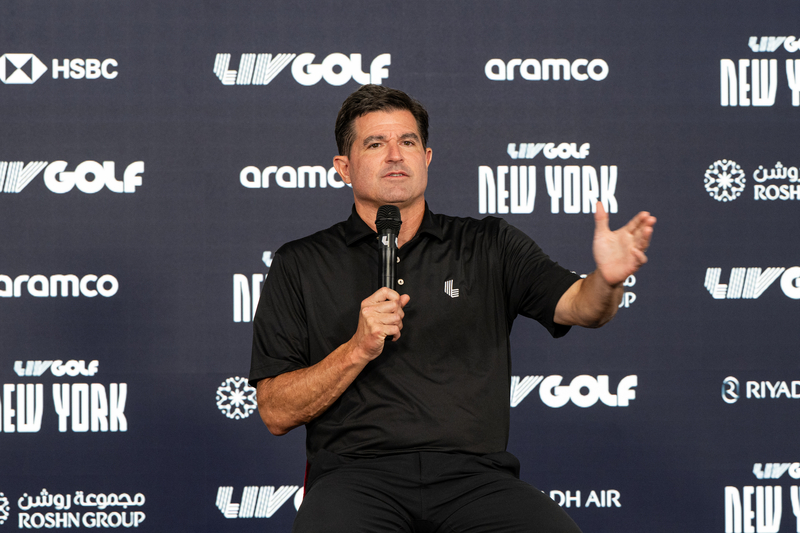
Our take: You’d be hard pressed to find anyone envious of the arduous task LIV Golf CEO Scott O’Neil faces at the moment. Only 17 months into his tenure after taking over for Greg Norman, he has to do his best to sell LIV to investors, sponsors and fans. Limited TV viewership and brand appeal, especially in the U.S, coupled with stars like Brooks Koepka and Patrick Reed returning the PGA Tour, all while operating on life support—and at massive financial losses—don’t necessarily scream “valuable investment opportunity” to would-be investors. LIV has already had to cancel its tournament in New Orleans and is trimming broadcast features like “Any Time, Any Shot.” Despite the struggles, O’Neil remains confident. “We continue to see strong momentum both on and off the course,” he said in a statement to FOS. “We’ve begun sharing our business plan with prospective partners who recognize the opportunity in team golf on a global scale.”
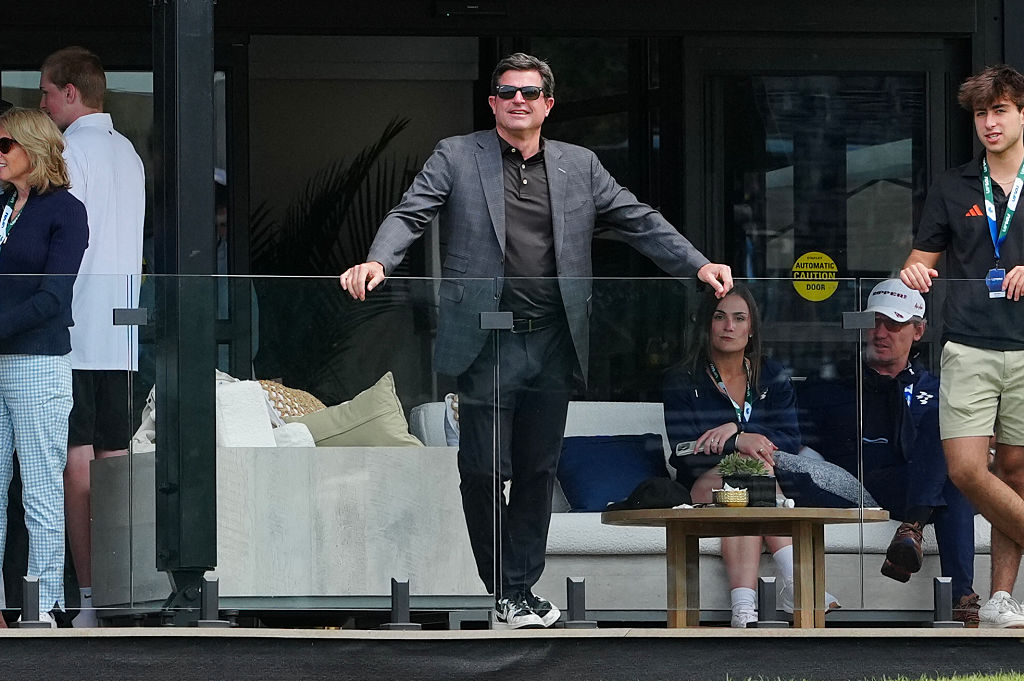
Scott O’Neil Has Herculean Task to Sell LIV Golf to Investors, Sponsors
‘I don’t envy Scott O’Neil,’ one industry exec said as LIV Golf CEO searches for $250 million to $350 million to keep tour operational beyond 2026
June 8, 2026
Michael Lore | mlore@bigswingmedia.news
When Scott O’Neil, former CEO of Harris Blitzer Sports & Entertainment, took over for Greg Norman as CEO of LIV Golf in January 2025, the upstart tour appeared to be on a path to industry acceptance—or at least tolerance.
A few factors working in LIV’s favor were:
- The “us-vs-them” narrative with the PGA Tour was put to bed when the two tours announced in December 2023 they would unify under one umbrella along with the DP World Tour.
- Jon Rahm quickly established his dominance by winning the LIV Golf Individual Championship his first two seasons after joining in December 2023.
- Brooks Koepka and Bryson DeChambeau proved LIV golfers could still compete among—and beat—the world’s best by winning the 2023 PGA Championship and 2024 U.S. Open, respectively.
- LIV Golf announced its most significant media rights deal to date in January 2025: a multi-year deal with Fox Sports based on a plan to live broadcast nearly all of the tour’s 210 hours of competition.
- In February 2025, both the USGA and The R&A announced they were easing exemptions for qualifying LIV golfers.
The golf industry was finally accepting the Saudi-backed league where players competed (in shorts if they wanted) as both individuals and teams in 54 holes of no-cut golf for eye-popping sums of money no more than 14 times per year across the globe from Adelaide to Bedminster, N.J.
But on April 30, 2026, LIV Golf’s biggest supporters, Saudi Arabia’s Public Investment Fund (PIF), announced it was severing funding at the conclusion of the current season.
Only 17 months into his role, O’Neil is tasked with having to not only prove that LIV Golf is valuable, but, more importantly, it can be profitable as he seeks between $250 million and $350 million from “long-term financial partners” in order to keep the tour operational beyond its Individual Championship and Team Championship events scheduled for late August.
“These guys are out on an island now,” one industry executive said. “I don’t envy Scott O’Neil at all because this is not what he signed up for. … At the end of the day, it’s a bit of an albatross.
“Unless something fundamentally changes, I don’t see how it hangs on.”
Big Swing Media spoke to multiple veteran industry executives with 50+ combined years of experience leading marketing, sponsorship and partnerships at some of the biggest sports properties.
Is LIV Golf valuable to investors & sponsors?
With limited broadcast viewership and brand appeal/interest in the U.S., stars like Patrick Reed and Koekpa returning to the PGA Tour, and trimming its already-limited tournament calendar to a reported 10 potential events for 2027—though players will be playing 72 holes—O’Neil has his hands full … just not with cash.
Industry sources believe the amount of funding LIV is looking for to ensure it survives post-PIF isn’t even enough to continue.
The PIF invested a reported $5 billion into LIV since it launched in June 2021. The tour lost a reported $461.8 million in its non-U.S. operations in 2024 alone.
“If PIF is completely out of it, they’re going to need a lot more than $250 million to operate,” another industry executive said.
Despite an uncertain future, O’Neil remains bullish in LIV’s value, particularly its themed teams, like DeChambeau’s Crushers GC, Rahm’s Legion XIII, the all-Aussie Ripper GC and Korean Golf Club.
“If you ask me where the value of this business is, it’s in the teams,” O’Neil said at a press conference ahead of LIV Golf Virginia in May. “If you’re looking for direction, we believe that teams will have extraordinary value. We believe that once we set the business in the right direction with the right trajectory, with the right revenue base and cost base—which we’re well on our way to doing—that these teams will have extraordinary value.
“And that’s where, if you’re an investor and you’re listening to this or reading this, that’s where you’re going to get your value.”
The statement screams as much (false) confidence as it does desperation.
LIV executives had also previously revealed in January that they could envision each of their 13 team franchises reaching $1 billion valuations.
Whether or not investors see value in LIV Golf—and its highly touted teams—is to be determined, but O’Neil is running out of time. LIV’s financial uncertainty is already impacting its current operations, including its tournament schedule (see: LIV New Orleans) and broadcast/streaming (see: Any Time, Any Shot).
Even DeChambeau is trying to determine his future. In one breath he says he’s debating prioritizing YouTube golf and content creation while only playing majors to recently hitting the campaign fundraising trail alongside O’Neil, Richard Marsh and Ducera Partners in search of millions by “giving all I can” to help attract investors.
How does LIV’s uncertainty impact sponsors?
While LIV is looking to secure its future, the tour has to continue to deliver on contractual obligations made to corporate partners and suppliers, some of whom may have paid upfront.
Whether they’re looking to cut contracts and losses short or trying to recoup any dollars spent, leading sales and sponsorship executives say a few scenarios could play out:
- Contracts that have a clause regarding change of ownership can give sponsors an opportunity to leave, but if it remains the same technical ownership with new investors, then contracts could remain binding.
- If LIV folds, sponsors can attempt to recoup any invested dollars through litigation, which will be a lengthy and complex process.
- The entire operation is shuttered if LIV Golf files for bankruptcy which would enact force majeure, freeing both sides from liability and obligation as a result of an extraordinary, uncontrollable or unforeseeable event occurring.
Already operating at a massive loss, LIV Golf losing all of its funding and not being able to operate certainly seems to be a justifiable excuse to trigger that clause. Sources told Bloomberg that LIV management and advisers were looking into filing Chapter 11 bankruptcy as a “last resort.”
Prior to the PIF’s proclamation of withdrawal, O’Neil claimed at an October 2025 event that LIV brought in “half a billion” dollars worth of sponsorship over the prior 10 months.
Multiple industry sources agreed that that figure should be taken with a grain of salt if you trace the money.
“As far as sponsorship goes, they’ve struggled really, really mightily in the U.S. market to generate any real interest,” one industry executive said. “I’ve read about their $500 million (in sponsorship). The vast majority of that is Saudi brands, and likely part of PIF itself. So companies like Aramco and Riyadh Air—and there are one or two others that they probably post on their website—but it’s basically one hand sort of feeding the other.”
Who are LIV Golf’s partners?
Four of LIV Golf’s six Global Partners are Saudi companies with PIF ties.
The PIF owns a combined 16% (8% direct, 8% indirect) of Aramco, a Saudi Arabian national oil company boasting a market cap of $1.749 trillion. The PIF is the majority shareholder (63.78%) of Saudi Arabian Mining Company, Ma’aden, the largest multi-commodity metals and mining company in the MENA region. Riyadh Air and Roshn Group, Saudi Arabia's leading multi-asset class real estate developer, are both wholly owned subsidiaries of the PIF.
LIV Golf and the PIF aren’t hiding this fact nor is it new news. The tour’s partners page also includes non-PIF-owned giants HSBC, one of the world’s largest banking and financial services organizations with assets of $3.054 billion, as well as Salesforce, the world’s leading cloud-based CRM platform with a $164.49 billion market cap.
LIV also lists Bahri and JCB as Premium Partner and Presenting Partner, respectively. Official suppliers like New Era, Panini and Trackman provide everything from wine to headwear, trading cards and technology.
Rolex, announced as an Official Partner in January, isn’t listed on LIV Golf’s “Our Partners” page at the time of publication. Despite the omission, the luxury watch manufacturer remains committed to LIV. When asked for comment, a Rolex rep said: “Rolex remains a global partner of the LIV Golf League.”
How much longer Rolex and other LIV sponsors remain in their corner is contingent on whether or not the tour continues operations beyond this year. How they “end the relationship” and whether or not it's an amicable split will be a case-by-case scenario.
“All those Saudi-based companies, they’re going away because they’re connected to the Saudi funding,” an exec said. “So now you’re down to HSBC, Rolex and Salesforce. I’m sure all the folks over there are going, ‘WTF. What?’
“I don’t know what the ‘outs’ are in their contracts to be able to get out if the Saudis backed out. The smart guys probably would have had a clause of some sort for that because that was really critical to the success of the league. It’s going to be interesting going forward here, and I don’t think it’s a long-term horizon either.”

One last thing... Jimmy Roberts
You know, whenever I'm worried golf might be shooting itself in the foot. All I need to do is look at college football, and I realize things could be a whole heck of a lot worse. You know the old saying you can't tell the players without a scorecard? Well, with so many college football players hopping around to chase NIL money.
And by the way, God bless them. The ink on the scorecards isn't even dry before the rosters have changed. I'm not saying, that players shouldn't be paid. They should. But there's got to be a system that makes sense for everyone. Or colleges just turn into shell companies.
And now the latest piece of craziness in this clown show.
College football is throwing around the idea of expanding the playoff to 24 teams. 24. You should understand that no matter what the stated justifications are, the only thing moving this train is, surprise money. Look, what we had for a long time was lame for almost a hundred years. It was just a matter of opinion. Writers and coaches chose who got the title.
So we moved to a playoff two, then four, then 12. And now the game is on the brink of losing its mind. This does nothing but devalue the regular season. This is where every Saturday mattered. Not anymore. What are we doing here? As Texas A&M coach Mike Elko said this past week. Nobody's looking out for the good of the sport.
Everybody's looking out for the good of themselves. Of course. Coaches want a better chance to get into the playoffs. Of course, college presidents want a shot at a payday. You know, there used to be a joke about SMU in the 80s. What's the difference between playing for the ponies and going to the NFL? Well, the answer is when you turn pro, you take a pay cut.
Maybe not so much of a joke anymore, but what's happening to the college game is no laughing matter now. Don't ask me how a boy from New York ended up preoccupied with a game that's about as native to this region as rugby, but I love college football. And all of this is so sad because right now the game is an unmitigated mess.
Past Briefs

Become a member
*Available for a limited time only, subscribe to our twice-weekly newsletter for a discounted rate of $150 for your first year. Subscription renews at annual rate of $175 at the end of the first year.
Purchase Disclosure
By completing your purchase, you agree to enroll in an annual subscription to The Big Swing – Inside the New Golf Economy at the current rate of $150 for the first year (founding member offer). Your subscription will automatically renew annually at $175/year unless canceled prior to the renewal date.
You may cancel at any time through your account settings or by contacting customer support. All sales are final and non-refundable except where required by law.
Offer valid for a limited time and may not be combined with other promotions. Limit one per customer.
By subscribing, you agree to our Terms of Service and Subscription Terms.