
August 27, 2026

The Big Swing: Inside the new golf economy
There certainly hasn’t been a shortage of news this week… On Monday, we reported on Golf Channel’s return of reality series “The Big Break,” this time as “Big Break x Good Good” presented by Golf Galaxy. Those plans have abruptly shifted as Good Good and Callaway find themselves embroiled in controversy following an ad that depicts Good Good co-founder Garrett Clark charging at and shoving a woman to the ground for touching his driver.
How this ad made it past an initial pitch remains a question, but backlash has been swift and severe. Golf Channel postponed the Big Break premiere by a week to Sept. 1 after title sponsor Golf Galaxy, owned by Dick’s Sporting Goods, pulled its endorsement hours before the show’s scheduled airing. Golf Galaxy and Dick’s also removed Good Good’s merchandise from its shelves, and as of Wednesday morning, the Good Good driver isn’t available on Callaway’s online retail platform either.
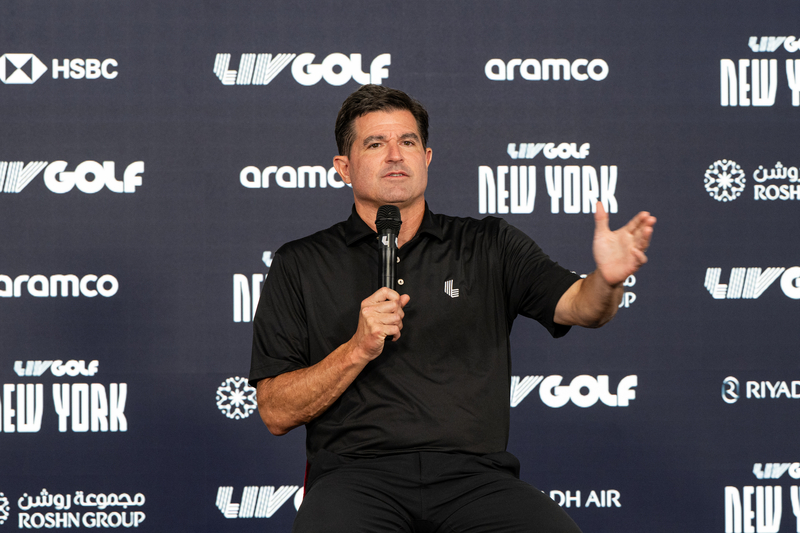
Good Good is the title sponsor of a new FedEx Cup Fall event taking place Nov. 12-15 at Omni Barton Creek Resort in Austin, Texas, but PGA Tour CEO Brian Rolapp doesn’t appear thrilled about the possibility, saying on Tuesday "I think what we saw was concerning, is clearly not aligned with PGA Tour values. I think their initial response was disappointing… a bit defensive and late,” adding the Tour will continue to monitor and work with them going forward.

This and that...
LIV Golf guts its staff as PIF money (finally) runs dry
LIV Golf notified the majority of its U.S. and U.K. workforce (300+ employees) that their jobs will end Sept. 1, following a WARN Act filing. The cuts come as Saudi Arabia’s PIF winds down the funding commitment that bankrolled the league since 2021 and LIV pivots toward a leaner “LIV 2.0.”
Our take: The layoffs are the clearest signal yet that LIV’s next chapter will run on unit economics, not petrodollars. With the league’s own house getting smaller, leverage in any PGA Tour reconciliation talks have likely shifted further away from LIV’s stars.
PGA Tour names Uber, Uber Eats as mobility and delivery sponsors
The PGA Tour signed a multi-year marketing partnership naming Uber the Tour’s official rideshare sponsor and Uber Eats its on-demand food delivery sponsors, spanning both the PGA Tour and PGA Tour Champions. Financial terms of the deal were not disclosed, but the activation includes exclusive category rights, integration across digital and social platforms, and builds on the existing seasonal “Uber Golf” product letting fans book rides up to 90 days out for up to four players with clubs.
Our take: The Tour is monetizing the last-mile fan and player experience — getting to the course, suites and hospitality — and slots Uber into golf the way it already sits inside other major sports properties, notably Team USA and the LA28 Olympic and Paralympic Games.
LeBron James Family Foundation partners with PGA Tour for Akron Invitational
The PGA Tour has been busy this week, also launching a partnership with LeBron James to create the LeBron James Family Foundation Invitational, a new event at Firestone Country Club in Akron, Ohio, set for July 6-7, 2027. The event will mix pros, amateurs and celebrities with mentorship programming tied to James’s I Promise School. The event will also field the top 5 APGA Collegiate-ranked players annually through a “Pro-Bound Five” pathway.
Our take: LeBron’s golf-adjacent portfolio is starting to rival his media and spirits collections. Instead of a one-off celebrity appearance, the foundation has opted for brand equity and access-to-the-game positioning, and gives the Tour a crossover marketing opportunity with a global athlete from outside the sport.
Rally Nation launches fan engagement app “Rally Golf”
Multi-sport fan engagement platform Rally Nation launched Rally Golf, an interactive experience that lets fans compete with friends and other fans while following professional golf tournaments in real time. Launching in time for the PGA Tour season finale and fall schedule, fans can draft pros within a salary cap and compete on live leaderboards during tournaments, with ambassadors including sports broadcaster Ann Liguori and former collegiate golfer and golf content creator Sabrina Andolpho. The platform is free-to-play and positioned with no gambling or sports betting component.
Our take: It’s a smart bet on second-screen engagement without touching the regulatory and reputational complexities that come with sports betting. We’ll be interested to see if it becomes a more common template for monetizing fan attention as betting products have saturated most other major sports.

The Weather Trade: Golf's Insurance Layer Is Becoming an Asset Class
Climate volatility is repricing how golf courses get insured. The risk-transfer layer emerging underneath that repricing may be the next undercovered piece of the golf economy, the mirror image of the agronomy and real-estate story.
August 27, 2026
Matthew Erley & Evan Roosevelt | Old Tom Capital
In June 2024, eleven and a half inches of rain fell on Whispering Pines Golf Club in Trinity, Texas, ranked the number one course in Dallas by the Dallas Morning News, in a single day, nine of them in four hours. The short course eroded. The bulkheads on the par-3 fifteenth's island green failed. The club closed indefinitely, four days after hosting the Big 12 Championship. A year later, half a country away, Split Rock Creek crested near record levels and put half of Brandon Golf Course in South Dakota under as much as twelve feet of water, costing the club an estimated $6,000 to $10,000 a day in green and cart fees while it waited for the water to recede. Neither storm drew significant national attention, and neither appears in golf industry databases. While the golf industry has developed sophisticated systems for tracking course operations and performance, there is comparatively limited data on the cost of insuring golf properties or the extent to which weather-related risks are influencing those costs.
An Untracked Cost Line
Golf's major trade groups are extensive measurers. The National Golf Foundation tracks rounds played by geography and season; the GCSAA surveys maintenance, staffing and capital budgets; and the CMAA benchmarks club operations and financial performance. Yet no standardized industry-wide series was identified that tracks what golf courses pay for insurance, how those costs are changing over time, or how increases break down among catastrophe exposure, liability, inflation and other underwriting factors. For an industry with extensive operating data, insurance remains a comparatively fragmented data point.
The evidence that does exist is scattered but specific. A 2022 Golf & Country Club State of the Market report published by the Massachusetts Golf Association and its insurance partner reported commercial property and casualty premium increases of 10 to 25 percent and umbrella and excess liability increases of 15 to 45 percent, while noting that very few carriers were offering tee-to-green and outdoor grounds coverage compared with prior years. Golf Property Analysts separately modeled a hypothetical course facing a property-and-casualty premium increase of more than 33 percent, alongside higher labor, water, fertilizer and other climate-related costs. The analysis estimated roughly $82,500 in additional annual operating costs; capitalized at a 10 percent cap rate, that would imply an approximately $825,000 reduction in asset value. The calculation is illustrative, not an industry benchmark, but it shows how higher recurring costs can translate directly into course valuation.
The insurance market itself provides another signal. T2Green Insurance, a golf-and-country-club-focused program within Warburg Pincus-backed K2 Insurance Services, expanded to 48 states in November 2025. In announcing the expansion, K2 described a golf and country club insurance market that had faced “instability,” with carriers and MGAs frequently entering and exiting the category. T2Green, founded in 2020, writes package, auto and umbrella coverage exclusively for golf and country clubs through A-rated carrier partners. Its national expansion does not establish that climate risk is solely responsible for changes in golf insurance capacity, but it does provide direct evidence that specialized underwriting is expanding amid instability in the broader golf-and-country-club insurance market.
The Mismatch Between Risk and Coverage
The more important finding is not simply that premiums are rising. Commercial property insurance has become more expensive across many asset classes. The issue for golf is that traditional property coverage does not always align with the assets most exposed when severe weather hits a course.
Standard commercial property policies are generally designed around buildings, equipment and other scheduled property. The playing surface itself can be more complicated. Fairways, greens and other outdoor grounds may be excluded or subject to separate coverage, leaving operators exposed to losses that occur outside the clubhouse. Flood presents an even clearer gap: the National Flood Insurance Program does not provide coverage for golf courses, while many courses occupy low-lying or water-adjacent land that can be particularly exposed to flooding.
Coverage disputes can also turn physical damage into litigation risk. In June 2025, the operator of three North Carolina golf courses sued Cincinnati Insurance, alleging that the carrier improperly denied roughly $3 million in property claims related to Hurricane Helene. The case does not establish that the claims should have been covered, but it illustrates how questions over policy language and the scope of coverage can become material financial issues following a major weather event.
That mismatch is more important than the premium headline alone. A golf course derives much of its economic value from a large outdoor playing surface exposed continuously to flood, wind, drought, heat and other weather conditions. Traditional property insurance is generally strongest around buildings and physical assets; some of the course's most economically important outdoor exposures can require specialized coverage or remain difficult to insure. The resulting gap between the risks golf operators face and the risks conventional policies are designed to absorb is creating room for more specialized forms of risk transfer.
Case Evidence: What the Exposure Looks Like
Recent weather events show how quickly that coverage mismatch can become an operating and capital problem. When Hurricane Helene struck western North Carolina in September 2024, flooding from the Swannanoa River destroyed the front nine at Asheville Municipal Golf Course, including eight greens, most bunkers, every tee box and its irrigation system. FEMA later approved $7.77 million toward the recovery. Nearby Broadmoor Golf Links was submerged under as much as 20 feet of water, with 60 to 70 percent of the course buried beneath sediment and its maintenance facility and clubhouse destroyed. Insurance proceeds are helping fund a rebuild targeted for completion in 2026.
Not every exposure arrives as a discrete catastrophe. Drought can affect the same asset more gradually through water restrictions, higher operating costs and deteriorating playing conditions. In early 2026, extreme water shortages in Florida forced courses in The Villages onto once-weekly fairway irrigation and allowed rough areas to go dormant.
Taken together, these cases illustrate the range of losses a golf property can face: physical damage to the playing surface, business interruption, rebuilding costs and longer-term operating pressure. The question for investors is increasingly not whether weather affects the asset, but how much of that exposure can be transferred, at what price, and to whom.
The Parametric Answer
One response to this coverage gap is emerging outside the traditional claims process. Parametric insurance pays a predetermined amount when an objectively measured trigger, such as rainfall, flood severity or wind speed, crosses a specified threshold. Unlike traditional indemnity insurance, payment is tied to the trigger rather than an adjuster's assessment of the physical loss. For golf, that structure can provide coverage around weather exposures that are difficult to address through conventional property policies.
Golf-specific products are already in market. In August 2024, Amwins and Floodbase launched Tees-to-Green, described as the first parametric flood insurance product designed specifically for U.S. golf courses. The product uses satellite and hydrologic data to measure flood severity and is designed to cover the course itself, including turf, as well as business interruption associated with closure. Amwins has also said minimum premiums for parametric coverage have declined considerably over the past five years, suggesting that the capacity supporting these products is becoming more accessible.
On the events side, Vortex Weather Insurance, underwritten through Mitsui Sumitomo Insurance USA, offers parametric rain coverage for golf tournaments and outings. Policies can trigger at specified rainfall thresholds and pay based on the measured event rather than whether the tournament was ultimately canceled. Examples cited in the market include the South Florida PGA and the Metropolitan PGA Foundation. Indicative pricing reported for $100,000 of coverage against roughly one-third of an inch of rain ranges from approximately $3,500 to $7,500, depending on geography and other factors.
No dedicated parametric drought or turf-stress product marketed specifically to golf-course operators was identified in this research, rather than agriculture more broadly. That suggests a potential area for further product development, although the absence of an identified product is not, by itself, evidence of commercial demand.
The broader parametric market is attracting significant capital. Arbol raised a $60 million Series B in 2024 after reporting gross written premium growth from $2 million in 2020 to $250 million in 2023. Descartes Underwriting has raised $120 million, while The Demex Group raised $10.25 million in 2024 and subsequently bound $65 million of reinsurance capacity in its first selling season. None is evidence that golf alone represents a large insurance market. Collectively, however, they demonstrate that investors and capacity providers are funding specialized businesses built around weather and climate risk.
The Macro Picture
The broader insurance backdrop is counterintuitive. Global property-catastrophe reinsurance is currently softening. Risk-adjusted global property-catastrophe rates fell 14.7 percent at January 2026 renewals, the steepest decline since 2014, following an 8 percent decline a year earlier. The catastrophe-bond and insurance-linked securities market ended 2025 with $61.3 billion outstanding, while annual issuance reached a record $25.6 billion, up 45 percent year over year.
That does not necessarily conflict with tighter conditions in specific primary insurance markets. Reinsurance capacity operates upstream from the policies purchased by individual businesses, and pricing can move differently across layers, perils and geographies. Greater availability of reinsurance and alternative capital can provide capacity for specialty MGAs and parametric underwriters to build products around risks that are more difficult to address through generalist primary coverage.
The underlying protection gap remains substantial. Swiss Re estimates the global natural-catastrophe protection gap at $424 billion, with North America accounting for approximately $140 billion. But the picture varies materially by jurisdiction. California continues to face pressure in its admitted property market, while Florida's market has shown signs of stabilization following its 2022 insurance reforms; Citizens Property Insurance's policy count fell below 400,000 by December 2025 as private carriers absorbed more policies.
For golf, that distinction matters. “Climate risk” is not one underwriting variable. Flood, wildfire, wind and drought exposures differ by geography, as do insurance capacity, regulation and pricing. Any investment thesis built around this market therefore has to underwrite the peril and jurisdiction as carefully as the underlying golf asset.
The Bet
Golf's agronomy costs, real estate and insurance exposure ultimately sit on the same underlying asset. Each is affected by weather, but insurance approaches that exposure from the other side of the ledger: by pricing and transferring the risk rather than absorbing the physical cost when it occurs.
The investment thesis is not that golf-course insurance alone is necessarily a venture-scale market. Golf is a relatively narrow vertical. The more interesting possibility is that it can serve as an entry point into a broader specialty-insurance and insurtech opportunity built around weather-exposed physical assets.
Three layers are beginning to emerge. Golf-focused MGAs and program administrators can build underwriting expertise around a specialized category. Parametric products can address specific exposures, from flood and tournament interruption today to potentially other course-level risks over time. And data and capacity providers can supply the weather models, triggers and reinsurance infrastructure behind products sold across golf and other industries. Businesses are already operating at each of these layers, from T2Green and Floodbase to broader parametric platforms such as Arbol and Descartes.
The open questions are equally important. There is no reliable estimate of golf-specific premium volume; adoption of parametric products remains early; and the evidence for a golf insurance “protection gap” still rests on a relatively small number of documented cases rather than a comprehensive claims dataset. Those are diligence questions, not reasons to dismiss the category. They determine whether golf represents a meaningful standalone market, an attractive initial vertical for a broader platform, or simply one use case among many.
The remaining question is whether these emerging products can move beyond isolated use cases and support durable underwriting economics at scale. That remains unproven. But the pieces are beginning to form: specialized distribution, new risk-transfer products, increasingly accessible capacity and venture-backed infrastructure built around weather risk. Golf may prove to be a standalone market, an attractive initial vertical, or simply one application of a much larger platform. Each outcome creates a different investment opportunity that is worth watching.

One last thing... Jimmy Roberts
You Can Fix a Process, Culture Is Harder
Today's essay was written by Fred Bucher, Big Swing Media Co-Founder & CEO
The Good Good-Calloway controversy is about more than a bad ad.
It’s been a helluva week in golf, and we aren’t even at the weekend yet. The biggest story has been the fallout from the disastrous ad Good Good produced for Callaway.
Like everyone else, I’m stunned that two brands at the top of the golf business could actually think such an ad was acceptable.
In their respective responses, I was struck by how both the CEOs of Good Good and Callaway talked about changing their internal processes so something like this never happens again.
That’s all well and good. But here’s the problem: neither talked much about culture.
Any leader of a well-functioning organization knows everything starts with culture. Process lies well downstream and is a byproduct of culture.
I’ve spent much of my career as a CMO at three large companies and now as a CEO, and one lesson I’ve learned is that process can’t compensate for a culture that rewards the wrong behavior.
And any discussion about culture in the golf business can’t avoid the fact that the industry is still dominated by men.
Many have noted that having more women and diverse voices in the room might have stopped this ad from ever seeing the light of day. I agree. Golf needs more female leaders.
But I think the cultural issue runs deeper than a lack of women in the executive suite.
The question isn’t only what this ad says about how these organizations view women. It’s also what it says about what they think appeals to young men.
As the father of three daughters, including one who loves to play the game, I was shocked and disgusted to see a young woman treated that way.
But I’m also the father of a 28-year-old son who also loves golf. And it was horrifying to see top-tier brands in the sport I love, and play often with my kids, represent young men in such a base, violent and deplorable way.
That’s the part of this conversation I don’t think has gotten enough attention.
What is it in the culture of an organization that leads people to believe this is the kind of content young men want to see? And what does it say when enough people agree that the idea actually gets made?
The revolution in how golf is consumed in media has done so much good for the sport. More people play and watch than ever before, in part because social media has made the game more accessible, entertaining and relevant to a new generation.
But there’s a downside. The chase for clicks and views rewards provocation and constantly pushing the boundaries of what gets attention. That puts even more responsibility on the people and brands creating the content to understand where those boundaries should be.
So where does this leave Good Good and Callaway?
It’s not for me to say. But if their analysis of this episode stops at process and approval chains, I think they will have missed the bigger lesson.
If they really want to get at the root cause, they need to take a hard look at their cultures: what they value, what they reward, and what they believe about the audience they’re trying to reach. Also the hard reality is they need to look at some of the people and determine if they represent the culture they seek to build.
Because you can change an approval process pretty quickly.
Changing a culture is a lot harder.
Past Briefs
.jpg)
.png)

Monthly and Annual Membership Options Available.
Member Pricing
$9.99 per month, OR $99 for one year.
Cancel Anytime.
Available for a limited time only, subscribe to our twice-weekly Golf Business Intelligence Brief for a discounted rate of $9.99/month or $99/year. Subscription renews at the same price each month or year, depending on the subscription selected.
Purchase Disclosure
By completing your purchase, you agree to enroll in a monthly or annual subscription to The Big Swing Golf Business Intelligence Brief at the current rate of $9.99 a month or $99 a year.Your subscription will automatically renew monthly at $9.99 or annually at $99 unless canceled prior to the renewal date.
You may cancel at any time through your account settings or by contacting customer support. All sales are final and non-refundable except where required by law.
Offer valid for a limited time and may not be combined with other promotions. Limit one per customer.
By subscribing, you agree to our Terms of Service and Subscription Terms.